
China is not interested in how Central America is governed. It makes no difference to this Asian giant whether the officials signing a loan agreement or a cooperation deal are democrats or autocrats. Beijing seeks to establish on the isthmus a two-coasts logistics corridor and to deal the final blow in Taiwan’s isolation. It has perfected this strategy in Africa for decades and it brings with it the promise of transforming the Global South, based on the development model embraced by most countries in the region, and most recently, Nicaragua.
Daniel Ortega and Rosaro Murillo’s regime has not only thrown the doors open to China, but has also created a legal and political framework offering preferential treatment of the highest order; however, this hasn’t turned into a significant enough economic relationship capable of substituting Nicaragua’s main trading partner: the United States.
That same pattern—infrastructure projects financed by loans and carried out by Chinese companies in Africa—is now beginning to be replicated, albeit on a smaller scale, in Central America.
What is currently happening at the ports of La Unión in El Salvador or at the dams in Honduras is part of China’s efforts to forge diplomatic and commercial alliances amid its geopolitical dispute with the United States—a dispute whose nuances are more heated than ever, with President Donald Trump placing the Chinese government at the center of his criticism and as the main antagonist of his model, despite the complex trade relationship between these two powers.
Apart from this, two decades ago, Beijing began pouring large sums of money into Africa, in order to carry out large infrastructure projects which Western financial institutions had rejected as financially unviable or lacking transparency. This happened in Angola, Zambia and Djibouti.
On this continent, China funded the construction of roads, hydroelectric dams, and skyscrapers. These investments are part of China’s Belt and Road Initiative (BRI), which has also expanded into Latin America. Although Central America is not a mass consumer market, its seven countries offer a geographical advantage, being very close to the U.S., the power with which Beijing competes.
According to Evan Ellis, analyst and Latin American Studies researcher at the Strategic Studies Institute at the US Army War College, China is seeking what he calls “bicostality:” control of logistics hubs connecting the Atlantic and the Pacific.
From managing containers to a military base
This is the same game China played in the Horn of Africa, where they went from managing containers at the port of Djibouti, to establishing their first foreign operational military base. In Central America, for now, the U.S. has become a lender for infrastructure projects, such as road construction in Nicaragua’s Pacific region; however, these do not amount to major investments when compared to those in other countries, such as the megaport in Chancay, Peru, whose total cost exceeds $3.5 billion.

Jordi Bacaria, international relations expert, states that China’s major investments are not exactly in Central America. “Costa Rica, El Salvador, and Nicaragua are the countries with the most investment in Central America, but nothing comparable to that of other countries in the region. What is important for China, however, is to establish a foothold there in order to compete with the United States,” the expert adds.
China’s strategy in Central America is far removed from its interests in South American countries, where trade plays a major role in nations such as Brazil, Argentina, and Chile. In fact, Parsifal D’Sola, director of the Andrés Bello Foundation in the Chinese-Latin American Research Center, goes so far as to say that there is no clear-cut strategy for Central America.
“There is a lot of lobbying among political elites, but Central American countries do not represent major economic opportunities for China,” D’Sola points out.
Taiwan’s isolation: Beijing’s long-standing goal
In June 2023, only three months after assuming the presidency of the world’s second largest economy, Xi Jinping arrived in San José—this was no random stopover. In 2007, Costa Rica had been the first domino piece to fall in Central America. It became the first country in the region to sever ties with Taiwan and embrace Beijing’s financial support.
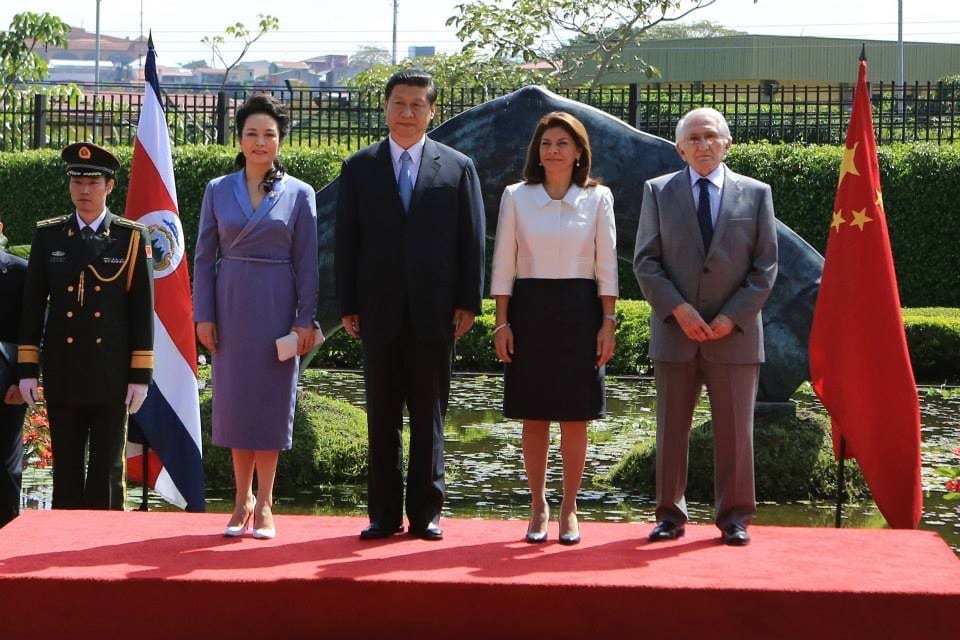
Xi Jinping’s visit was a promise to the rest of the Isthmus. The Chinese leader—unlike his then counterpart, Barack Obama, who had also visited San José months earlier—did not give speeches about democracy, but instead brought an investment portfolio amounting to $2 billion. The ultimate symbol of that new friendship was a $100 million National Stadium, donated entirely by China. This gave birth to the “stadium diplomacy” in the region, which sought to erase Taipei from the diplomatic map.
What appeared to be a generous gesture in 2013 was in fact the beginning of a systematic siege. Beijing used the success of its relationship with Costa Rica as a showcase to woo its neighbors. The intended message was the urgency of recognizing “One China,” with modern infrastructure and million-dollar investments as rewards, which, unlike Washington’s, were not conditional on institutional reforms or democratic adjustments.
In 2017, Panama shook things up by recognizing Beijing and opened the floodgates for its neighbors. El Salvador followed suit in 2018, looking to the Asian giant as an economic and political lifeline. Nicaragua’s breakaway in 2021 and Honduras’ in 2023 ultimately solidified an almost unanimous regional bloc.
Taiwan has been reduced to a nostalgic memory in a region that now prefers Chinese steel over the principles of its former alliance. Only Guatemala and Belize maintain diplomatic relations with Taipei.
“China’s primary concern in Central America and the Caribbean is the international isolation of Taiwan. Ever since China took its official seat at the United Nations, the Communist Party has made a constant effort to isolate Taiwan,” says D’Sola.
In addition to this goal, Panama remains the crown jewel. Through Hutchison Ports, China operates the Balboa and Cristóbal terminals at both ends of the Canal; this investment exceeds $1.5 billion and grants Beijing a privileged watch over 5% of global trade. However, in 2026, under pressure from U.S. President Donald Trump—who went so far as to threaten to retake control over the Canal on national security grounds—the Panamanian government began to show cracks, even going so far as to review concessions for terminals operated by Hong Kong companies in an attempt to appease its northern neighbor.
But Beijing’s relations are not uniform.
In El Salvador, while the $100 million National Stadium stands as a symbol of modernity, the real focus resides in the Port of La Unión, a key asset for controlling the Gulf of Fonseca. In Honduras, following the 2023 diplomatic shift, energy and transportation are now priority, with initiatives such as the hydroelectric project Patuca III and studies for an interoceanic railway to compete with traditional logistics.
Jordi Bacaria warns that this strategy acts as an “octopus” reaching into critical sectors: infrastructure, energy, and telecommunications. By controlling the 5G network and ports, China is not only moving goods, but also managing the data and energy that sustain the region. It is a model of technical dependence which, according to experts consulted for this report, makes the sovereignty of Central American nations fragile.
The U.S. neglects its “backyard”
Beijing’s advance in Central America resulted from Washington’s lack of interest. For nearly two decades, while the White House turned its attention on the Middle East or the plains of Ukraine, its “backyard” was relegated to an agenda of lectures on institutional frameworks and migration crises. This vacancy was the perfect catalyst for China to extend its tentacles into a region of little importance, beyond the Panama Canal.
For experts like D’Sola, this oversight allowed China to establish itself in sectors where Washington is now trying to regain lost ground. “China has little interest in getting involved in sectors such as migration or drug trafficking,” D’Sola explains, pointing out that China’s strategy has been to avoid a direct confrontation on national security issues until its presence in ports and telecommunications became a fait accompli.
The United States’ 2026 National Defense Strategy (NDS) marks a significant shift from the White House’s former policies, both in its emphasis on partners shouldering a greater burden with less support from Washington and in its more measured tone towards traditional adversaries such as China and Russia. The U.S. now wants to restore its military dominance in the Western Hemisphere.
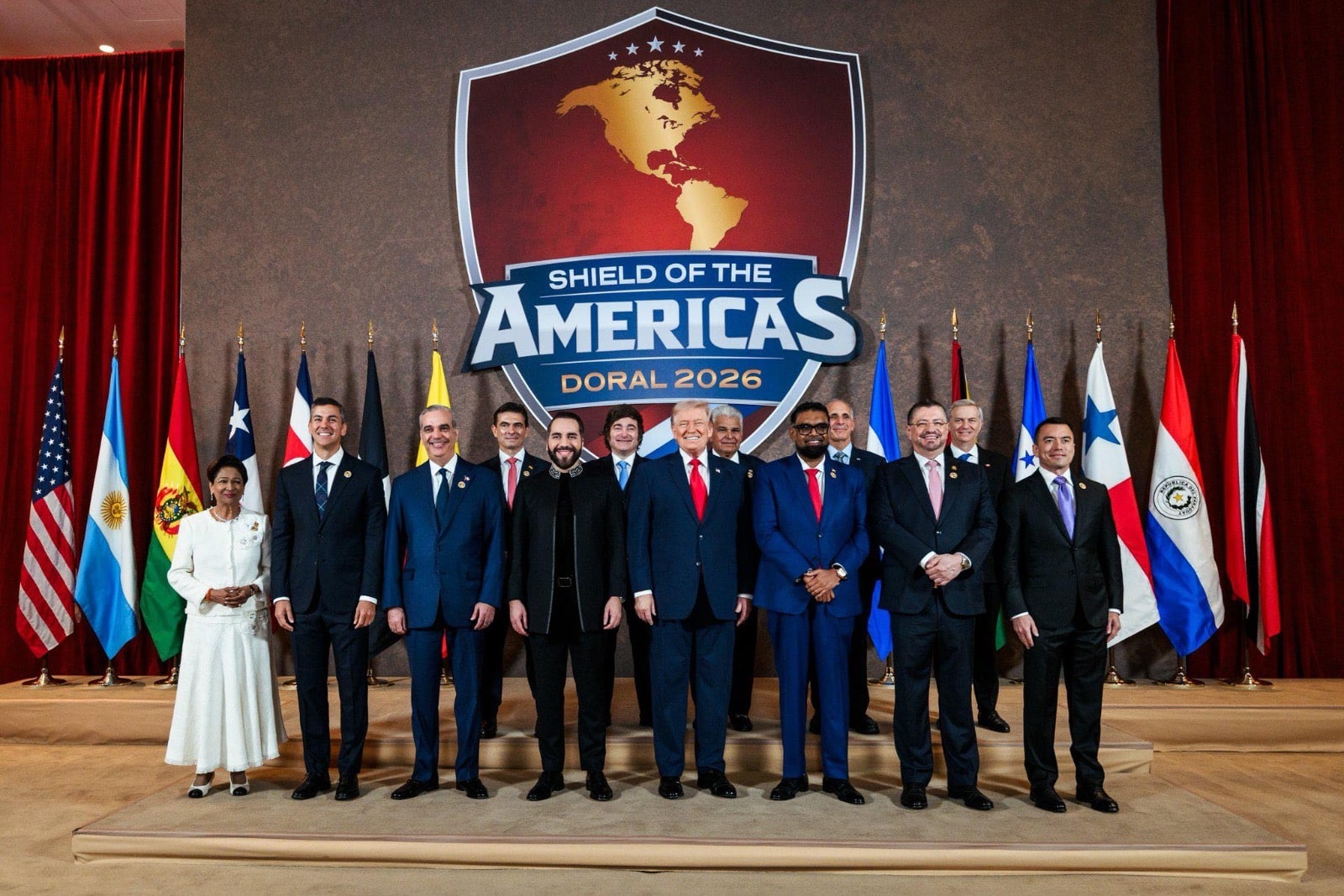
Proof of this is that in March 2026, the U.S. turned its attention back to the American subcontinent. Under the “Shield of the Americas” banner, the Trump administration has revitalized the Monroe Doctrine with a level of aggressiveness not seen since the Cold War. A recent summit in Miami served as the backdrop for this resurgence, and according to experts, it might involve diplomatic pressure on the governments of Panama, El Salvador, and Honduras to distance themselves from China.
Beijing responded to Trump’s initiative with an animated video posted on X, mocking him with the following message: “Shield of the Americas, or shackles of the Americas?” The post was later deleted.
“Trump once again seeks to ensure that his backyard isn’t dominated by others. Now that China is in Latin America, he may put pressure on Costa Rica, Honduras, Panama, and El Salvador to pull out of Chinese investments and reduce its influence, although China isn’t going to back down,” Bacaria states.
Trade between China and Latin America has grown steadily over the past decade. In 2024, bilateral trade in goods and services reached an all-time high of nearly $518 billion, which reflects the growing economic integration between Beijing and the region. China became South America’s largest trading partner and Latin America’s second-largest overall, trailing only the United States, according to data from the Council on Foreign Relations.
Concurrently, China has expanded its financial presence in the Western Hemisphere. According to the Center for Strategic and International Studies, over the past few decades, Chinese institutions have provided more than $120 billion in loans to Latin American governments, primarily for infrastructure, energy, and transportation projects.
Although Central America accounts for a smaller share of this trade compared to South American economies, trade has grown too. According to regional figures, trade between China and Central American countries surpassed $18 billion in 2023, driven primarily by imports of Chinese manufactured goods and exports of agricultural products such as coffee, sugar, seafood, and meat. Countries such as Costa Rica, Panama, and Honduras account for a large share of this trade, while trade with Nicaragua remains more limited.
The increase in trade has strengthened Beijing’s economic presence in the region, although its influence still falls far short of that of the United States, which remains the primary destination for exports, a source of investment, and the origin of remittances for most Central American countries.
In countries such as Nicaragua, this bilateral relationship takes root in “the lack of internal democratic control” and a “widespread corruption in the management of resources,” according to a report by the Institute on Race, Equality and Human Rights.
This organization warns that China’s influence reinforces authoritarian practices, reduces public oversight, and expands the scope of state discretion. This dynamic has allowed, for example, Daniel Ortega’s regime to increase its dependence on China to “mitigate international isolation” and evade accountability for “crimes against humanity.” Beijing has also trained the National Police—an institution sanctioned for human rights abuses—in “forensics, kung fu, and the use of drones,” in an exchange that the regime describes as ties for “defense and security.”
This scenario is similar to what Africa experienced, where China also promoted its authoritarian model. The issue is whether Washington will be able to halt this advance or whether, as has happened in other regions of the world, China’s presence will ultimately take root in the isthmus that, for decades, the United States considered to be part of its own backyard.
D’Sola believes that China lacks the capacity to challenge the United States’ historical influence.