
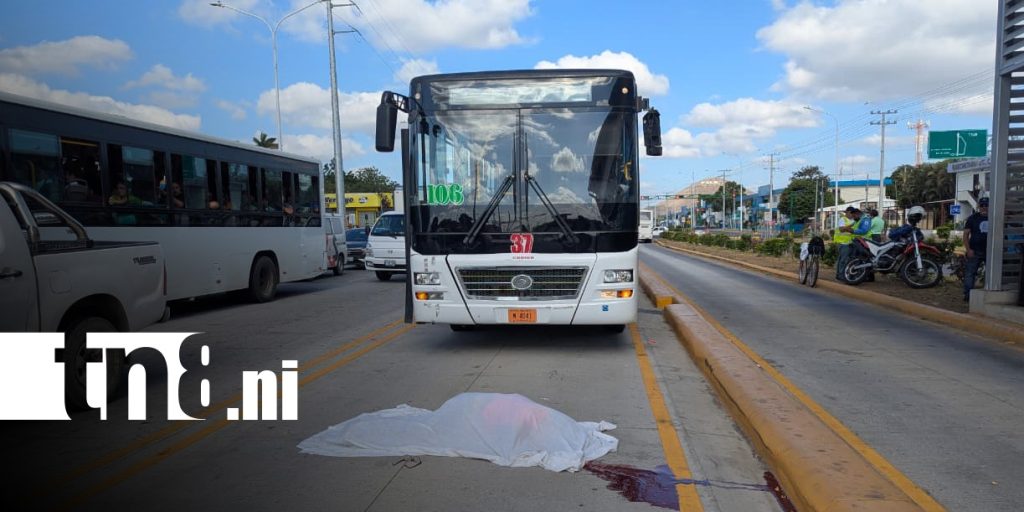
María Teresa Cajina, 60, was struck and killed in April 2026 while attempting to cross the Heroes and Martyrs of the Insurrection Highway to reach a bus stop located in the middle of the road, in the El Zumen area. The woman was attempting to cross the bus-only lane of a ten-lane highway when she was struck by a bus on Route 106.
Her case not only reflects the risks pedestrians face daily in Managua but also the challenges of a city that is attempting to renew and reconfigure its urban mobility while grappling with “serious problems” related to road infrastructure, urban planning, and safety for those who travel through the capital every day.
The Heroes and Martyrs of the Insurrection Highway, the flagship project of Daniel Ortega’s regime, was presented as a milestone in the capital’s modernization and urban transformation, promising to reduce travel times, improve road safety, strengthen public transportation, boost commerce, increase urban connectivity, and alleviate traffic congestion, according to Managua Deputy Mayor Reyna Rueda, speaking to a pro-government media outlet.
Negligent Pedestrians and Lenient Police
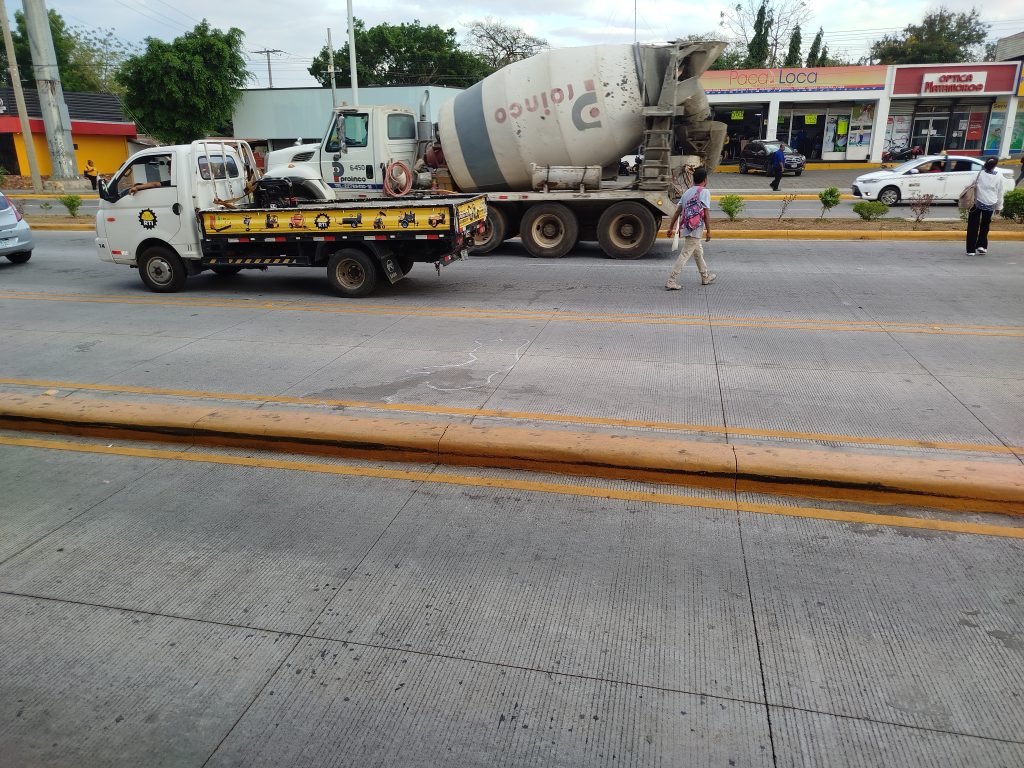
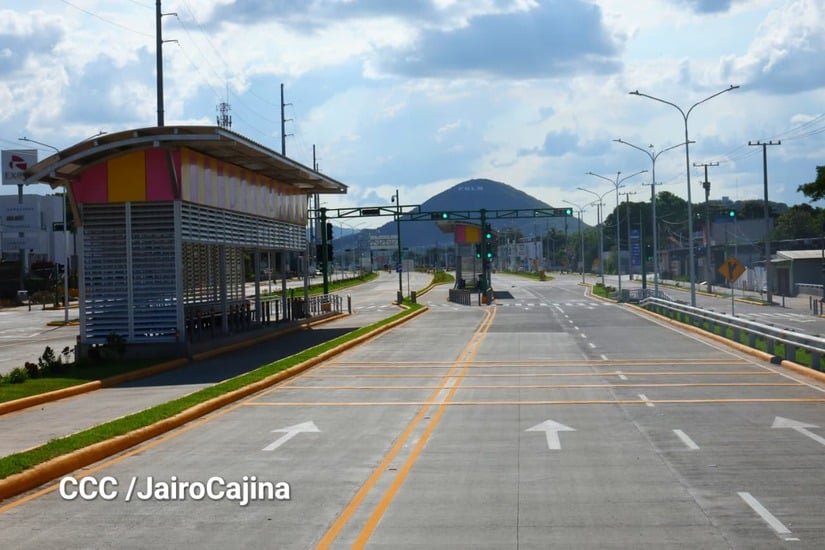
Cajina’s accident occurred at one of the locations where the Bus Rapid Transit (BRT) system—installed by the Managua Mayor’s Office on the first section of the road expansion—operates. The corridor features two bus-only lanes and eight enclosed stations located in the center of the road, forcing passengers to cross several lanes to access public transportation; some use the designated crosswalks, while others take shortcuts in the sweltering heat of Managua.
Beyond the infrastructure, the challenge also lies in how pedestrians, drivers, and public transit riders interact with the construction site. During several site visits conducted by DIVERGENTES at various points along the new road, DIVERGENTES observed pedestrians crossing the road outside designated crosswalks, drivers encroaching on crosswalks, and passengers getting off buses at unauthorized locations. Several of these incidents occurred even in safe crossing zones monitored by the National Police.
Along the first 10 kilometers of the road construction—which corresponds to the first section of the project—authorities established at least twelve pedestrian crossings, most of which are located at traffic-light-controlled intersections to facilitate connections between the neighborhoods surrounding the road and to ensure the integration of the BRT system, with which Managua residents are not yet familiar.
BRT System Transforms Managua, But Complicates Pedestrian Mobility
According to the Institute for Transportation and Development Policy (ITDP), this type of bus system should be integrated into areas with high levels of urban activity and a concentration of passengers.
However, when these corridors are built on increasingly wide avenues—with dedicated lanes in the center, safety barriers, and long walkways to access stations—they can create what urban planners call the “wall effect.”
While modernity—as Fidel Moreno, secretary general of the Managua Mayor’s Office, points out—is necessary for the country, the roadway already served as a barrier to pedestrians before the expansion, yet it allowed for greater interaction between the two sides of the neighborhoods.
The reason is that cities are not structured solely around vehicular traffic. They are lived-in spaces where “daily routines and customs” lead people to cross the street to go to the corner store, take their children to school, attend church, or visit a relative on the other side of the road.
The problem, according to Carlos Zambrana, a civil engineer who spoke with DIVERGENTES on condition of anonymity to ensure his safety, is that “Nicaragua is a place where infrastructure has been prioritized for vehicles rather than for pedestrians, cyclists, or public transportation.”
With the transformation of the road into a ten-lane corridor and stations located in the city center, existing pedestrian crossings have become longer and more complex, creating a constant tension between the speed and efficiency of the transit system and the safety of pedestrians. This is compounded by the “lack of road safety culture among pedestrians and drivers,” notes another civil engineer, Julián Martínez, who also spoke on condition of anonymity.
According to the ITDP, BRT systems must meet international design standards, such as those applied to Bogotá’s TransMilenio, Mexico City’s Metrobús, and systems in Guatemala and Brazil.
Among these standards, safe, ground-level pedestrian accessibility stands out, which includes crosswalks equipped with synchronized traffic lights before each station. Under this model, buses and vehicles must stop to yield to pedestrians, not the other way around.
Long Distances Between Crosswalks
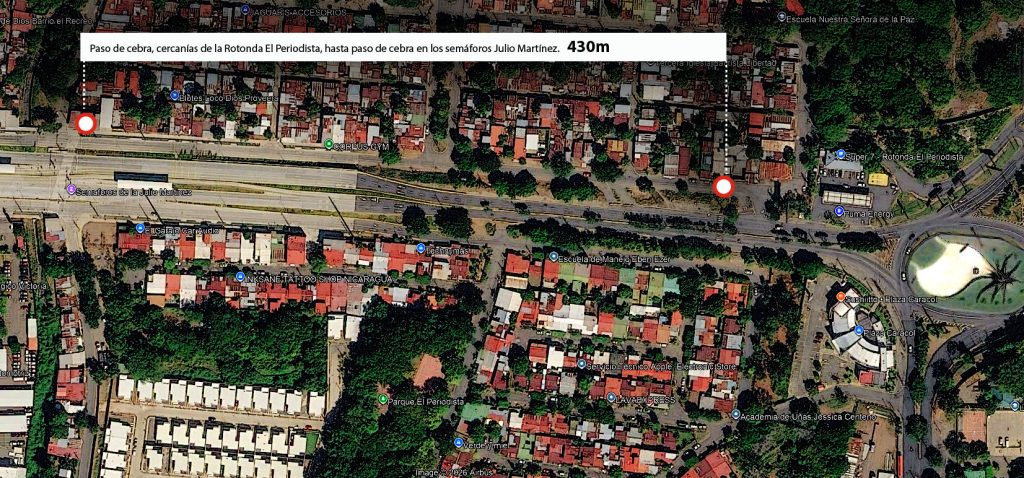
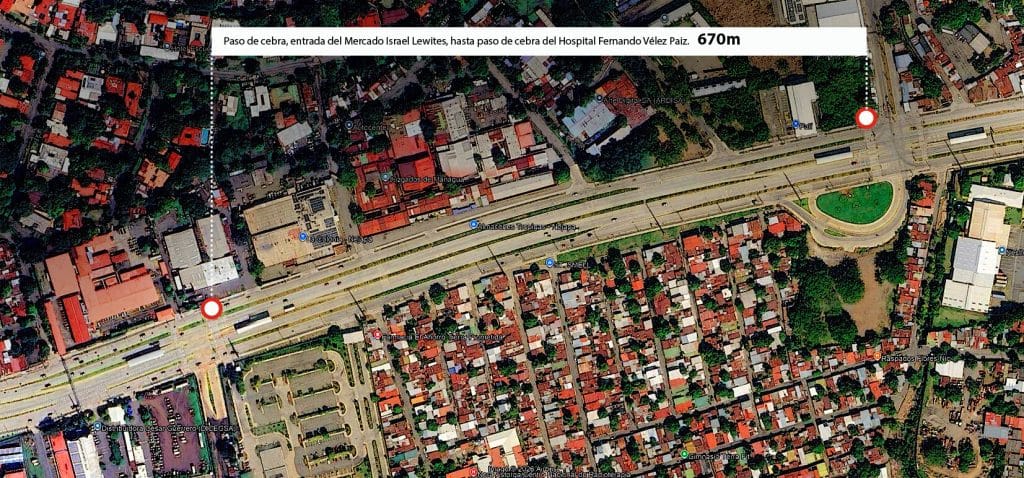
Although the Heroes of the Insurrection route includes this type of crossing, there are sections where the distance between one crosswalk and the next exceeds 300 meters. According to the ITDP standard, stations and crossings should be spaced so that users do not have to walk excessive distances to cross the track, with a recommended maximum of 250 meters.
Martínez argues that pedestrian crossings should be spaced at least 100 meters apart. He also points out that traffic regulations require a pedestrian crossing at every signalized intersection—a requirement that the project does meet.
However, he warns that this requirement is not met on many of Managua’s main roads, where the network of safe crossing points remains insufficient. In his view, the solution lies in establishing more crossings at intersections and building pedestrian bridges that are truly functional for users.
The expansion also includes infrastructure for cyclists and people with disabilities, featuring accessible entrances and sidewalks that offer greater protection. Zambrana believes these elements represent progress in urban mobility and inclusion; therefore, he insists that their effectiveness will also depend on citizens learning to use them properly and respecting traffic rules.
According to Zambrana, mobility studies show that people tend to use crosswalks when they are close to their route, but when they are too far away, the opposite occurs.
This phenomenon is also related to the distance between some stations in the transit system, which in certain cases ranges from 70 to 560 meters. This distribution also influences the walking distances required to access public transit and poses an additional challenge to adapting mobility habits.
Why Could the Masaya Highway Have Been Another Option for the BRT?
Martínez recalls that, following the 1972 earthquake, Managua grew disproportionately and haphazardly, both in terms of infrastructure and neighborhoods. “The disorder kept growing, and a project of the magnitude of the Heroes of the Insurrection Highway should not intersect with residential areas. These are thoroughfares that lead to major highways. This problem is now intrinsic to the city’s growth. We have to find a way to coexist,” he argues.
He mentions that a good alternative for the BRT system would have been the Masaya Highway, where there aren’t as many pedestrians or surrounding neighborhoods, and which also connects to the country’s main commercial routes. “There are more vehicle accidents on the Masaya Highway, but not accidents involving pedestrians as occur in other parts of the city.”
For his part, Zambrana believes that the lane represents an interesting option for urban transportation, as it improves mobility and can boost commercial activity in the city. However, he agrees with Martínez that the Masaya Highway would also have been a viable alternative for implementing a BRT system because it already had the infrastructure capable of supporting it.
He points out that this road has a major limitation because it connects the city from north to south but does not link up with strategic corridors such as the North Highway. “The problem is that it runs north to south and splits the city in two. It doesn’t connect with the North Highway, and that’s where this new road becomes important, because it links two key thoroughfares in Managua,” he explains.
When Crossing the Street in Managua Becomes a Risk
This is not only the case for the first section of the Heroes and Martyrs of the Insurrection Highway. Gerónima Zambrana, 64, also lost her life under similar circumstances. After waiting on a median in the middle of the road, she attempted to cross near the traffic lights at Linda Vista, in Managua’s District II. According to reports from a pro-government media outlet, a vehicle traveling in the inner lane yielded to her, but she was struck by a motorcyclist traveling in the outer lane.
The case highlights another challenge on Managua’s roads: even if one driver yields to a pedestrian, other vehicles traveling in parallel lanes may fail to notice the pedestrian or stop in time, creating high-risk situations even in areas with traffic regulations.
Five days later, Canal 10 reported that Efraín Escobar, 36, was struck and killed by a motorcycle while crossing the street near the Armando Guido neighborhood, just a few meters from the road leading to the Julio Buitrago overpass on the Pan-American Highway North. According to witnesses, he crossed the street recklessly.
The incidents involving Cajina, Zambrana, and Escobar occurred just weeks apart. Although the circumstances differed, all involved pedestrians attempting to cross heavily trafficked roads. This highlights another reality that goes beyond pedestrian recklessness: drivers who exceed the speed limits, fail to yield, or ignore traffic laws. Although the law recognizes the rights and protections of pedestrians and authorities lowered speed limits in June 2025, pedestrian accidents continue to occur in various parts of the country.
Nicaraguan law provides broad protections for pedestrians. The Law on Vehicle Traffic and Traffic Violations (Law 431) stipulates that drivers must drive courteously and with caution to avoid endangering the lives of pedestrians; this means that the law recognizes pedestrians’ right of way when crossing the street at marked crosswalks and at intersections regulated by traffic lights or traffic officers.
In practice, many of these crossings are nonexistent, insufficient, or so deteriorated that they are difficult to identify. The law also mandates the use of pedestrian bridges where they exist so as not to obstruct vehicular traffic. However, there is a clear gap between what the law stipulates and what actually happens on the streets.
In Managua, many sidewalks remain occupied by shops, workshops, street vendors, or parked vehicles, forcing people to walk on the road. This situation is particularly evident around markets and in numerous neighborhoods of the capital, where space designated for pedestrians is often insufficient or simply nonexistent.
Fining to Change Road Safety Culture
Alejandro Estrada—as we’ll call a motorcyclist who commutes daily to Bello Horizonte for work—believes that the road widening has improved traffic flow, although he thinks the authorities should have accompanied the project with greater road safety education efforts aimed at both drivers and pedestrians.
“We need to figure out how to impose fines or some other measure on pedestrians to prevent them from crossing wherever they please. It’s true—they only fine us drivers. They should fine pedestrians too, because they won’t understand until it hits them in the pocketbook,” he told DIVERGENTES.
“We need to do a little more to promote a culture of road safety, and there are campaigns to encourage it. Of course, the problem won’t be solved overnight—it’s a process. It’s a new road, and people will gradually adapt. That’s where the authorities also need to roll out educational campaigns—even going so far as to issue fines to cyclists and pedestrians… It’s a complicated issue because, even when the rules are in place, people don’t follow them,” says engineer Martínez, who is confident that this bike lane will contribute to traffic order in the capital and hopes more projects will follow.
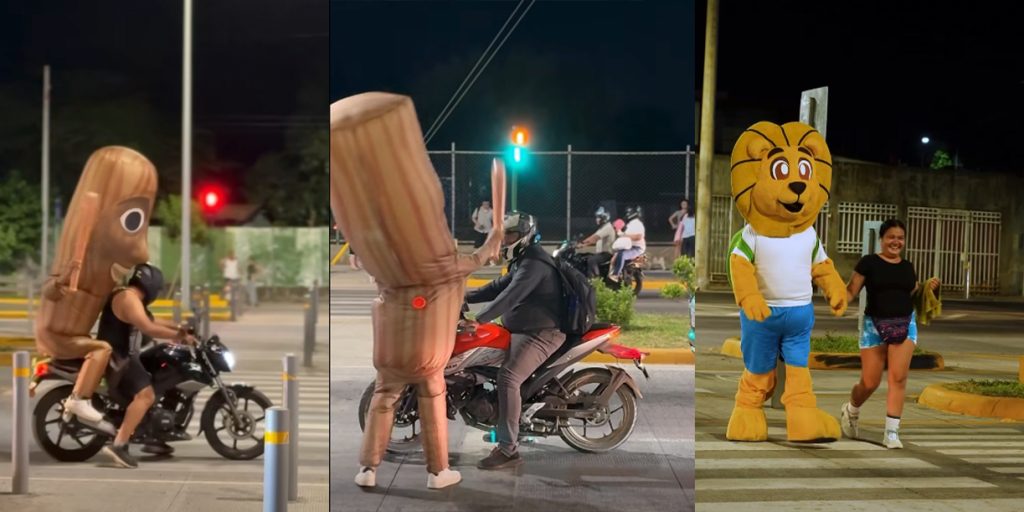
With that goal in mind, the Managua Mayor’s Office has launched awareness campaigns on the Heroes and Martyrs of the Insurrection Highway. In a post shared on TikTok, the institution promoted the message: “Let’s make the proper use of crosswalks a trend. Pedestrians and drivers, we’re all part of a safer Managua… this message is to remind us that respecting crosswalks saves lives.”
The video features the mascots Tun Tun Sahur and Xolt reminding drivers and pedestrians of the importance of respecting marked crosswalks. One scene illustrates the resistance these initiatives still face: a motorcyclist stopped at a traffic light tries to approach one of the mascots and yells at him, “Go find a job, freeloader!”
“It’s a matter of habit. People cross where it’s easiest, so in future road projects, authorities need to analyze how people move in order to place the necessary crosswalks,” recommends Zambrana.
The Fear of “Heat Stroke”
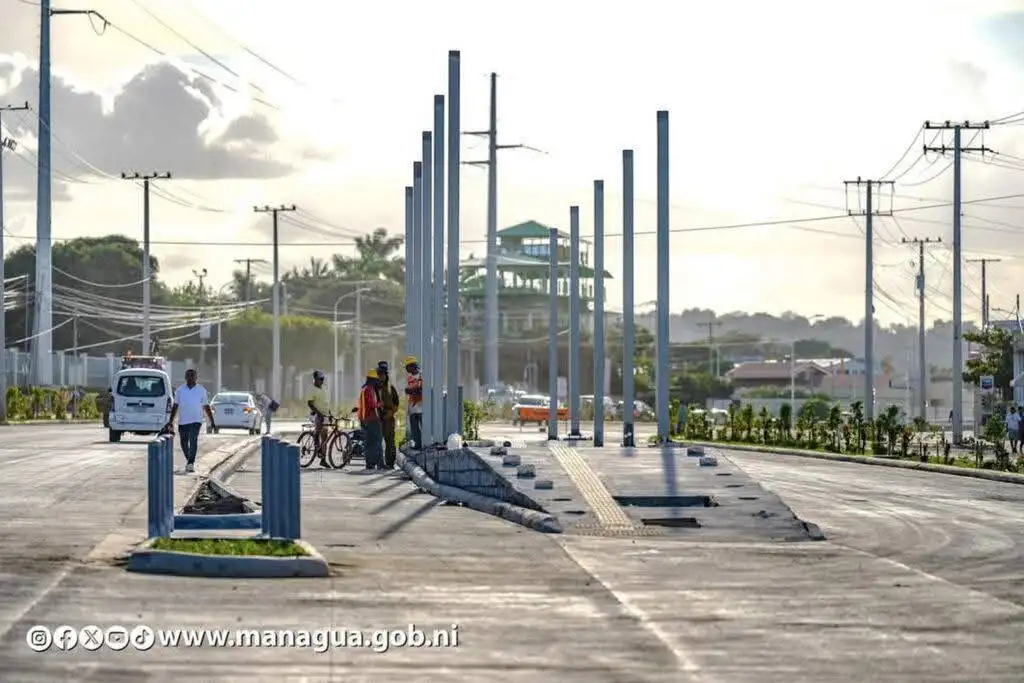
Zambrana believes that Nicaragua’s climatic conditions must also be taken into account when designing this type of infrastructure. “Walking 300 meters in Managua, where it’s hot and there’s nowhere to take shelter, causes a 60-year-old woman to choose to cross the street,” he notes.
For this reason, he emphasizes the need to complement road infrastructure with tree planting, rest areas, and covered crossings that allow pedestrians to use designated crossings without being exposed to the sun or rain.
Today, at least in Nicaragua, Zambrana believes that many pedestrian bridges are not located in the most suitable places, citing the one in Rubenia as an example. “People don’t want to climb stairs or walk extra distances. So the viable solution is education and the implementation of rest areas. If people don’t use it, it’s not a solution either,” he warns.
Another aspect that, according to the civil engineer, must be taken into account is that the Heroes and Martyrs of the Insurrection Highway has fairly straight stretches, which makes it easy for some drivers to speed.
“It becomes a danger to drivers and pedestrians,” he notes. For this reason, he believes it is necessary to install speed bumps, increase National Police patrols, impose fines when appropriate, and establish speed-controlled zones around bus stops, schools, markets, and crosswalks.
Undoubtedly, this new road highlights one of Managua’s main challenges: adapting a city that grew haphazardly to an infrastructure designed to move hundreds of people every day. However, the difficulties exposed by this project are not unique to this corridor; rather, they are part of problems that have been recurring for years in various parts of the capital.
As efforts to modernize the country’s main roads continue, the big question is: How will the authorities accompany these projects with road safety education, enforcement, and safety measures that truly reduce risks for pedestrians and drivers?