
At 9:50 a.m. on September 14, Deykel Santamaría received a call from an unknown number. She answered out of habit—she always answers every call she receives—but she didn’t expect the voice on the other end to be that of her husband, the Nicaraguan journalist Luis Galeano. She knew immediately that it was some kind of emergency. In less than 15 seconds, he told her that officers from the U.S. Immigration and Customs Enforcement—best known as ICE—had detained him while he was working as an Uber driver in Florida.
Galeano told his wife that “he was at a police station, but didn’t know exactly where; that it was ICE; and that she should contact his lawyer.” That was all she heard, because the cell phone they had lent him to notify Deykel was snatched away.
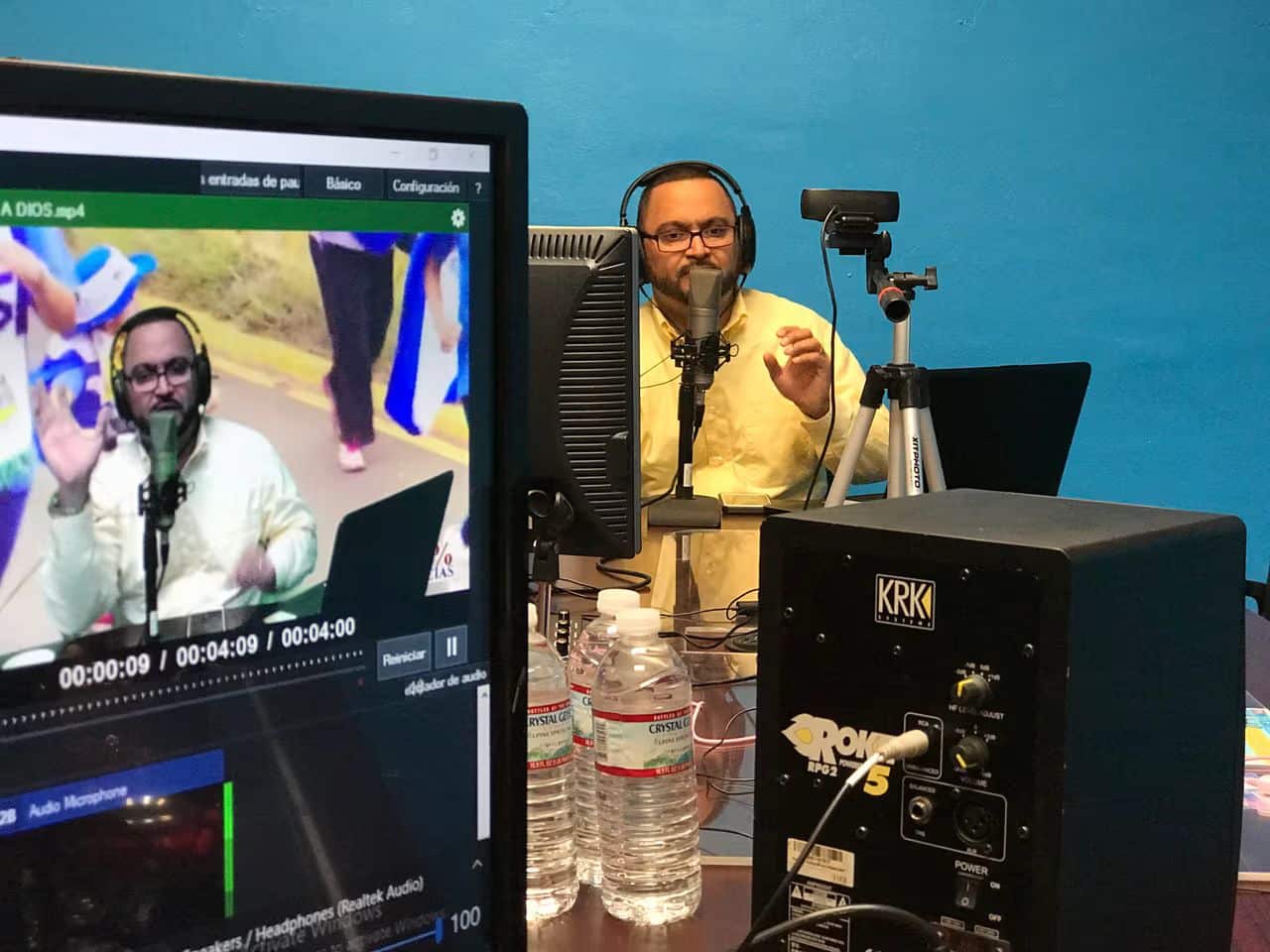
Galeano, a journalist critical of the regime of Daniel Ortega and Rosario Murillo, arrived in the United States after the 2018 protests due to political persecution against him. In 2019, he applied for asylum and settled in Miami with his family. He began broadcasting his popular program, Café con Voz, from the studio of a small evangelical radio station called “Más que Vencedores,” located above a sex shop in downtown Miami. From that point on, he began balancing his journalistic work with his job as an Uber driver.
In February 2023, the co-presidential regime stripped Galeano of his Nicaraguan citizenship and declared him a fugitive from justice, along with 93 other opposition figures and reporters. This was yet another attack that bolstered his case for asylum in the United States—a case he is now trying to bring to the attention of the immigration authorities under President Donald Trump’s administration, which is carrying out relentless raids, particularly in Florida, against immigrants.
“Luis applied for asylum in 2019, and after the dictatorship issued an arrest warrant against him, he decided not to return to Nicaragua. His asylum case is pending, but because the system is overwhelmed, his immigration court hearing has been postponed,” said his wife, Deykel.
However, with the intensification of Trump’s anti-immigration policies, a lawyer consulted for this article explained that, for ICE, being in the asylum process is not in itself an immigration “status,” and “lately they have been detaining any immigrant who does not have legal status.”
So far, Galeano’s detention has sparked outrage among various exile communities, as well as among U.S. lawmakers. “America must always know the difference between a criminal and a political exile,” warned Republican Congresswoman María Elvira Salazar.
“Luis is a respected journalist who paid a price for telling the truth about the Ortega-Murillo dictatorship. The regime persecuted him, forced him into exile, and stripped him of his citizenship,” Salazar continued. “That history matters. He cannot be sent back into the hands of the people who targeted him.”
Salazar emphasized that she has been “clear” with the Trump Administration: “Enforce the law and deport dangerous individuals, but do not treat political exiles like criminals.”
“We are still learning the details of his detention, but his case must be reviewed immediately and with the full weight of what he has already endured,” she urged on her Twitter account.
The Nicaraguan Democratic Coalition called on U.S. authorities to reconsider the situation of Galeano and other Nicaraguans detained under similar circumstances. The organization appealed to the U.S. government to recognize that these are individuals persecuted by the Ortega-Murillo regime and to allow them to regularize their immigration status, warning that a potential deportation to Nicaragua could expose them to serious human rights violations.
One More Case
Galeano’s detention by ICE is not the first involving members of the opposition who were stripped of their citizenship or were victims of the Ortega-Murillo repression in Nicaragua and who, through the humanitarian parole program or by arriving on visas, applied for a change in immigration status, citing political asylum. Last April, Spain granted Galeano citizenship.
On August 17, Marlon Gerardo Sáenz Cruz, known as “Chino Enoc,” was detained by ICE agents when he arrived for a second interview related to his asylum application. Sáenz had arrived in the United States on February 9, 2023, as part of a group of 222 political prisoners who had been released from prison, exiled, and stripped of their nationality by the co-presidential regime.
Sáenz’s case, however, has unique aspects. Before breaking with the regime and ending up imprisoned by Ortega and Murillo, he was a member of the Sandinista guerrilla, a member of State Security, and admitted to having participated as a paramilitary during the crackdown on the 2018 protests. His background raised questions among some sectors of the exile community, who even asked U.S. authorities to review his immigration status. So far, the authorities have not publicly specified whether those allegations played a role in his arrest or what the outcome of his asylum application will be.
Another case involves Yadira Córdoba, a member of the Asociación Madres de Abril and the mother of Orlando Aguirre Córdoba, who was killed on May 30, 2018, during the state’s crackdown on protests. Córdoba had sought asylum in the United States after reporting her son’s murder and claiming she faced the risk of criminalization in Nicaragua, but her request was denied. She remained in ICE custody since August 20, 2025, and after exhausting her legal remedies, U.S. authorities ordered her deportation.
Initially, it was decided that she would be sent to Honduras, but that country refused to accept her. Finally, on February 5, 2026, she was deported to Mexico, where she remained in Tapachula under the supervision of the National Human Rights Commission while she filed an asylum application with the Mexican authorities.
The Trump Administration’s immigration crackdown has also sent Nicaraguans to distant destinations. In late August, ICE deported three Nicaraguans to the Central African Republic, even though none of them had ties to that country and at least two had protections in place that prevented their return to Nicaragua.
The men reported that they were transported in handcuffs and under duress, and were left stranded in Bangui with an uncertain immigration status. The case is part of a broader policy by Washington to send migrants to third-party African countries when there are legal impediments to returning them to their countries of origin.