
The first recommendation Sonia received when she sought psychological help at the Nilda Patricia Velasco de Zedillo Primary Care Hospital in Ciudad Sandino was to go to a private clinic. The second, when she returned to ask about the free service at that health center, was that she would have to wait up to six months to get an appointment.
Neither option solved her problem. Sonia, 35, was unemployed and suffering from depression after facing financial difficulties and a divorce in September of this year. The private consultations she found cost between $50 and $75—an amount she could not afford.
According to her account, the doctor who treated her even advised her against using the hospital’s mental health services because he considered the care to be substandard. Since then, Sonia has been trying to cope with her emotional problems through exercise, without having received the professional treatment she was seeking.
Sonia’s experience stands in contrast to the commitments announced by the Ministry of Health (or Minsa, its acronym in Spanish) to expand mental health care in Nicaragua. In August 2026, just one month before she sought help, the Pan American Health Organization (PAHO) reported that health authorities had committed to strengthening community services, training staff, and improving patient follow-up.
However, it is unclear what resources will be used to fulfill these commitments. A review by DIVERGENTES of the Ministry of Health’s budget for 2026 found that, although the institution has 27.7 million córdobas at its disposal, the breakdown among its five main programs does not specify how much money is allocated specifically to psychological and psychiatric services.
The lack of information is not limited to the budget. The public documents reviewed also do not make it possible to determine how many specialists are currently working in the public system, how long patients wait to get an appointment, or what results the announced measures to expand coverage have yielded.
The Ministry of Health’s Commitments to PAHO
On August 4, 2026, PAHO reported on a technical mission conducted in Nicaragua to assess progress in mental health and define new care priorities.
During the visit, led by Renato Oliveira e Souza, head of PAHO’s Mental Health and Substance Use unit (NMH/MH), representatives of the organization met with health authorities and learned about care experiences at specialized facilities.
According to PAHO’s official statement, the Ministry of Health reaffirmed its commitment to strengthening community-based care, integrating mental health services into primary care, and improving the capacity of health care personnel.
Priorities also included updating standards and protocols, strengthening clinical records, and developing a national “telehealth” strategy to enable remote specialized consultations.
The mission included visits to the Psychosocial Care Center in Granada and the National Center for Child and Adolescent Mental Health Care, where the delegation learned about how the services operate and the experiences of their teams.
How Many Psychologists and Psychiatrists Does the Ministry of Health Have?
In June 2026, Health Minister Meyling Brenes reported that 7,083 doctors were working in Nicaragua’s public health system. However, amid the policy of information opacity under Daniel Ortega and Rosario Murillo’s regime, the Ministry of Health (Minsa) continues to release incomplete figures.
It has not published updated national data showing how many of those doctors are psychiatrists or how many psychologists work in public health facilities.
In August 2025, the ministry announced a training program to strengthen care for patients with mental disorders. The plan called for forming teams of facilitators in the 19 Local Comprehensive Health Care Systems (or SILAIS, its acronym in Spanish), who would subsequently train 395 workers, including psychiatrists, psychologists, general practitioners, nursing staff, and other professionals.
The training covered intervention techniques, psychosocial rehabilitation, and care for psychiatric patients. However, the figure of 395 workers does not make it possible to determine how many specialists are available to serve the population, how they are distributed geographically, or how long patients must wait to get an appointment.
Specialized Centers and Access to Care
Nicaragua’s public health system has 79 hospitals and 153 health centers, according to data published by the Ministry of Health (Minsa). These facilities provide various medical services, including mental health care, in addition to the care offered by specialized centers.
Among the latter are the Psychosocial Care Centers (or CAPS, its acronym in Spanish), of which there are approximately 19 nationwide, according to Deputy Health Minister Enrique Beteta, who spoke at the First International Mental Health Congress held on October 8, 2026. This figure represents an increase from the 16 centers reported by Minsa in 2023.
According to projections by the National Institute for Development Information (or INIDE, its acronym in Spanish), Nicaragua had a population of approximately 6.9 million in 2025. With the approximately 19 CAPS recently reported, this equates to one specialized center for every 365,600 residents.
A Three-Day Hospitalization Extended to Ten
Carla, the sister of a young man diagnosed with schizophrenia, reports that her relative was assaulted by other patients and mistreated by staff during his first admission to the Managua Psychiatric Hospital.
Her brother began experiencing mental health issues around the age of 28. After going to the hospital, he received the diagnosis, and the doctors recommended admitting him for three days for observation. However, he remained for 10 days in a ward alongside patients who, according to Carla, had more severe psychiatric disorders.
After being discharged, the young man told his sister that he had also felt mistreated by the medical staff.
“I felt like they were interrogating me as if I were a criminal. I don’t understand why they spoke to me that way. It’s true that they told me things I don’t remember doing, but they spoke to me as if I were lying to them, instead of offering me support or reassurance,” Carla recalls her brother telling her.
Since 2020, the Ministry of Health (Minsa) has had a Mental Health Care Standard in place that establishes criteria for hospital admission, treatment, and follow-up of patients with mental disorders, as well as the responsibilities of medical staff. However, Carla does not know what procedures were followed during her brother’s hospitalization or whether the hospital took any action in response to the mistreatment he reported.
More Propaganda, Fewer Mental Health Statistics
The difficulties in assessing the public system’s current capacity stand in contrast to the information that the Ministry of Health itself had released in previous years.
In 2019, the ministry recorded 18,104 patients with mental illnesses and 130,825 care visits related to those diagnoses. These figures were published in 2020.
Minsa also detailed the reasons for mental health consultations. Between 2017 and 2018, anxiety disorders accounted for 25% of consultations, childhood-related problems for 24%, and depressive disorders for 17%.
Two years later, the 2022 Short-Term Institutional Plan established specific goals for mental health care. These included 42,011 psychosocial care visits at CAPS and 58,308 cases of free medication provided to patients with psychiatric disorders.
In May 2023, authorities once again released specific figures. They reported a cumulative total of 299,155 mental health consultations between 2022 and May of that year, of which 292,143 were for adults treated at CAPS and 7,012 were for children under 15 at the National Center for Child Mental Health, located in Managua and specializing in the care of children and adolescents.
Statistics on psychiatric disorders also continued to appear in the National Health Map. By 2024, official records tallied 24,742 cases, compared to 14,594 in 2020, representing a 69.5% increase over four years.
However, the most recent institutional documents reviewed by this media outlet do not provide a corresponding update on the care provided at the CAPS, the number of patients receiving medication, or compliance with the goals established in 2022.
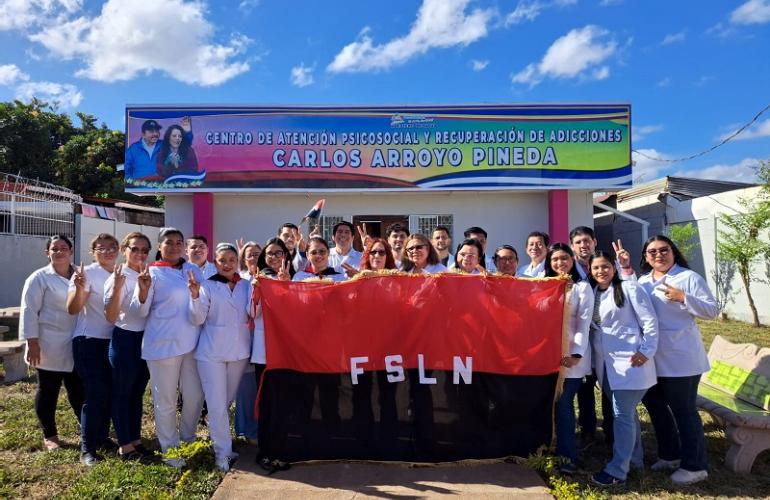
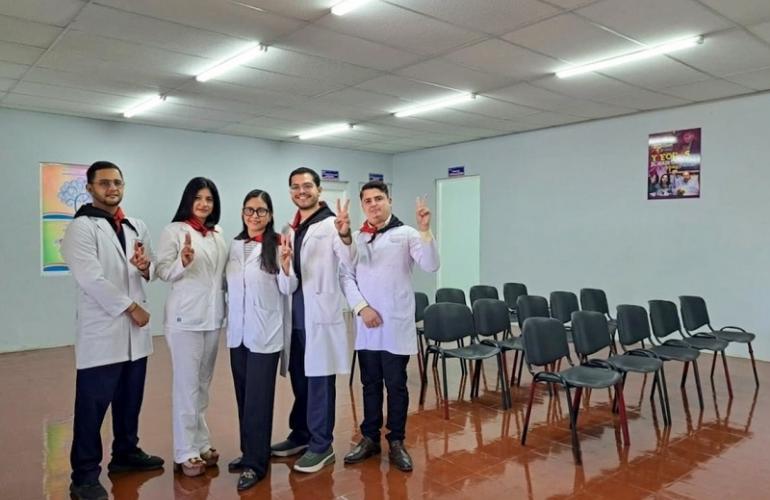
While the Ministry of Health (Minsa) is releasing less and less data on mental health care, the Ortega-Murillo regime uses the inaugurations of health centers to promote its political propaganda. In the images released of these events, healthcare workers appear with party flags and symbols on their uniforms.
Ministry of Health Sets Indicators but Conceals Results
Current mental health care regulations also established mechanisms for evaluating essential aspects of the services.
The indicators included promotion and prevention activities, the availability of trained medical personnel, the supply of psychiatric medications, and the availability of beds for patients with mental disorders in secondary-level facilities.
The regulations established compliance targets and mechanisms for periodic monitoring. However, no recent, comparable results for these indicators were found in the public documents reviewed that would allow for an assessment of the level of compliance.
The Budget Does Not Specify the Investment
In addition to the lack of information on specialists and coverage, there is no separate allocation for mental health within the Ministry of Health’s overall budget structure.
The 2026 General Budget of the Republic allocates 27.7 million córdobas to the ministry, distributed among five programs.
The two main programs are Hospital Health Care, with 13.1 million córdobas, and Comprehensive Primary Care, with 11.6 million.
The remaining funds are allocated to promotion and prevention, central activities, and local offices.
In this classification, mental health does not appear as a separate budget program. Therefore, the overall allocation does not allow for identifying how much is specifically earmarked for psychological consultations, psychiatric care, specialized medications, or the operation of CAPS.
Digitization and Patient Follow-up
Strengthening clinical records is another priority for the Ministry of Health (Minsa) and PAHO. In its 2025 annual report, the agency noted that a mental health component was incorporated into the electronic health record to improve patient follow-up, although it did not specify how many facilities use it.
A recent report by DIVERGENTES documented cases of patients whose medical records or test results were lost, forcing them to undertake them again. These failures can particularly affect those who require long-term treatment and regular follow-up, as is the case with psychiatric patients.
PAHO has also highlighted positive experiences with community-based care, such as that of a young man from Granada who received specialized support at a CAPS. However, these experiences contrast with the difficulties reported by Sonia, who was unable to receive psychological care at a public hospital, and Carla, who questions the conditions of her brother’s hospitalization.
Without up-to-date data on coverage, wait times, and service capacity, it is difficult to assess whether the Ministry of Health’s commitments are translating into improvements for patients.