

In 2026, the National Police has nearly four times as many personnel assigned to protect co-presidents Daniel Ortega and Rosario Murillo and other dignitaries as it does to ensure road safety in Nicaragua, according to a breakdown of the General Budget of the Republic.
This is despite the fact that the latter area is responsible for regulating traffic and carrying out 78,801 preventive and awareness-raising actions throughout the country during that same year.
The 2026 budget allocates 1,269 posts and 248 million córdobas (C$), equivalent to 6.8 million dollars ($), to the VIP Protection Program, while Road Safety has 345 posts and 71.7 million córdobas ($2 million) to carry out its functions nationwide.
For every córdoba allocated to Road Safety, VIP Protection receives 3.5 córdobas. In terms of personnel, the ratio is four posts for every one assigned to the program responsible for preventing accidents, regulating traffic, and carrying out road safety and education initiatives.
Of the Police’s total budget for 2026, which amounts to 5,622 million córdobas ($153.5 million), VIP Protection accounts for 4.4% and Road Safety for 1.3%. Among its functions, VIP Protection is responsible for ensuring the safety of the co-presidents, state officials, the diplomatic corps, and national and foreign dignitaries.
Road Safety receives a smaller share of resources in a country where traffic accidents were the sixth leading cause of death in 2025, according to data from the National Health Map of the Ministry of Health (or Minsa, its acronym in Spanish). That same year, the National Police recorded 903 deaths in traffic accidents.
More Posts Allocated to Protecting VIPs Than to Road Safety
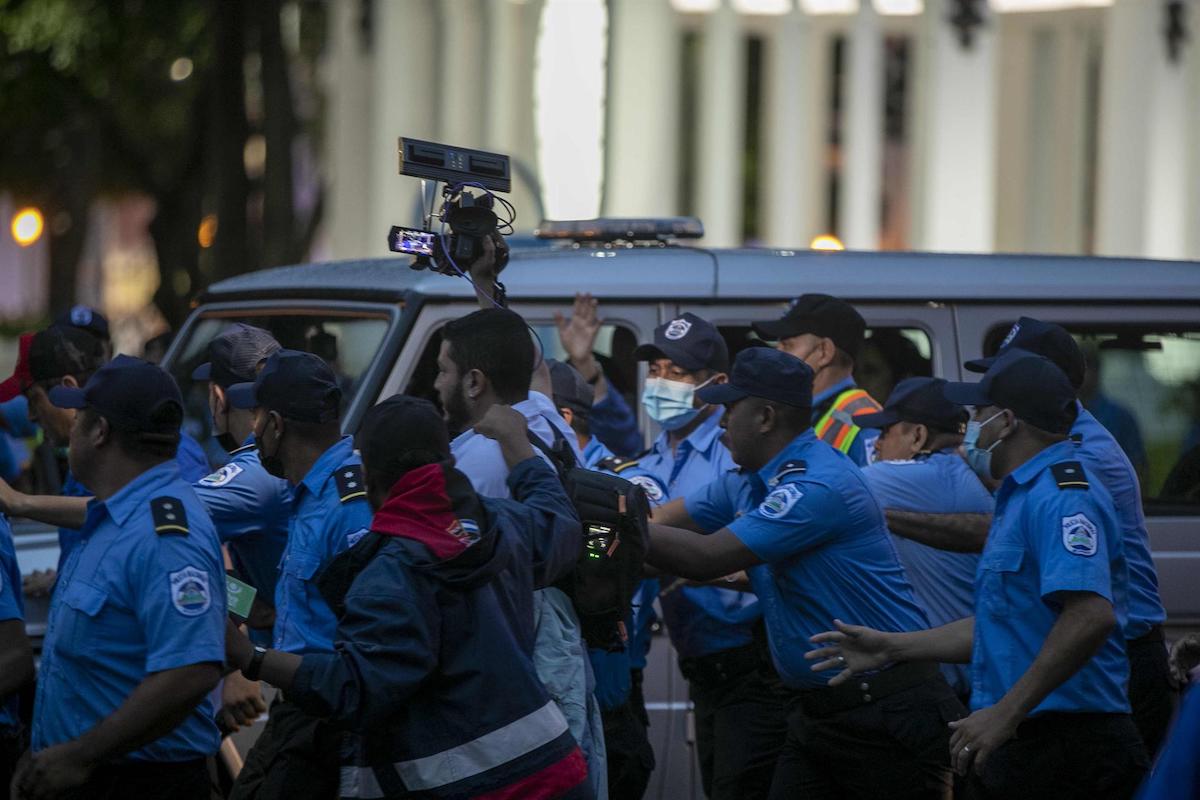
By 2026, the police projected 39,749 protection plans for members of the branches of government, the diplomatic corps, and foreign dignitaries, in addition to 265,072 technical inspections to detect explosives at high-security targets. Added to these are 33 protection plans specifically scheduled for co-presidents Daniel Ortega and Rosario Murillo.
Protecting the dictators, however, goes beyond what the general budget figures detail. An investigation published by DIVERGENTES in July 2026 documented a security operation involving at least 73 National Police officers, distributed across 28 checkpoints and three security perimeters around the co-presidents’ residence in the El Carmen neighborhood of Managua.
The investigation found that the police perimeter around El Carmen has existed since 2018 but was reinforced between late 2025 and early 2026, following the U.S. capture of the Sandinista regime’s political ally, Venezuelan dictator Nicolás Maduro. The security operation was then expanded to three levels of security extending from the residence to the streets connecting to some of Managua’s main thoroughfares.
The three rings serve different functions within the security perimeter. The outer perimeter extends the police presence along the streets surrounding El Carmen, while the subsequent levels increase security as they get closer to the residence. The third ring acts as the final line of defense and maintains constant surveillance near the residence, where drones, patrol cars, and motorized officers are deployed.
The 73 officers DIVERGENTES counted do not represent the total number of personnel involved in Ortega and Murillo’s security. The count does not include private security personnel inside and in front of the residence, other strategic posts located on high ground, or the drone operators who patrol the neighborhood daily, due to the difficulty in identifying them and determining their numbers.
The investigation also revealed, based on sources from the Ministry of the Interior (or Mint, its acronym in Spanish), that the 253.8 million córdobas allocated in 2025 to the VIP Protection Program were used entirely by the Ortega-Murillo family.
A Robust Structure to Protect the Co-Dictators
The budget allocated for the Protection of VIPs has remained largely unchanged over the past eight years. In 2018, it had 1,243 posts, and by 2026, that number has risen to 1,269—just 26 more. Over the past four years, the number of posts went from 1,262 in 2023 to 1,260 in 2024, 1,263 in 2025, and 1,269 in 2026.
The budget allocated to the program also increased compared to 2018. That year, it received 211.3 million córdobas ($5.8 million), while for 2026, it has been allocated 248 million córdobas ($6.8 million), a 17.4% increase.
Over those eight years, the budget for the Protection of VIPs reached its highest point in 2020, at 333.9 million córdobas ($9.1 million), and its lowest in 2022, at 210.3 million córdobas ($5.7 million). By 2026, it stood at 248 million córdobas ($6.8 million).
345 Posts Dedicated to Road Safety Nationwide
The structure designed to protect high-profile figures stands in contrast to the one the police maintain for road safety nationwide, which has fewer personnel and a considerably smaller budget.
The 345 posts budgeted for road safety cover a much broader scope than simply regulating traffic on the streets. The program is tasked with preventing accidents, regulating and controlling vehicular traffic, developing educational campaigns, training drivers and students, and implementing road safety plans. The budget also stipulates that the program must record and analyze accident data to identify causes and guide preventive measures.
By 2026, Road Safety will be required to fulfill these responsibilities with a budget 71.1% smaller than that allocated to VIP Protection. With 71.7 million córdobas ($2 million), the program will have to implement 7,362 accident prevention plans and 78,801 preventive and awareness-raising actions. It also plans to train 214,939 drivers and 186,054 students and members of the Student Traffic Regulation Brigades.
These figures mean that the program must carry out, on average, more than 20 prevention plans and about 216 preventive actions every day of the year. These activities are not necessarily carried out individually by the 345 staff members, who must also fulfill the other responsibilities assigned to Road Safety.
Nor does the budget specify how these 345 posts are distributed geographically. It does not indicate how many are assigned to Managua, how many are allocated to the other Departments in the country, or how many are directly involved in traffic enforcement on highways and streets.
Fewer Traffic Enforcement Personnel as Road Fatalities Persist
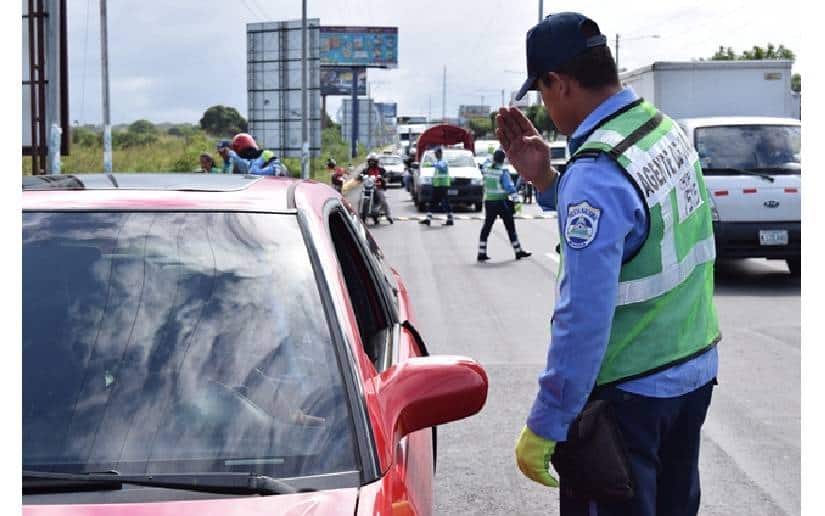
In 2024, Road Safety had 638 posts allocated. By 2025, that number had fallen to 345 and remained the same in 2026. That is a decrease of 293 posts in one year—a reduction of nearly 46%. The budget documents reveal the decline but do not explain whether those posts were eliminated, transferred to another police program, or administratively reclassified.
The reduction occurred during a period in which traffic accident fatalities have remained higher than those recorded eight years ago. The police recorded 726 fatalities in 2018, 846 in 2019, 830 in 2020, and 904 in 2021. In 2022, the figure rose to 978, and in 2023 it reached 1,014—the highest figure for that period.
After that peak, deaths fell to 941 in 2024 and 903 in 2025. Even with this reduction, the latest figure exceeds the 2018 total by 177 deaths, representing a 24.4% increase. The 2025 police report also shows that 505 of the 903 deaths were linked to motorcycle accidents.
Police Step Up Traffic Controls with Fewer Traffic Posts
To reduce the number of traffic-related deaths reported in recent years, the police strengthened the National Road Safety Emergency Plan with breathalyzer and speed checks, license suspensions, vehicle occupancy checks, vehicle inspections, traffic enforcement, and road safety education campaigns.
In June 2025, these measures were supplemented by a nationwide reduction in speed limits. The measure established a maximum speed of 50 kilometers (31 miles) per hour for private vehicles, public transportation, and freight vehicles, and 40 kilometers (25 miles) per hour for motorcycles.
An expert on security issues, who requested anonymity for safety reasons, explained to DIVERGENTES that publicly available information does not reveal the reason behind the reduction of 293 road safety posts between 2024 and 2025. Nor does it allow for determining whether those posts were transferred to other areas, reclassified, or eliminated from the police structure.
“The police’s own official figures show where their priorities lie. More resources and personnel are allocated to protecting Daniel Ortega and Rosario Murillo than to addressing road safety—a problem that continues to claim hundreds of lives each year in Nicaragua,” the source added.
Police Surveillance of the Population Has a Budget in the Millions
The disparity in resources is not limited to VIP Protection. The Police Investigation and Intelligence program has been allocated 351.5 million córdobas ($9.6 million) and 1,095 posts for 2026—nearly five times the Road Safety budget.
The program covers criminal investigations, forensic analysis, intelligence operations, and actions against drug trafficking and organized crime. However, another source consulted for this report—linked to the National Police and who requested anonymity for security reasons—assured DIVERGENTES that part of the resources allocated to this unit is used primarily to fund political surveillance of the population.
The existence of such surveillance activities carried out by the police’s intelligence units has been documented by the United Nations Group of Human Rights Experts on Nicaragua. In its 2025 report, the Group noted that the police have an Information and Intelligence Center that reports to the General Sub-Directorate of Police Investigation and Intelligence and gathers information on opponents or individuals perceived as such in order to identify them and place them under surveillance.
The experts also documented that these practices have intensified since 2023 and are part of a network involving other state institutions and structures linked to the FSLN.
The Priorities Behind the Police Budget
In total, the National Police has 5,622.3 million córdobas ($153.5 million) for 2026. The largest allocation goes to Prevention and Public Safety, with 2,844.2 million córdobas ($77.7 million) and 11,938 of the 17,299 posts budgeted for the institution.
Another 1,733.3 million córdobas ($47.3 million), about 31% of the police budget, is allocated to Central Activities. This category includes the institution’s management and administrative functions.
Hospital Health Services receive 259.4 million córdobas ($7.1 million), and Police Training receives 114.1 million ($3.1 million). Road Safety, with an allocation of less than 100 million córdobas, is the program with the smallest budget among the seven that make up the National Police.
Investigation and Intelligence and Protection of VIPs together receive 8.4 times the resources allocated to Road Safety, even though the latter area is responsible for regulating traffic throughout the country and is scheduled to carry out more than 78,000 preventive actions and 7,000 plans to reduce accidents in 2026.