
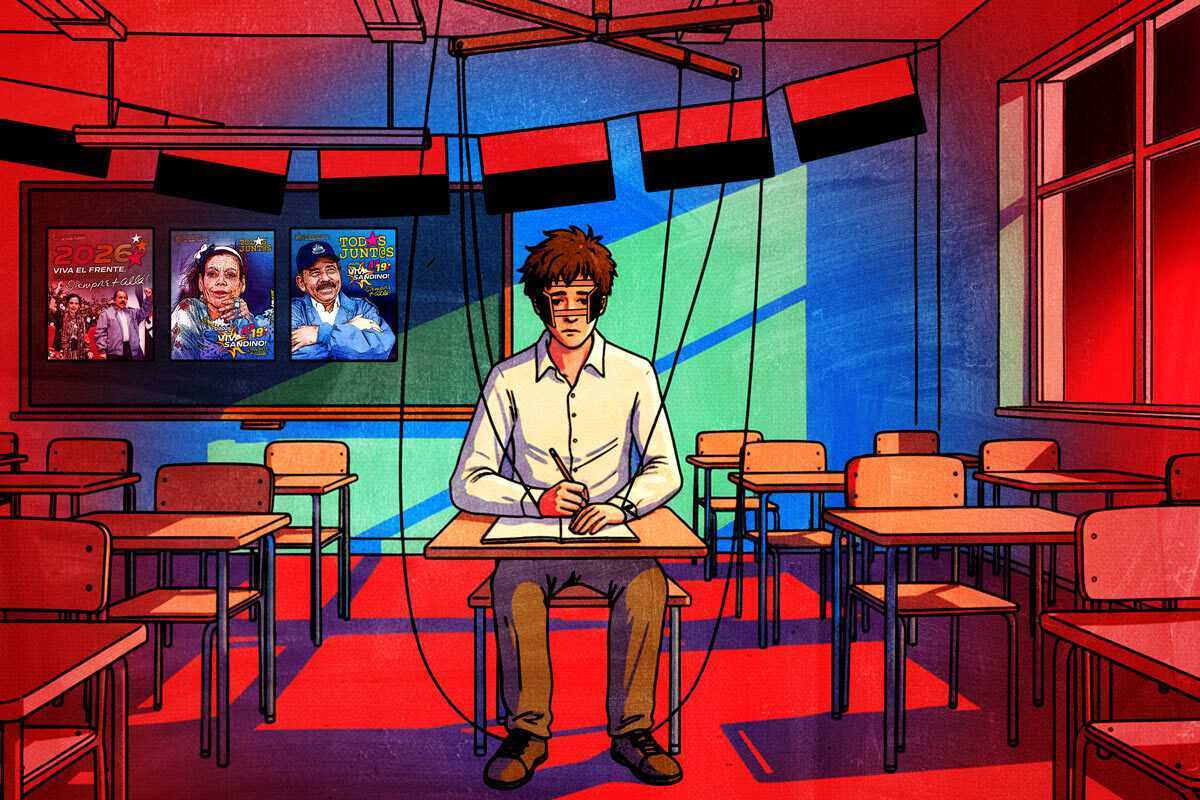
Daniel Ortega and Rosario Murillo’s regime restructured the higher education system and redefined its curriculum following the seizure of private universities. In the new public institutions created by the Ortega regime, students must take a mandatory course that requires them to research and glorify Sandinista “heroes and martyrs,” under guidelines that, according to documents and testimonies, restrict critical thinking and reinforce an official political narrative.
DIVERGENTES had access to several academic papers written by students from various programs at the Casimiro Sotelo Montenegro National University (formerly the Central American University, UCA), which show how the new course “National Identity and Patriotic Pride” focuses its content on exalting Sandinista figures.
The documents reviewed all focus their research on figures classified as “heroes and martyrs” of Sandinismo, emphasizing their lives, participation in the revolutionary struggle, and legacy as role models for new generations.
The texts analyzed by this publication portray these assignments as exercises aimed at reinforcing historical memory and national identity, in line with the official rhetoric of Daniel Ortega and Rosario Murillo’s regime.
These research projects are presented as an “academic homage” by the students and use language that highlights the “preservation of values” associated with the revolutionary struggle, incorporating symbols and direct references to the Sandinista National Liberation Front (or FSLN, its initials in Spanish), as part of the assessment.
One of the documents reviewed indicates that the project aims to become an “ethical benchmark for new generations” and asserts that historical memory must serve as a “driving force for national identity and patriotic pride.”
The academic research establishes that learning about these figures allows one to “understand that national identity is built through historical memory and the commitment to continue defending the ideas of justice, solidarity, and unity.”
Among the figures students are required research is Carlos Alberto Tinoco Montiel, presented as a “hero and martyr of the battle of Pancasán,” which took place on August 27, 1967, alongside other guerrilla members who fell in the battle, such as Silvio Mayorga, Francisco Moreno, and Otto Casco, whose profiles are highlighted as examples of dedication and struggle.
There are also studies that incorporate other historical Sandinista Front figures, such as Augusto C. Sandino, Carlos Fonseca Amador, Tomás Borge Martínez, and Camilo Ortega Saavedra, who presented in these works as models of values and political commitment for new generations.
One of the academic studies indicates that the research aims to “strengthen the sense of belonging” and “convey values associated with the revolutionary struggle,” arguing that the legacy of these figures must remain relevant for future generations.
Another academic project also includes direct references to the Sandinista Front and the use of party symbols as part of the academic work, including the creation of a model representing a community center with red-and-black flags. In these projects, co-dictators Ortega and Murillo appear as central figures within the historical narrative promoted in the research.
Students Under Pressure
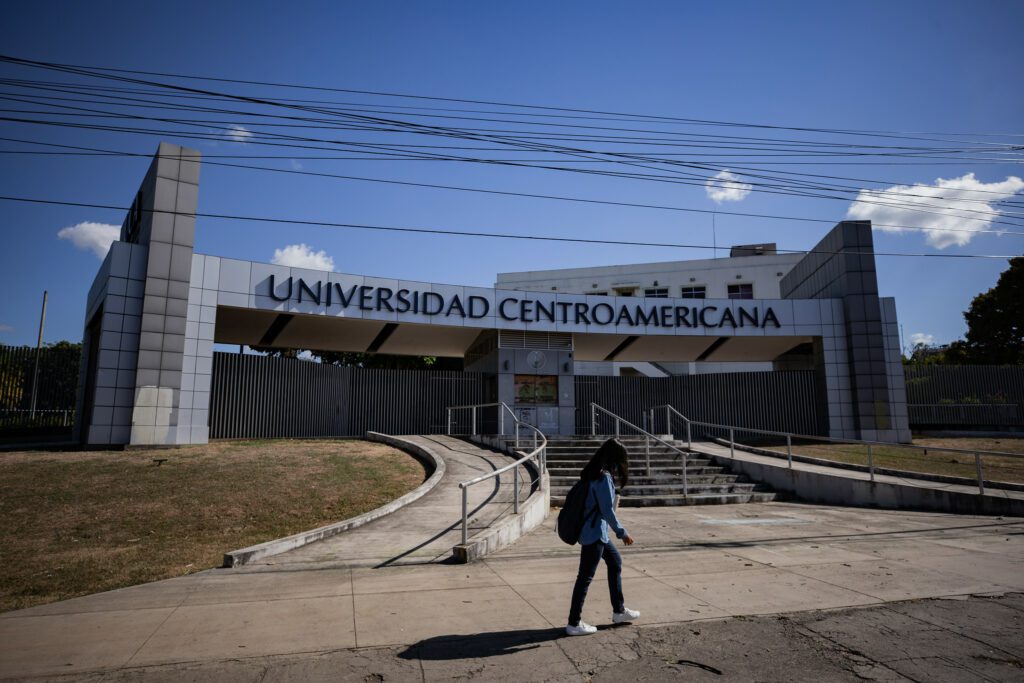
Students interviewed anonymously for their own safety report that this type of assignment is common across various degree programs and state-controlled universities, where it is a mandatory part of the curriculum.
Ana, a sophomore at Casimiro Sotelo University, notes that the assignments have specific guidelines and a political slant that cannot be avoided.
“They ask us to write papers on Sandinista heroes and martyrs. There’s a specific way they expect you to do it, aligned with what the university promotes. In the end, everything revolves around the co-presidents (Daniel Ortega and Rosario Murillo),” she says.
According to her, this new course has no connection to her major, and in fact, she regrets that it is part of the university’s academic curriculum. “That class is a political imposition. The university doesn’t consider that one might have a different way of thinking or not identify with that line, and it’s not even an elective because it’s mandatory,” Ana notes.
Carlos, a junior at the same university, agrees that the assignments amount to political indoctrination. “It’s not like we can research freely, as we would for a research project. They tell us explicitly that it has to be about Sandinismo, and we know full well that this is more important than any other assignment we have to turn in,” he explains.
He also points out that there is unease among students, although they cannot express it among themselves for fear of being singled out. “Many of us don’t like this mixing of politics with classes. Some of my classmates belong to the Sandinista Youth, and you can’t say anything in front of them,” Carlos adds.
Rewriting History Through the Education System
Scholar and education expert Ernesto Medina analyzes this situation as part of the deterioration facing higher education in this country. He also believes that Daniel Ortega and Rosario Murillo “have tried and continue to try to rewrite Nicaragua’s history,” particularly regarding the Sandinista Revolution.
“They are trying to position themselves as the central figures of that revolution, and to that end, they seek to use the education system to impose that version of history,” Medina states.
According to the scholar’s analysis, the content of these courses reflects an interest in establishing a specific interpretation of Nicaragua’s recent history.
Medina points out that this practice redefines how historical processes are addressed in the university setting. He notes that the emphasis is placed on certain actors and events, while other perspectives are excluded from academic analysis.
“We know perfectly well that none of them (Sandinista heroes and martyrs) gave their lives so that the Somoza family’s dictatorship could be replaced by another family’s dictatorship,” he adds.
The scholar also warns about the conditions under which these projects are carried out within universities. As he explains, the assignments are presented as a mandatory part of the curriculum and are conducted in an environment where students face pressure to comply with established guidelines, under the risk of being sanctioned or singled out if they do not.
Political Activities Are Normalized in University Life
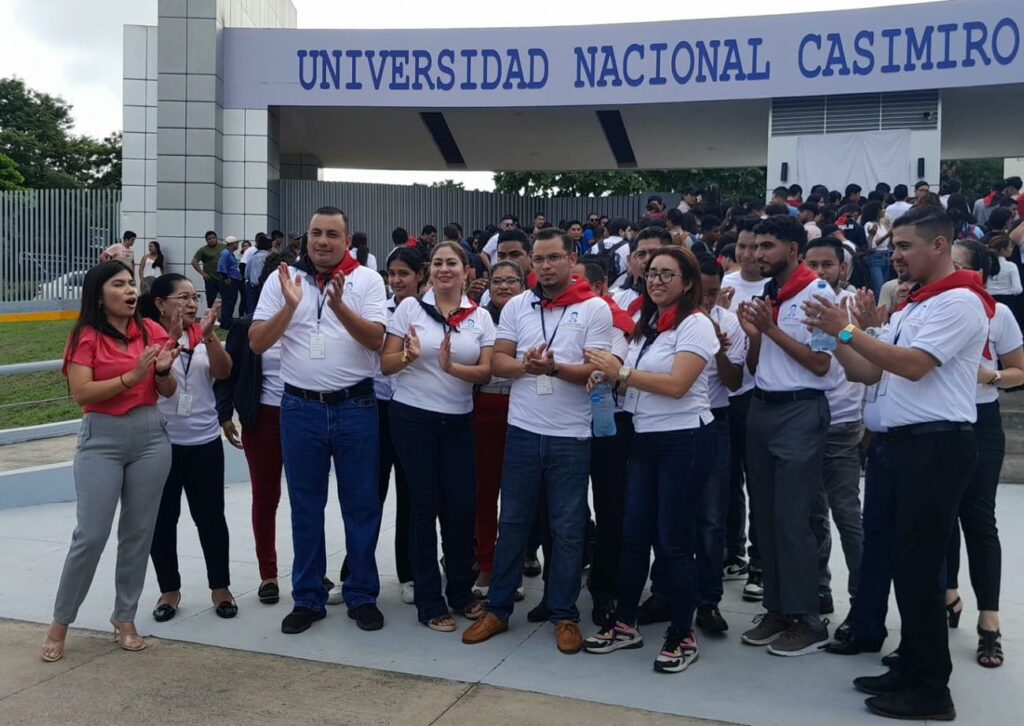
In addition to academic assignments, students incorporate extracurricular activities into their daily university routine. Videos posted on social media show that class days include political rallies in support of the Sandinista Front.
One such video was posted on April 18 by Julissa Bustamante, a content creator and veterinary medicine student at the National Agrarian University (or UNA, its acronym in Spanish). On her TikTok account, the young woman shows what she describes as “a normal day in college.”
In the video, she explains that she had classes that day, that she was not able to record much because she was studying, and that she later went out to eat. “After class, they told us about a march, and obviously I wasn’t going to miss the event, but after a few hours I was already feeling tired and hungry, so I went home to eat,” she added.
The footage shows her at a gas station in Managua, surrounded by people carrying red-and-black flags and wearing scarves around their necks, as she participates in one of the marches organized by the government as part of the official April activities, promoted under the slogan “marches for peace.”
According to students who spoke on condition of anonymity, these rallies are held every year around this time because April marks the start of the 2018 social protests, when thousands of Nicaraguans took to the streets and the crackdown left more than 300 dead, according to human rights organizations.
Over the past three years, the dictatorship has shifted the focus of this commemoration, and on April 16, 2023, it declared April 19 as “National Day of Peace,” promoting activities with that message throughout the month.
For education expert Ernesto Medina, these practices are part of the same pattern that is replicated within classrooms. As he explains, both the courses and the activities organized by universities follow the same line that dictates what is studied and how recent history is interpreted.
He also warns about the limited scope students have to deviate from that narrative. “I don’t know if anyone will dare to develop a project different from the one assigned to them without running the risk of sanctions or being considered an enemy of the government,” he notes. In that context, he adds, academic space and the development of critical thinking within Nicaraguan universities are being curtailed.
Context of University Control
Since 2018, the regime has revoked the legal status of at least 27 private universities, whose assets were transferred to new state-controlled institutions, according to records from academic and human rights organizations.
Medina argues that these changes have impacted the internal operations of universities. “The Ortega-Murillo regime has done everything possible to destroy university autonomy, academic freedom, and freedom of thought,” he states.
According to his analysis, institutional control influences academic content and the way activities are conducted in the classroom. “What they seek is to turn students into an amorphous mass that parrots the regime’s slogans,” he concluded.