

Between January and mid-July 2025, the newly created Ministry for the Promotion of Entrepreneurship, formerly the Ministry of Family, Community, Cooperative, and Associative Economy (MEFCCA), announced the launch of 10,043 new businesses in Nicaragua, reportedly generating 50,215 jobs. But economists consulted by Divergentes argue these figures do not reflect a healthy trend; rather, they reveal a stagnant economy pushing thousands into informal self-employment.
“I see this as pure political propaganda. If anything, it shows the failure of Nicaragua’s economic policy. A country doesn’t develop by investing in secondhand clothing shops. It develops by investing in technology and high-value jobs,” said economist and political exile Juan Sebastián Chamorro.
The new Ministry for the Promotion of Entrepreneurship, created in January 2025 to replace MEFCCA, reported that 732 businesses opened in January; 1,705 in February; 1,700 in March; 1,694 in April; 1,281 in May; 1,511 in June; and 1,420 in the first weeks of July.
These numbers were celebrated in pro-government media as signs of an active, growing economy. However, the types of businesses registered suggest the rise of microenterprises in traditional sectors, with little innovation or growth potential. In July alone, 280 new food vendors were recorded, including street food stalls, bakeries, and informal eateries.
The trend also includes 652 small retailers, such as corner stores, secondhand clothing vendors, and general product sellers, alongside 83 repair shops and workshops, and 345 personal service providers including barbershops, beauty salons, private transport, and clinics. In stark contrast, only about ten new businesses were linked to tourism or financial services.
An Economy Trapped in Informality

According to economist Marco Aurelio Peña, these low-productivity occupations that require minimal startup investment offer no stability, formalization, or real growth. He believes their proliferation signals structural stagnation and a weakened formal labor market in Nicaragua.
Though the regime presents them as “achievements of good governance,” experts agree these ventures do not represent real economic momentum, they reflect an economy mired in informality.
“We’re seeing economic growth that doesn’t translate into development. They report official growth, but in reality, we’re living in an economy of distress. Instead of generating well-being, this economy is producing hardship,” Peña said.
He criticized labor statistics used to portray Nicaragua as a developing economy, noting they rely on the International Labour Organization’s broad definition of employment: anyone who worked at least one hour during the reference week is considered employed.
“If someone worked nine hours doing yard work that week, they count as employed. Using that broad definition, the government claims nine out of ten people are employed, when in reality, they’ve simply found a way to make ends meet, often through informal self-employment,” the financial expert explained.
No Business Vision or Innovation
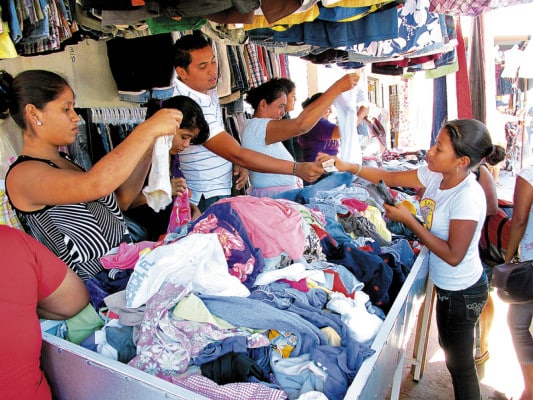
Peña notes that many of the new ventures arise not from entrepreneurial vision but from lack of alternatives. In this context, informality becomes a survival mechanism in an economy with scarce formal employment.
“These are initiatives born out of the need to survive within a system that distorts and, in the worst cases, suffocates both workers and entrepreneurs,” he said.
“True entrepreneurship involves identifying opportunities, innovating, and applying knowledge. Entrepreneurs are people with vision, and not everyone has that. Some just cut hair every day with no long-term plan, just trying to survive,” Peña added.
He emphasized that informality dominates Nicaragua’s labor market, with 75% of the workforce lacking social security coverage or paying taxes, reflecting a parallel, precarious economy.
Additionally, four out of ten workers are underemployed, holding jobs below their qualification level or earning insufficient income. “An engineer driving a taxi is overqualified but has no alternatives. In many countries, that’s considered hidden unemployment, but here, it’s added to the formal employment stats,” he noted.
Official Indicators Conceal Precarious Jobs
According to the Central Bank of Nicaragua (BCN), the unemployment rate averaged 3.1% in 2024, up from 2.5% in December 2023. Yet underemployment, meaning part-time or low-skill jobs held by overqualified individuals, reached 39.8% by the end of the year, slightly higher than the previous annual average. These numbers confirm a labor market where most people lack access to quality, formal jobs.
Social security enrollment is another key indicator. As of December 2024, there were 802,372 registered INSS members, a modest annual increase of 1.3%, or 10,459 more insured workers compared to the end of 2023. While there’s some formal job growth, it’s not enough to offset widespread underemployment and informality.
In its 2025 Macroeconomic Outlook, the BCN forecasts GDP growth between 3.0% and 4.0%, stable unemployment between 3.0% and 3.5%, and inflation between 2.0% and 4.0%. While these figures suggest macroeconomic stability, they hide a labor market that has not improved meaningfully for most Nicaraguans. The recovery of formal employment remains weak in the face of soaring informal work and underemployment.
An Economy of Survival

“The economy doesn’t function thanks to the dictatorship, it functions despite it. Nicaraguans aren’t sitting around waiting for the government to feed their children. Entrepreneurs aren’t waiting for the state to sell their products. People work, move forward, and survive, not because of the regime, but in spite of it,” Peña remarked.
He also stressed that education levels no longer guarantee better wages. “The economic structure doesn’t reward professional training because there are no sectors that need qualified workers,” he said. He added that public employment is politicized: “Here, you don’t get hired for your résumé, but for your party affiliation. The party is the family, the family is the state, and everything is intertwined in a single logic of power.”
A Ministry to Simulate Economic Dynamism
The Ministry for the Promotion of Entrepreneurship was formally created on January 17, 2025, under Law 1233, to support small family businesses, according to its representative Frania Peralta in an interview with pro-government outlet Estudio TN8.
Peralta said the ministry’s mission is to “strengthen the country’s small businesses” through a comprehensive approach including strategic planning, formalization, and technical support.
“We aim to help Nicaraguan families carry out strategic plans that enable gradual and sustainable growth,” the Sandinista official stated.
She also told La Primerísima, another pro-government outlet, that between 8,000 and 9,000 businesses received support in 2024, ranging from corner stores to workshops, marking the start of a “new era” of national entrepreneurship.
However, despite the official discourse, experts criticize these projects, like barbershops, food stalls, and street vendors, as lacking innovation, added value, or growth potential.
Entrepreneurship as Survival
For the economists interviewed, the rise in small businesses stems more from income necessity than entrepreneurial spirit. “In a survival economy, people find ways to make money, even if it means working in precarious conditions,” Peña noted.
He explained that, unlike the 1980s, Nicaragua no longer has a state-run economy, but it also lacks a healthy market economy. “It’s a distorted system with anti-competitive structures and a state that interferes negatively. It’s not fully socialist like it was in the ’80s, that led to economic disaster, but it’s still a damaged market economy,” he said.
According to both experts, the more than 10,000 businesses registered in 2025 are not signs of progress. Nicaraguans are not truly entrepreneuring, they’re surviving. And while the regime may try to frame this reality as a success, the data paints a clear picture of an economy trapped in informality, underemployment, and precarity.