
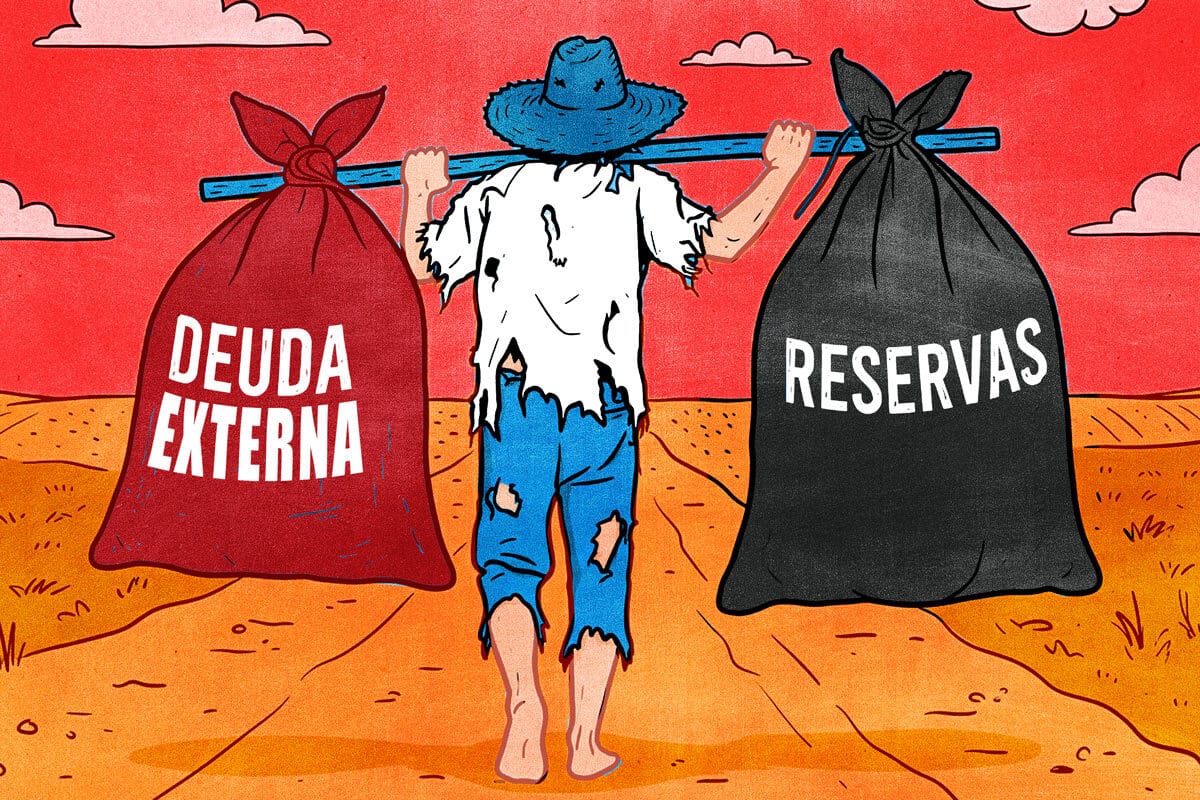
Nicaragua has more international reserves today than ever before, but that record does not mean that Nicaraguans are more prosperous. Economists Manuel Orozco and Marco Aurelio Peña agree that the growth of this “cushion” strengthens the country’s financial position and its ability to weather a crisis, although its benefits do not directly translate into higher incomes or better living conditions for the majority of citizens.
The Central Bank of Nicaragua (or BCN, its initials in Spanish) reported that Gross International Reserves (GIR) reached $9,808 million at the end of June 2026, $1,483 million more than in December 2025—a growth of nearly 18% in six months. The institution attributes the increase primarily to the purchase of foreign currency, the inflow of external funds into the public sector, and interest generated by investments of the reserves themselves.
The record, however, shows only part of Nicaragua’s economy. Manuel Orozco, director of the Migration, Remittances, and Development Program at the Inter-American Dialogue, warns that the strengthening of the country’s finances coexists with a high level of informal employment, low incomes, and a distribution of public resources that has not improved at the same rate.
His analysis shows that informality rose from 69% to 75% between 2015 and 2025, while consumption taxes increased their share of total tax revenue from 55% to 65%. During that period, the government increased its revenue-collection capacity in an economy where the majority of workers remain in the informal sector.
“It is the Nicaraguan people who are paying off that debt, and thanks to that, there are more reserves, but the benefit does not go to them,” Orozco argues.
Peña, for his part, agrees that financial strength should be distinguished from household well-being. “The fact that monetary reserves increase substantially does not mean that a country is richer,” he explains.
10 Billion Function as a Safety Net
To explain in simple terms what reserves are and what their function is, Peña compares them to a family’s emergency fund. A household can set aside money to cope with an illness, a loss of income, or another unforeseen event. Those savings improve the family’s ability to respond to a crisis, but they do not mean that the family has a higher income, nor that it can spend the money freely.
In a country, reserves serve a similar function. They allow the Central Bank to have dollars and other assets on hand to respond to a decline in foreign exchange inflows, meet external obligations, and protect exchange rate stability.
“The goal is for the Central Bank to be able to respond in the event of an emergency, an external shock, an economic crisis, or a decline in the supply of dollars in the economy,” explains Peña.
He also explains that the nearly $10 billion is not held in cash either. The reserves consist mainly of foreign currency assets and other financial instruments managed by the central bank. The figure reported also corresponds to gross international reserves.
For households, the benefit is indirect. Reserves reduce the country’s vulnerability to an external crisis and help ensure the availability of foreign currency, but they do not in and of themselves increase wages, nor do they automatically fund hospitals, schools, or social programs.
The Government Collects More Revenue but Redistributes Less
The gap between the stability of large corporate accounts and household finances is also evident in public finances. According to Orozco, tax revenue rose from 16.4% of Gross Domestic Product (GDP) in 2015 to 19.5% in 2025, while the share of taxes levied on consumption increased.
The economist contrasts this increase in tax revenue with trends in social spending. Education’s share of the budget fell from 24% in 2015 to 19% in 2025, health care decreased from 18% to 16%, and social protection dropped from 5% to 4%.
Public investment followed the opposite trend. Orozco estimates that it rose from about 4% of GDP to 7% during the same period, financed both by increased tax revenue and by foreign loans. The economist questions whether this growth is truly prioritizing the social needs of the population.
This gap is also reflected in workers’ pockets. Orozco estimates that by 2026, 76% of the workforce will be in the informal sector and that the average monthly wage will be about $416, while the cost of the basic basket of goods is around $600 per month. In other words, there is an approximate difference of $184 per month between the two amounts.
For Orozco, these indicators show the limits of interpreting record reserves as a sign of prosperity. The government has greater financial backing and collects more revenue, but that strength has not translated into a corresponding improvement in households’ economic capacity.
Dollars Coming From Abroad Bolster the Reserve Cushion
The Central Bank does not generate the dollars it accumulates. Foreign currency enters Nicaragua through exports, remittances, foreign investment, tourism, and external financing, explains Peña. A portion of this may subsequently end up in the reserves through transactions carried out by the BCN.
During the first half of 2026, the BCN accumulated reserves primarily through a net purchase of 1,186 million in foreign currency—that is, it acquired more dollars than it sold. Added to this were $637.4 million in external resources received by the public sector and $167.9 million in interest generated by the investment of reserves. External debt payments and other transactions partially offset this growth.
Foreign currency purchases are one of the methods used by the BCN to accumulate foreign currency. The Central Bank buys dollars from commercial banks and provides córdobas in exchange. Those dollars then become part of its assets.
“Who produces those dollars? The government? No,” Peña points out. Exports generate foreign currency through sales by producers and companies abroad. Remittances come from the work of Nicaraguans who have emigrated. Added to these sources are tourism, investment, and foreign loans.
Among these inflows, Orozco highlights the growth in remittances, which rose from $1.501 billion in 2018 to about $7.1 billion in 2026, according to the figures used in his analysis. During that same period, reserves increased from $2.08 billion to more than $9 billion.
That does not mean that the dollars sent by migrants go directly into reserves. Remittances reach households and circulate in the economy, but they increase the availability of foreign currency that the Central Bank can subsequently acquire through its foreign exchange operations.
Orozco points out the “enormous impact” that remittances have on reserve accumulation. Peña agrees on their importance. “If remittances increase, more dollars come in—that is, more foreign currency,” he explains.
The availability of dollars, however, is not enough on its own to explain the record high. Peña maintains that there is also an explicit decision by the Central Bank to accumulate them. “There is a commitment on the part of the Central Bank president and the Board of Directors to accumulate monetary reserves. That increase is planned.”
Rising Public Debt
The increase in reserves comes at a time when Nicaragua has a high level of public debt. This coincidence may seem contradictory. If the country is close to accumulating $10 billion, why does it continue to take on debt rather than using part of that money to pay off what it owes?
Peña explains that debt and reserves serve different purposes. The former is an obligation of the state. The latter are assets managed by the Central Bank to underpin monetary stability and respond to external shocks.
Debt service is scheduled each year in the General Budget of the Republic and is paid with the funds allocated for that purpose. “Reserves have nothing to do with the General Budget of the Republic,” Peña notes.
External financing can even help increase reserves. When Nicaragua receives a loan, dollars flow into the country, and a portion of those foreign currency funds may end up at the Central Bank of Nicaragua (BCN) through its financial and foreign exchange operations. A country can, therefore, increase both its debt and its reserves at the same time, because one represents a liability and the other a backing asset.
The data used by Orozco show that both debt and reserves have grown. External public debt rose from $5.95 billion in 2018 to $9.024 billion in 2026, while reserves increased from $2.08 billion to more than $9 billion. The amount the country must pay each year on its debt—including principal and interest—also grew. It rose from $248 million in 2018 to $810 million in 2026.
However, reserves grew at a faster rate. According to Orozco’s calculations, annual debt service amounted to 12% of reserves in 2018 and 9% in 2026.
Peña rules out the idea that the existence of debt justifies using that cushion to pay it off. “Debt is not an emergency, nor is it an external shock; it is a scheduled obligation,” he explains.
The Regime Controls the Central Bank, but Tapping Into the Reserves Comes at a Cost
The reserves do not belong to the government nor are they part of the General Budget of the Republic. Their administration falls under the Central Bank, an institution that, by law, enjoys functional, administrative, and financial autonomy.
Peña warns, however, that this independence is not upheld in practice. “The regime maintains political control over the Central Bank, just as it maintains political control over all institutions,” he asserts.
In 2012, Daniel Ortega attempted to commit 1% of Nicaragua’s international reserves as a contribution to the ALBA Bank. Antenor Rosales, then president of the Central Bank, publicly responded that the executive branch could not decide on its own regarding those resources. “International reserves will not be managed at anyone’s whim or caprice,” he stated on February 6 of that year.
Rosales explained that any decision regarding those assets had to go through the appropriate channels at the Central Bank and comply with the established investment criteria. A week later, he was removed from his position.
His replacement, Alberto Guevara, took a different stance and announced that he would explore the possibility of placing part of Nicaragua’s reserves in the ALBA Bank.
For Peña, that episode serves as a precedent for the limits that should be placed on the use of these resources. The difference lies in the amount currently managed by the Central Bank. In 2012, reserves stood at around $1.8 billion, approximately 82% less than the $9.808 billion recorded in June 2026.
More than a decade later, the stakes are much higher. According to Peña, despite political control over the BCN, the regime has maintained technical control over monetary and exchange rate decisions because irresponsible intervention would have economic consequences.
An unjustified reduction in reserves could generate mistrust, increase pressure on the exchange rate, and affect the country’s financial system. “Their limit is the economy itself—macroeconomic stability. It’s not in their best interest to tamper with that,” Peña argues.
Reserves Also Function as a Safety Net for the Regime

Maintaining high reserves also allows the regime to project to the outside world an economy capable of meeting its financial commitments—something particularly relevant for a country that continues to depend on financing from international organizations and creditors.
Peña believes that Ortega and Murillo have maintained technical control over areas such as monetary and exchange rate policy because compromising that stability would have economic and political consequences.
Orozco offers a counterpoint regarding how the benefits of that stability are distributed. His analysis shows that the government has strengthened its accounts and Nicaragua has greater capacity to weather an external crisis, while 76% of the workforce remains in the informal sector and the average labor income continues to fall below the cost of the basic basket of goods.
Nicaragua thus has the largest financial cushion in its history, but the strength shown by the country’s accounts is not reflected to the same extent in household finances.