
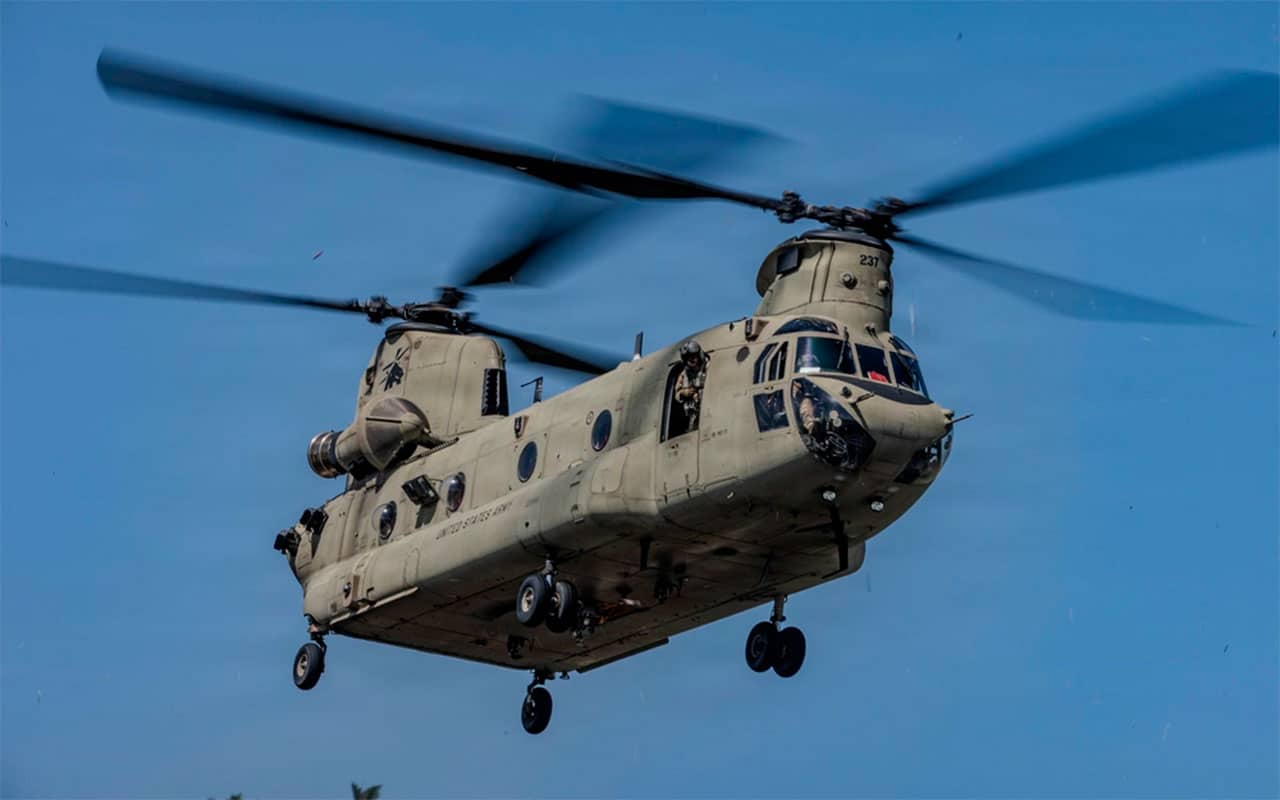
Videos and messages circulating on social media have turned actual aircraft sightings into a political assumption lacking solid evidence. According to information analyzed by DIVERGENTES and reports from specialized publications, the reported air activity coincides with regional cooperation operations whose objectives and timelines have been published by U.S. military sources.
The official record comes from Joint Task Force-Bravo (JTF-Bravo) of the U.S. Southern Command (SOUTHCOM), headquartered in Honduras, which indicates that two HH-60s and one UH-60 Black Hawk from the 1st Battalion, 228th Aviation Regiment departed from Soto Cano Air Base on March 8, 2026, bound for Base Aeronaval Cristobal Colon, in Panama.
According to press releases, the official objective was to provide medical evacuation (Medevac) support during the Jungle Operations Training Course-Panama. Far from being a tactical operation, the mission formally concluded on March 26, 2026. On that day, the course graduation ceremony took place—an event documented by the Pentagon’s Defense Visual Information Distribution Service (DVIDS) and shared by SOUTHCOM.
In response to an inquiry from DIVERGENTES on Saturday, April 4, Steven McLoud, the Media Relations Officer for SOUTHCOM, confirmed that the aircraft movements recorded between March 27 and April 3, 2026, correspond to “routine regional transit flights” in support of scheduled operations and training exercises.
According to the official response, JTF-Bravo aircraft conduct these authorized flights between Panama, Costa Rica, and Honduras. McLoud emphasized that these flights “were not related to any operation targeting Nicaragua” nor to law enforcement activities in Costa Rica, and stressed that SOUTHCOM conducts all air operations in close coordination with host nations, under agreements that respect their national sovereignty.
Contrary to interpretations on social media, the specialized website Mike Romeo Aviation—whose analysis is supported by other aviation observers in the region—reconstructs the movements based on technical sightings. Alongside this analysis, aviation observer and photographer Cristian Quijano (@crisquijano) accurately documents the aircraft’s passage through Guanacaste Airport (LIR) in Liberia, Costa Rica.
According to these independent records, the technical sequence of the flight was as follows:
- March 27, 2026: Aircraft observers and photographers in Liberia, Guanacaste Province, Costa Rica, confirmed the presence of the aircraft en route to Panama.
- March 28, 2026: User @crisquijano posted on X about the passage of a U.S. Army Boeing CH-47F Chinook helicopter (registration 17-0823, unit 237) in Liberia.
- March 31, 2026: The CH-47F Chinook transports General Francis L. Donovan during his visit to Panama.
- April 1, 2026: Mike Romeo Aviation reports a return technical stop in Liberia by a Black Hawk (registration 02-26962) coming from Panama.
- April 2, 2026: Sighting with GPS location and exact time recorded in the metadata of a Samsung Galaxy S24 Ultra. The Chinook (and the Black Hawks in formation) pass through Pochomil at 1:19 p.m.
Under this technical hypothesis, the helicopters flew from south to north over beach resorts such as El Tránsito, Pochomil, and Poneloya simply because that was the active flight path on that day. According to Mike Romeo Aviation’s post, JFT-Bravo typically alternates between the Caribbean and Pacific routes, depending on weather conditions, making this sighting a procedural event rather than a tactical decision.
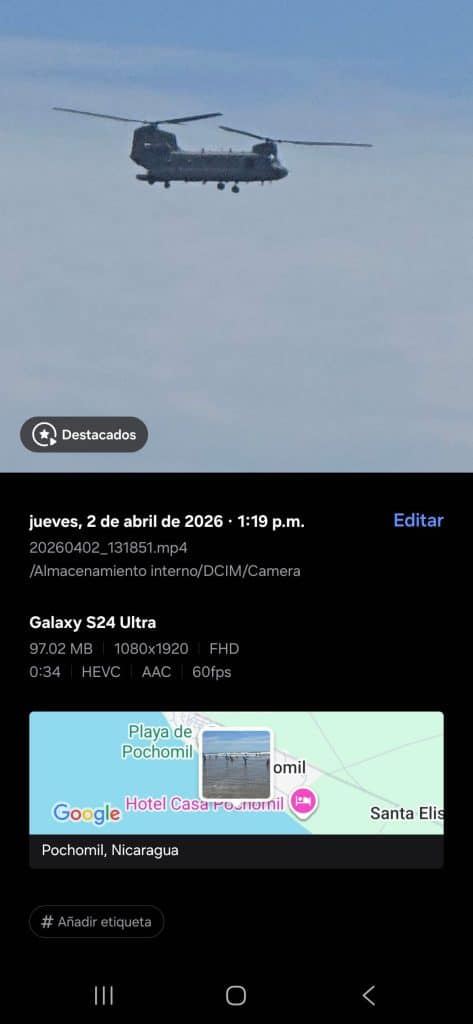
Although several viral posts circulated on April 3, evidence reviewed by DIVERGENTES indicates that at least some of that material was recorded by a user the day before. A screenshot of the original file for one of the videos is dated Thursday, April 2, 2026, at 1:19 p.m. in Pochomil, Nicaragua. This information demonstrates that the posts circulating on April 3 do not necessarily document what happened on that day, but rather reproduce recordings from April 2.
The presence of SOUTHCOM’s commander
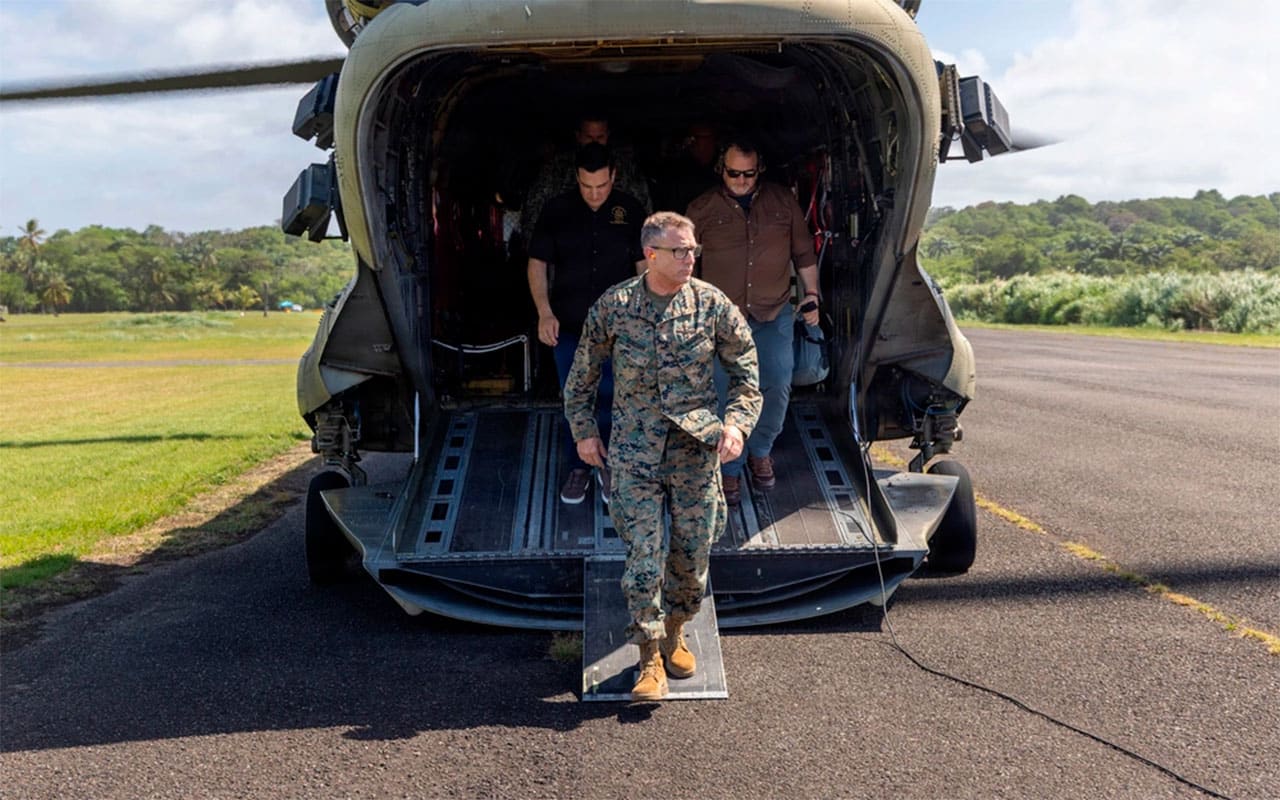
The viral narrative attempted to link the presence of SOUTHCOM’s commander, General Francis L. Donovan, to an alleged surveillance order. However, the timeline and official communications refute that version of events.
Donovan landed in Panama on March 30, 2026, aboard a Boeing C-40 Clipper. The following day, March 31, 2026, a photograph shows the general conversing with the crew of a CH-47F Chinook helicopter during a flight to Base Aeronaval Cristobal Colon.
Public photographs show that Donovan was conducting oversight visits to a previously scheduled bilateral security and cooperation activity in Panama, days after the main medical training had concluded.
The regional context which may have fueled this confusion includes the Southern Seas 2026 deployment, led by the aircraft carrier USS Nimitz, announced on March 23. Although this deployment entails a significant naval presence, its official focus is interoperability with regional allies in SOUTHCOM’s area of responsibility.
Additionally, the U.S. Federal Aviation Administration (FAA) maintains active advisories for the eastern Pacific warning of U.S. military activity in international airspace. These advisories explain why there might be aircraft sightings in the area, but they do not constitute proof of a mission specifically directed against the Ortega-Murillo regime.
Based on the publicly available evidence, it can be concluded that the flights in question were part of a scheduled military logistics operation—involving exchange and medical missions in Panama that have already been completed—and not an operation of political pressure.