

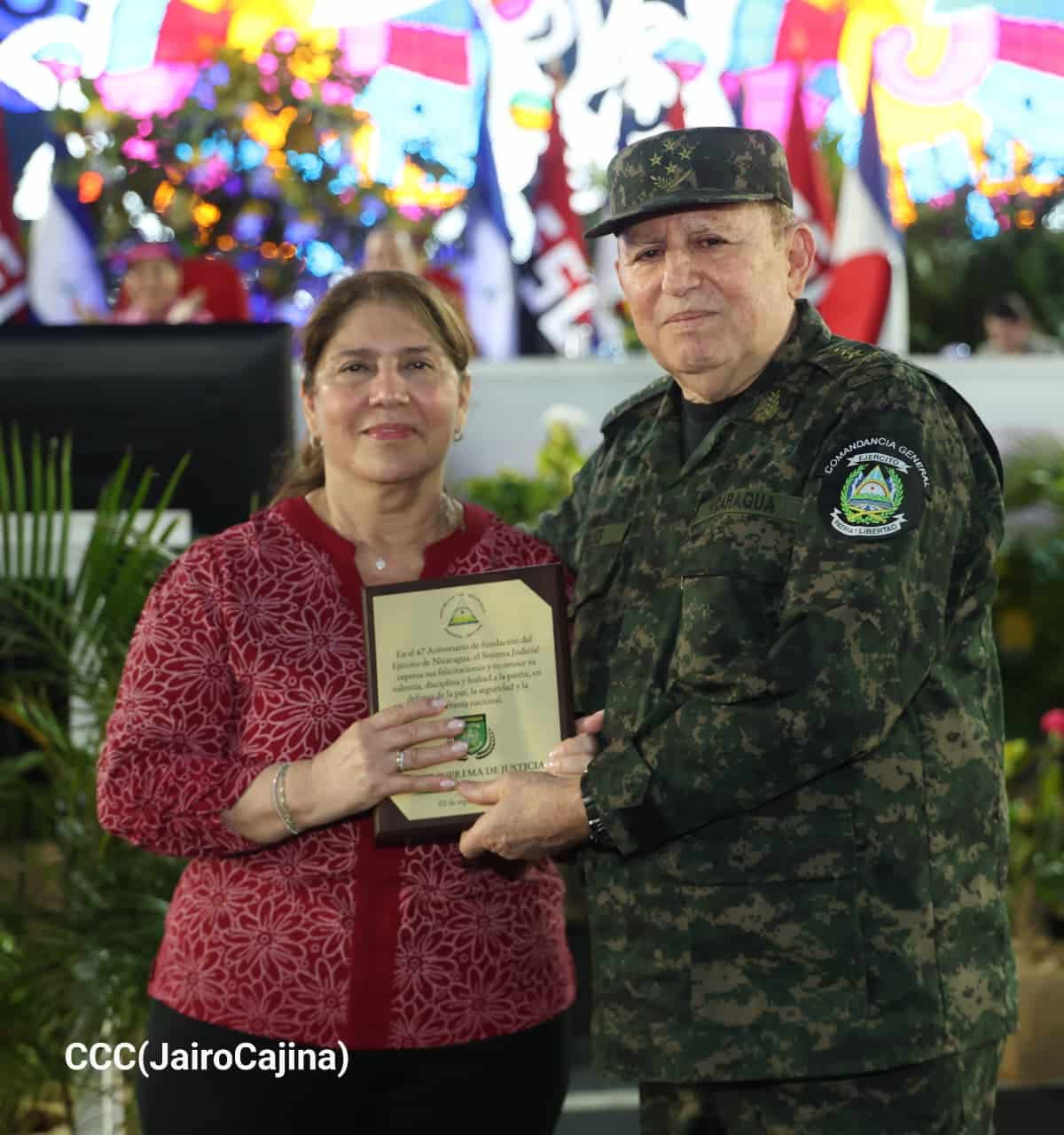
On September 2, Ana Julia Guido walked through Plaza La Fe to present an award to Army General Julio César Avilés. It was a public event in which the heads of state institutions paid tribute to the 47th anniversary of the founding of the armed forces. That evening marked the first time that Guido, dressed in a red blouse and black pants, was introduced as president of the Supreme Court of Justice (or CSJ, its initials in Spanish). After presenting the plaque, she turned to greet Daniel Ortega and Rosario Murillo with a smile.
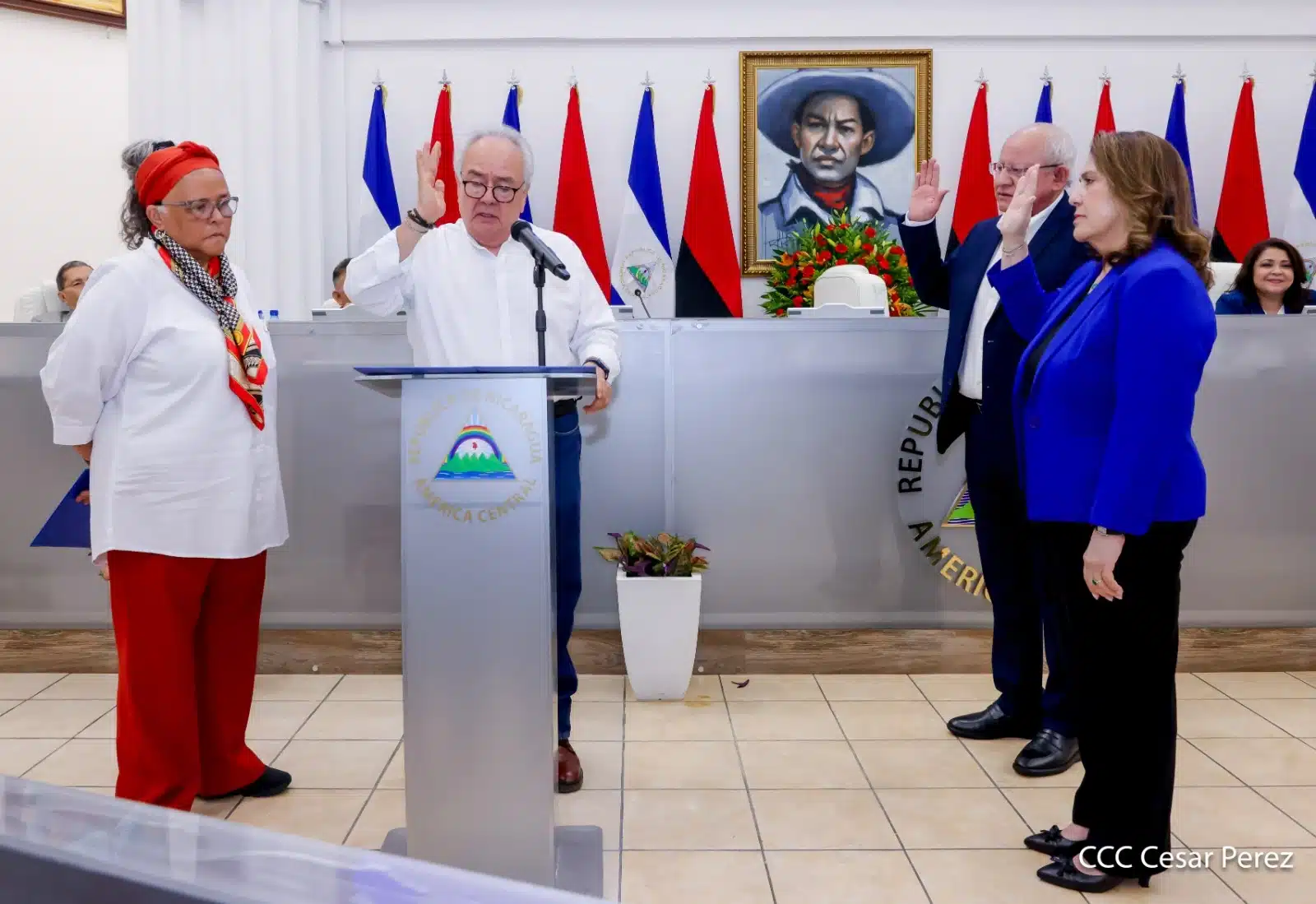
A day earlier, this 67-year-old woman was sworn in as the Court’s new president, 10 months after being elected as a justice, as part of a process of purges and reorganization carried out by Rosario Murillo within the justice system to install her most loyal allies.
Guido assumed the highest position in the judiciary after being accused of leading the prosecutorial apparatus that brought charges against political prisoners following the 2018 protests, according to international organizations. “The Attorney General conveyed political instructions to prosecutors and judges regarding the individuals who were to be prosecuted,” explains a report by the UN Group of Human Rights Experts.
However, in every interview she has given to the regime’s propaganda media, Guido has said she is proud of her Sandinista activism.
The judicial official comes from a countryside family in Matagalpa that supported the Sandinista National Liberation Front’s (or FSLN, its initials in Spanish) guerrilla struggle against the dictator Anastasio Somoza Debayle. As a teenager, she joined the party and participated in several operations, including the raid on a rural branch of the National Bank of Nicaragua in Abisinia, Jinotega, in 1974.
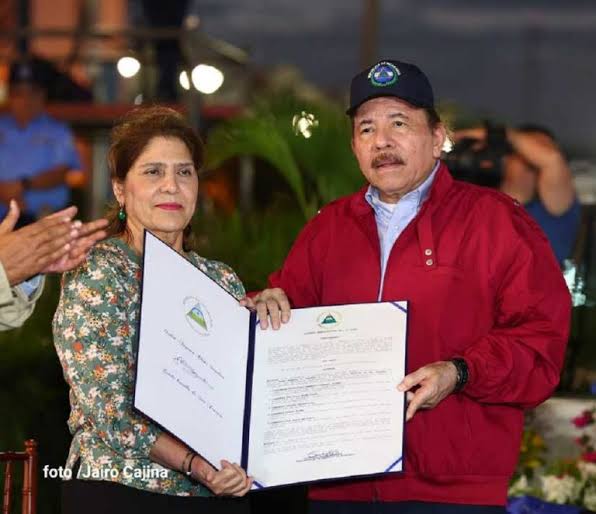
After the victory of the popular uprising in 1979, she was assigned to the Ministry of the Interior, a state agency headed by the party’s founder, Tomás Borge, to maintain public security, monitor, spy on, and carry out attacks against opponents. She later served in the National Police for 27 years; she was nominated by the Sandinista Front itself as Deputy Attorney General in 2006, and in 2014 she was appointed Attorney General. She has been a public official for 47 years, “which is as long as the revolution itself,” she said in the same interview with Canal 8.
The Award for a Key Official in the Repression
In her role as Attorney General, she became a key player in the crackdown on the peaceful protests of 2018. “She helped form a group of prosecutors who collaborated with the Nicaraguan National Police—which has been sanctioned by the United States—to fabricate cases against political prisoners. Furthermore, Guido created a specialized unit that has spent the last two years bringing charges against peaceful protesters,” the State Department stated in October 2020 when imposing sanctions against the current justice. The new president of the Supreme Court has also been sanctioned by Canada, the European Union, the United Kingdom, and Switzerland.
Her appointment as president of Nicaragua’s Supreme Court is seen as a reward for Guido’s loyalty to the presidential couple, for using the Office of the Public Prosecutor as “an accusatory machine” against opponents, according to legal experts and human rights specialists consulted by DIVERGENTES.
“The appointment of Ana Julia Guido serves to reinforce that segment of officials loyal to the Ortega-Murillo regime,” said Uriel Pineda, a lawyer with a master’s degree in human rights. “If repression is needed, the Supreme Court of Justice will act accordingly under Guido’s leadership,” he added.
Experts noted that this appointment is also a way to restore Guido’s status within the regime. Following the creation of the Office of the Attorney General—formerly the Procuraduría General de la República (PGR)—in August 2025, the Office of the Public Prosecutor was absorbed into it. As a result, Guido became subordinate to Attorney General Wendy Morales Urbina.
The regime then appointed her as a judge three months later, in November 2025, and she has now been elected president of this state body, “so she wouldn’t feel like she was being sidelined,” according to the lawyers consulted.
They Handed Her the Attorney General’s Office Even Though She Did Not Meet the Requirements
The Office of the Public Prosecutor was created on October 17, 2000, through the Alemán-Ortega pact, a political agreement between the two political leaders: Arnoldo Alemán of the Constitutionalist Liberal Party (or PLC, its initials in Spanish)—the ruling party at the time—and Daniel Ortega of the Sandinista National Liberation Front (FSLN)—the opposition party. The pact involved the sharing of power across all state institutions.
As part of that pact, Julio Centeno Gómez, a PLC loyalist, was appointed Attorney General, while Ana Julia Guido, of the FSLN, was elected Deputy Attorney General. However, Guido did not meet the requirements for that position. Specifically, she had not practiced law for at least 10 years, as required by the Constitution for appointment as Attorney General or Deputy Attorney General.
Legal expert Juan Diego Barberena, who has conducted investigations into the Office of the Public Prosecutor, stated that Guido was appointed Deputy Attorney General as a result of the Alemán-Ortega pact—a Special Commission of the Assembly ruled that she met the legal requirements—but this appointment is null and void because she does not meet the qualifications for the position, which require 10 years of practice as a lawyer.
Guido earned her law degree from the Central American University (or UCA, its acronym in Spanish)—which was seized by the regime in 2023—in 1994 and a master’s degree in Criminal Law and Criminal Procedure from the same university in 2001. However, during that time—for 27 years (between 1989 and 2006)—she was a member of the National Police, where she rose to the rank of Deputy Director. The point is that the Police Code of Ethics prohibited police officers from practicing law or serving as notaries, so Guido never practiced as a lawyer.
“The appointment is null and void and, therefore, she does not meet the requirements to serve as a justice of the Supreme Court of Justice. Her career as a lawyer was suspended while she was with the police and the Attorney General’s Office,” Barberena stated.
The FSLN Began Exerting Control Over the Office of the Public Prosecutor in 2007
The report by the Interdisciplinary Group of Independent Experts (or GIEI, its acronym in Spanish)—appointed by the Inter-American Commission on Human Rights (IACHR) to investigate the acts of violence that occurred in Nicaragua between April 18 and May 30, 2018— concludes that “the policy of control exerted by the FSLN over the Office of the Public Prosecutor, which initiated in 2007 with her election by the National Assembly as Deputy Attorney General, resulted strengthened by her appointment.”
“Her affinity with the national government has materialized in concrete decisions and administrative acts motivated by political reasons,” states the GIEI, citing as an example the decision to effectively eliminate public competitions for selecting officials of the Office of the Public Prosecutor. This allowed individuals with ties to or affinity for the FSLN to enter the institution. “The internal structure of the Office of the Public Prosecutor was accordingly compromised,” the document adds.
Once appointed Attorney General, Guido began a process of reassigning prosecutors who were not affiliated with the FSLN. However, the situation took on greater significance in April 2018, when she launched a political crackdown against independent and professional prosecutors, who ultimately resigned from their posts.
Although her four-year term in office expired in 2018, Ana Julia Guido remained Attorney General—without having been elected—under a constitutional provision approved in 2014, which stipulates that officials shall remain in office after their terms expire until their replacements are appointed.
Guido’s Children and Close Friends Working at the Office of the Public Prosecutor
During her 11 years as head of the Office of the Public Prosecutor, Guido surrounded herself with former police officers. For example, Deputy Attorney General Julio César González Sandoval was a Senior Commissioner, while Inspector General Douglas Roberto Vargas Flores was a captain in the National Police.
Vargas was the magistrate’s “longtime protégé,” according to sources at the Office of the Public Prosecutor. The Inspector General’s wife, daughter, and son-in-law worked at the Office of the Public Prosecutor until 2020. This was incompatible with the regulations of the Civil Service and Administrative Career Act, which required that public servants “not be related by blood up to the fourth degree or by marriage up to the second degree to the hiring authority or the authority making the appointment.”
Sources at the Office of the Public Prosecutor stated that at each of the institution’s departmental offices there was a political secretary for the party who was not necessarily the departmental prosecutor. Generally, local prosecutors hold positions within the party’s structures. In Managua, for example, Guido instructed officials to carry out political duties in their neighborhoods, within the Citizens’ Power Councils (CPC) or Sandinista Leadership Councils (or CLS, its initials in Spanish).
As part of this co-optation effort, Guido appointed her son, Camilo Romero Guido, as coordinator of the Managua Departmental Prosecutor’s Office. Camilo is not registered as a lawyer with the Supreme Court of Justice, but sources indicate that he wielded “significant power over prosecutors” throughout the country.
Ana Valeria Romero Guido, another daughter of the current president of the Court, served as her personal assistant at the Office of the Public Prosecutor. Ana Valeria does hold a law degree from the UCA and even taught some classes at that university.
Another close associate, Guiselle Tamara Borge, daughter of retired Commissioner General Fernando Borge Aguilar, was appointed by Guido as prosecutor for District V and coordinator of the Prosecutorial Assistance Centers (or CAF, its acronym in Spanish) at police stations in Managua. Guido would use this entire network during and after the 2018 protests to repress and imprison activists and members of the opposition.
The current head of the Court was included on a list of 54 individuals responsible for violations and crimes in Nicaragua since 2018, in a report published on April 3, 2025, by the UN-established Group of Human Rights Experts on Nicaragua.
The report notes the “lack of independence of the judiciary and of prosecutorial autonomy.” The experts gathered information on how Ortega and Murillo issued orders—either directly or through Néstor Moncada Lau, the presidential advisor on security and intelligence—to the then-Attorney General, Ana Julia Guido, and the Inspector General of the Office of the Public Prosecutor, Douglas Vargas Flores, to oversee coordinated investigative efforts between police and prosecutors in Managua and other departments across the country.
How the Cases Were Fabricated
To prepare reports containing the evidence necessary for a specific criminal charge, police investigators worked with the prosecutors in charge of the cases. Consequently, both Guido and Vargas formed a small group of prosecutors, led by Javier Antonio Morazán Chavarría, head of the Organized Crime Unit, which met within the Office of the Public Prosecutor.
“Javier Antonio Morazán Chavarría, received directives for the construction of these fabricated cases that led to further confiscation, under the supervision of Ana Julia Guido Ochoa and Douglas Roberto Vargas Flores,” the report states.
A source from the UN Group of Experts explained that this Organized Crime Unit was meeting secretly with high-ranking police officials. “They were tying up the cases and along the way they were capturing people from the marches, people who participated in the networks, social and political leaders. The Morazán office was key to this,” the source added.
Attorney Juan Diego Barberena maintained that this unit was the one that became active starting in 2018 to bring charges for political crimes. “The person who structures the entire framework of criminal prosecution, under Guido’s orders, is Javier Morazán,” stated Barberena, who conducted an investigation into the matter.
Morazán was a prominent prosecutor who was brought in by former Attorney General Julio Centeno Gómez and even received recognition in 2013 from John Kerry, U.S. Secretary of State under Barack Obama, for his work in the fight against human trafficking.
The group led by Morazán in the Attorney General’s Office worked in a special office alongside the team from the National Police’s Judicial Assistance Directorate, particularly with the departments of Narcotics, Violent Crimes, Cybercrimes, and Special Crimes, as well as the Control Registry of the Directorate of Firearms, Ammunition, Explosives, and Related Materials, and the National Police’s Institute of Criminalistics and Forensic Studies. All were tasked with producing incriminating evidence, according to investigators.
“This work included the preparation of ballistic expert reports, crime scene inspection reports, and recognition of persons, searches and seizure of computer equipment and other personal belongings. It also included the extraction of digital information and the creation of false profiles and social media posts, false testimonial and documentary evidence and other elements used as a basis to support accusations against persons opposed or perceived as such,” the investigation details.
Before the Law on the Defense of the People’s Rights to Independence, Sovereignty, and Self-Determination for Peace was passed in 2020, the regime classified political cases as common crimes. As a result, political prisoners were no longer charged with crimes such as “terrorism” but instead with “treason” or “undermining national integrity.”
On September 3, in an interview with Canal 4, the judge said that after 2018, the regime had to amend laws—such as the Cybercrime Law, the Law Against Organized Crime, the Anti-Money Laundering Law, and amendments to the Penal Code—“to protect the State and the Nicaraguan people.” Guido said that protesters committed “acts of terrorism” and actions intended to “undermine the Constitution,” which were not provided for in the laws. Consequently, laws were amended and penalties were toughened, the official stated.
According to the UN report, under Guido’s orders, assistant prosecutors—who were not involved in the cases—were required to sign indictments and defend them. Trusted prosecutors were appointed to preside over hearings in politically sensitive cases, and this even triggered a wave of resignations among prosecutors, as they were forced to sign indictments they were unfamiliar with. Prosecutors went so far as to file arrest warrants containing false information or omitting details such as the date of arrest, for example.
Attorney Uriel Pineda explained that the Office of the Public Prosecutor was “a decisive repressive link” within the political and legal framework beginning in 2018.
Pineda believes that Guido’s appointment means the Ortega-Murillo regime will continue its repression and concentration of power. “The message being sent is that the regime will do whatever it takes to remain in power,” he said.
Guido: “It Is Necessary to Confront and Curb Misinformation Originating From Abroad”
On August 25, on behalf of the Court, Ana Julia Guido endorsed the constitutional reforms aimed at eliminating political competition in Nicaragua. That day, she stated that to ensure the will of the people is expressed freely and without external conditions or influences, “it is necessary to confront and curb misinformation originating from abroad that seeks to interfere in internal affairs and create conditions of destabilization.”
The justice said that “defense today extends to cyberspace” and that the digital transformation requires strengthening cybersecurity and digital sovereignty “in the face of information manipulation and the misuse of data and technologies for the purpose of political influence, thereby protecting our electoral processes from external interference.”
The justice added that artificial intelligence and algorithmic targeting pose new challenges, “by enabling the influencing of public opinion and electoral behavior, thereby presenting new challenges for the protection of the sovereignty of democratic processes and the free formation of the electorate’s will.”
The appointment to head the Court is no minor position. Even after the constitutional reforms pushed through by the regime over the past two years—which downgraded the Court from a branch of government to a mere state body—it retains decisive powers within the political system.
Attorney Juan Diego Barberena explained that the judicial system “still holds the keys” to the rest of the state’s institutions. For example, it could declare the laws passed by the regime unconstitutional.
“If at any point there were to be a political transition in Nicaragua, the judiciary has sufficient capacity to become a key instrument of a new government by declaring all the laws passed by the regime unconstitutional,” the lawyer analyzed.
Ortega and Murillo needed someone loyal and willing to carry out their orders in a key state body, according to the experts consulted. The person who has embodied this loyalty for nearly half a century is Ana Julia Guido.