
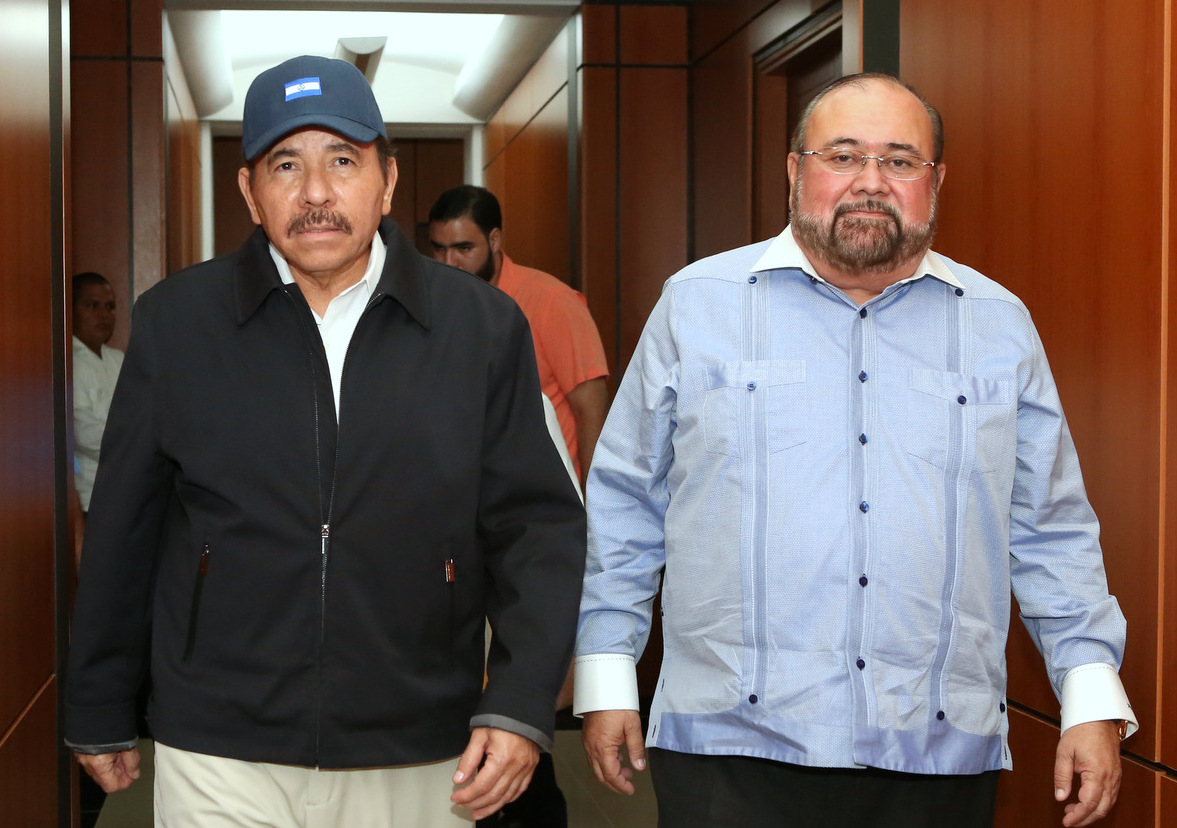
Héctor Mairena, 66, was stripped of his Nicaraguan citizenship and disbarred between February and May 2023. He does not recognize either of the two rulings by the Supreme Court of Justice as legitimate because, according to him, Daniel Ortega and Rosario Murillo’s dictatorship “manipulates the laws, interprets them as it pleases, and twists them to suit its purposes.”
Daniel Ortega’s control over the judicial system has allowed him, since he came to power in 2007, to carry out de facto actions and then turn them into laws, even elevating them to constitutional status. An example of this is the arbitrary application of legal retroactivity, both in statutes and in constitutional provisions, according to attorneys consulted by DIVERGENTES.
“The regime ensures that all laws are applied in a way that serves its interests,” analyzed Héctor Mairena.
The discretionary use of retroactivity was demonstrated when the Ortega-Murillo regime asserted that the amendments to Articles 23 and 25 of the OrMu Constitution—which provide for the automatic loss of Nicaraguan nationality for citizens who have acquired a second nationality—are not retroactive.
This report traces the major milestones at which the Ortega-Murillo dictatorship has applied laws retroactively to serve its political interests.
What Is Legal Retroactivity?
Legal retroactivity is the application of a new rule, law, or provision to events or acts that occurred before it took effect. Generally, laws are not retroactive: they apply prospectively and to events that occurred after they took effect. It is a principle that protects legal certainty and ensures that individuals will not be judged by rules that did not exist when they committed their acts.
However, there are exceptions when a law may be applied retroactively: when it expressly provides for such application and does not infringe upon fundamental rights, or, in criminal matters, when it benefits the defendant (if a new law reduces the penalty for a crime or decriminalizes a conduct, for example).
Attorney Juan Diego Barberena explained that, in the case of constitutional provisions, these “are retroactive by nature.” Barberena added that the principle of non-retroactivity applies to laws, not to the Constitution, because “the law is a normative category subordinate to the Constitution.”
Barberena argued that if the Constitution did not have retroactive effect, it would cease to be the supreme law. “Constitutional provisions are retroactive; they will always govern the past,” he added. However, he argued that the Ortega-Murillo regime has applied certain legal provisions for political purposes.
Legal scholar Uriel Pineda, who was stripped of his Nicaraguan citizenship and disbarred in Nicaragua, said that the Constitution has a repealing effect on the provisions it addresses. “The Constitution is retroactive in some cases, but not in the way the Ortega-Murillo regime has implemented it,” he noted.
Dual Citizenship
In May 2025, the regime announced that the right to dual citizenship would be eliminated, sparking uncertainty and discontent among broad sectors of the population.
In a country where people fear speaking out freely due to the risk of reprisals, Nicaraguans expressed their opposition and dissatisfaction on social media. They feared that, if the reforms were applied retroactively, thousands of citizens who had acquired other nationalities would lose their Nicaraguan citizenship and the rights that come with it.
Days later, Sandinista deputy and National Assembly President Gustavo Porras attempted to mitigate the situation by assuring that the reforms—which had been approved during the first legislative session—would not be retroactive and would take effect upon their approval during a second legislative session, which took place on January 14, 2026.
“The law is not retroactive—that’s the first point—and second, the Constitution stipulates that until the law takes effect—and this particular law, in this case—dual citizenship will be preserved from that point forward for those acquired up to that moment; thereafter, it is up to each individual to make the decision,” Porras said on May 21, 2025.
According to this argument by the ruling party, constitutional provisions are not retroactive—that is, they apply from the moment they take effect. However, the regime often applies constitutional norms de facto to serve its repressive agenda.
There are even cases in which it has implemented de facto measures to repress opponents and has used retroactivity “maliciously,” such as in the revocation of citizenship.
Ortega’s Spurious Reelection in 2012
Denationalization has not been the only measure in which legal retroactivity has been used to the regime’s advantage. Daniel Ortega’s reelection in 2012 was achieved thanks to a court ruling that nullified Article 147 of the Constitution, which prohibited consecutive presidential terms and limited the total number of terms to two. Once the Sandinistas gained control of the National Assembly, they passed a constitutional amendment to modify the article and formally allow reelection.
One of the most recent cases of the retroactive application of legal provisions is the revocation of citizenship for 222 political prisoners who were exiled to the United States in February 2023.
Days later, the measure was also applied to 94 people in exile. To carry out the denationalization, the courts of the then-Judiciary issued a series of rulings based on Law 1145, which regulates the loss of nationality, and amended Article 21 of the Constitution. This was approved through a constitutional amendment during the first legislative session.
According to the Nicaraguan Constitution, any partial amendment must be approved by two legislative sessions to take effect. In this case, the regime carried out the revocation of citizenship with approval from only the first legislative session.
Nicaragua had no amendment that legally authorized the revocation of citizenship. It was not until January 22, 2024—one year later—that the regime amended Article 21 of the Constitution to allow for the revocation of citizenship from those it considers “traitors to the homeland.” In other words, a measure was applied to these individuals that was not provided for when Law 1055 on treason was passed in 2020.
For Uriel Pineda, these actions by the Ortega-Murillo regime undermine the country’s legal certainty. “This means that the law is not the primary means of resolving a crisis or a situation, but rather obeys the political will of a regime that does not even adhere to minimum legal formalities,” he added.

The Case of Agustín Jarquín Anaya in 2013
Pineda noted that this has been Ortega’s modus operandi since he returned to power in 2007: “First they commit acts that amount to arbitrary conduct, and then they adjust the law.”
Before 2018, one of the most emblematic cases was that of Agustín Jarquín Anaya, a Sandinista Front congressman who was stripped of his seat for leaving his party’s caucus and declaring himself an independent in 2013.
The Supreme Electoral Council (or CSE, its initials in Spanish) revoked his congressional credentials on the grounds that he had “betrayed the mandate of his constituents” and that the seat belonged to the party or alliance that had nominated him. However, at that time, there was no law establishing that changing caucuses or parties was grounds for removal as a congressman.
Jarquín filed several appeals for constitutional protection, but they were rejected, including the final decision by the Constitutional Chamber of the Supreme Court of Justice—which is also controlled by the ruling party—on November 27, 2013.
In January 2025, the Inter-American Commission on Human Rights (IACHR) brought this case before the Inter-American Court of Human Rights (IACHR Court). The IACHR concluded that the CSE’s decision violated several rights protected by the American Convention.
Violations of the Principle of Nonretroactivity After 2018
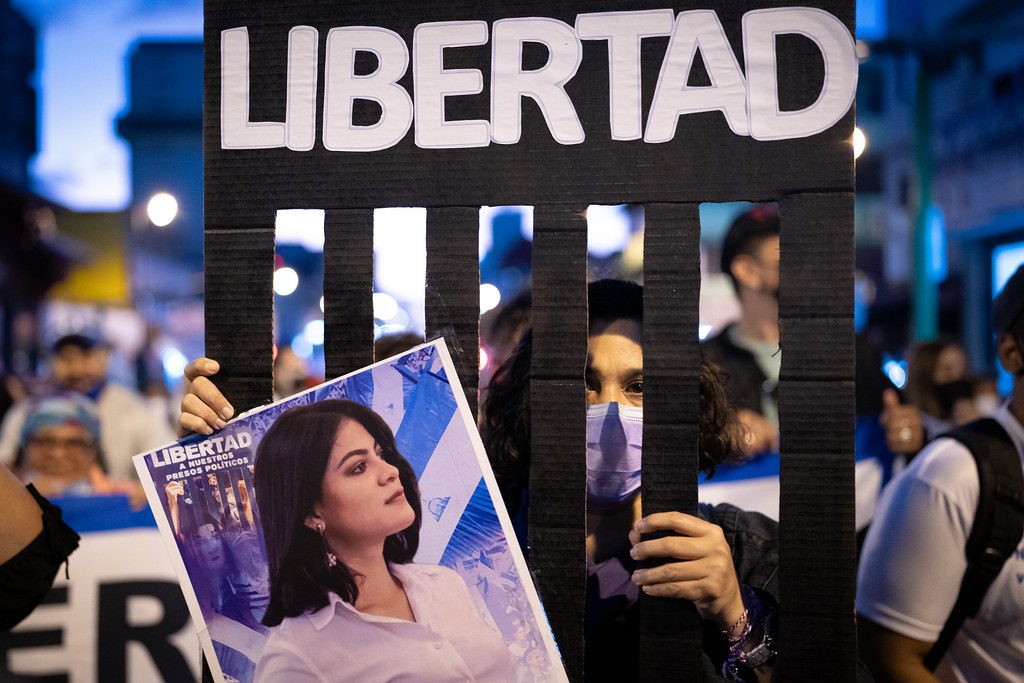
Following the crackdown of 2018, violations of the principle of nonretroactivity became even more evident. For example, in the application of the laws on Foreign Agents, Treason, and Cybercrimes—enacted between 2020 and 2021—to acts committed by opposition members in 2018 or even earlier. In various trials against political prisoners, the Prosecutor’s Office presented alleged evidence of acts these individuals committed years before the laws took effect.
Another example is the dissolution of more than 5,600 nonprofit organizations (NGOs), whose assets were also confiscated under laws passed in 2020 and 2022 that penalized alleged omissions that occurred decades ago. Many of these organizations were accused of “failing to report their financial statements for periods ranging from 1 to 35 years.”
Héctor Mairena, a lawyer in exile, explained it simply: in Nicaragua, there is a regime that controls both the body responsible for passing laws—the National Assembly—and the body responsible for enforcing them—the Supreme Court of Justice. “Both of these state bodies process and carry out the political decisions of the Ortega-Murillo family,” he stated.