
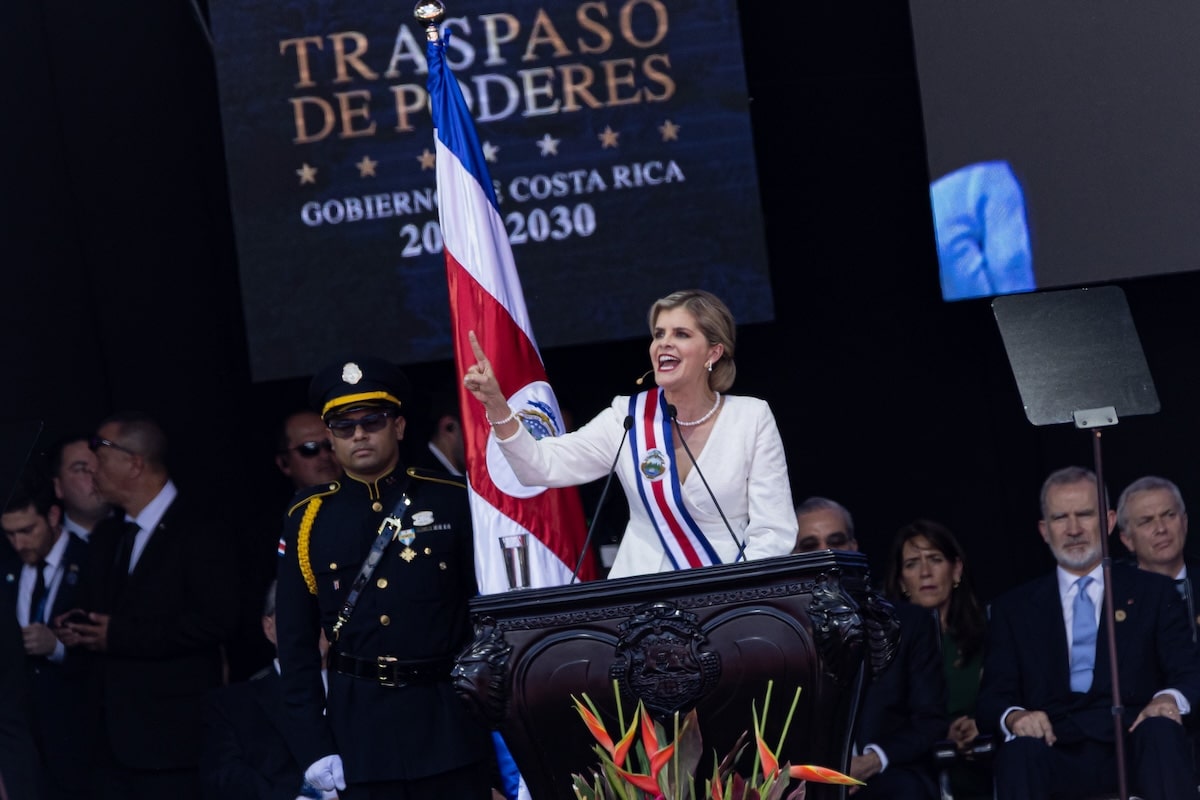
The statements by Costa Rican President Laura Fernández regarding Daniel Ortega and Rosario Murillo’s regime have not only sparked controversy and outrage among Nicaraguans but also contradict the critical stance toward Managua held by her primary and powerful ally: the United States. While the president asserted that Nicaragua has the “government it has chosen to have,” with which it maintains a “harmonious” relationship, Secretary of State Marco Rubio emphasized that the co-presidential regime constitutes “a challenge to hemispheric stability.”
Against a backdrop in which President Donald Trump’s administration—which is extremely close to the Chavista political project now led by Fernández—has imposed sanctions and visa revocations on Sandinista officials, the president’s statements to the NTN24 network have been disconcerting. For Manuel Orozco, a researcher at the Inter-American Dialogue, the remarks reflect “political amateurism for failing to prepare her meeting with the support of foreign service staff.”
Orozco points out that Costa Rican officials in foreign policy, intelligence, and trade “are well aware of Nicaragua’s nature as a dictatorship and how to deal with the country: with distance, without conflict, with better protection of the sovereignty and human security of Costa Ricans and refugees, but without flattery.”
“The immediate reaction, as a very influential Costa Rican figure put it, is ‘second-hand embarrassment’ in the face of such an unexpected political blunder by a leader in the country’s history,” remarked the political analyst.
Orozco is referring to former President Luis Guillermo Solís, who criticized Fernández’s statements on social media. But other former leaders also spoke out. One of the most vehement was Laura Chinchilla, who publicly apologized to “our sisters and brothers in Nicaragua” for what she called the president’s “atrocious statements.”
Chinchilla listed Fernández’s errors: she ignored the fact that the Ortega-Murillo regime’s last three reelections were contested by international observers and that, in the most recent one, seven presidential candidates were imprisoned or disqualified; she used the pretext of so-called “economic stability” to cover up more than 350 murders, more than 120 cases of forced disappearance, more than 1,000 detained opposition members, and more than 5,000 shut-down civil society organizations; she ignored the death in custody of Miskito leader Brooklyn Rivera, which prompted statements from the OAS, the State Department, and the European Union.
Chinchilla also questioned Fernández’s reference to God in Nicaragua. The president concluded her remarks with “God be with Nicaragua,” which the former president interpreted as an exoneration of dictators, in a country where priests have been imprisoned, religious congregations expelled, and Holy Week processions banned. For Chinchilla, there are only two possible explanations for these statements: “ignorance or indifference.” “If it is the former, it brings shame upon the country; if it is the latter, it dishonors our tradition of unequivocal condemnation of tyranny,” she criticized.
No Expected Impact on Relations with Washington
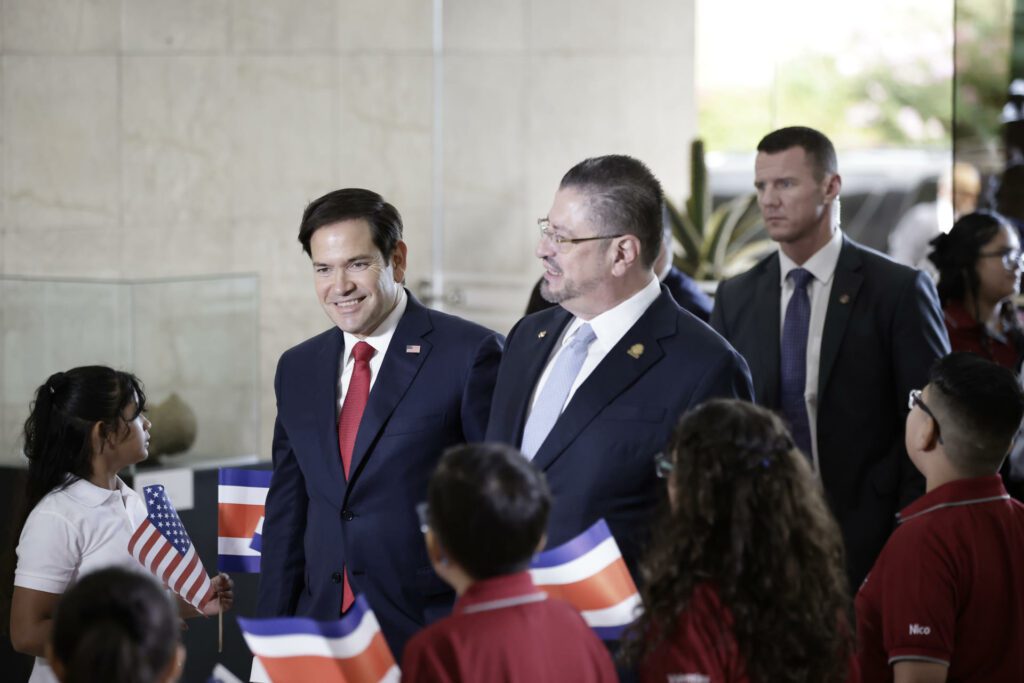
Despite the uproar caused by Fernández’s statements, Orozco dismisses the idea that they will affect Costa Rica’s relationship with Washington. “It was a very ill-advised statement that won’t have any further repercussions, but it did raise some eyebrows,” he says.
The political analyst warns, however, that the bilateral relationship between San José and Washington is facing its own tensions: The United States recently accused Costa Rica of trade irregularities linked to forced labor, and Costa Rican exports fell by 12% in the first four months of the year, primarily in medical devices and electronic equipment.
For Orozco, U.S. foreign policy continues to prioritize four key objectives: containing China, reducing trade deficits, curbing migration, and confronting illiberal forces—among which he includes the Ortega-Murillo regime, whose sanctioned officials have had their bank accounts frozen in 2026.
“In Nicaragua, the co-presidential regime interpreted Fernández’s statements as a victory of its own. However, this does not change how Costa Rica perceives Nicaragua,” explains Orozco. “Fernández may have learned her lesson, or it may simply reflect another characteristic of her approach to politics in the country.”
Fear of a Border Closure?
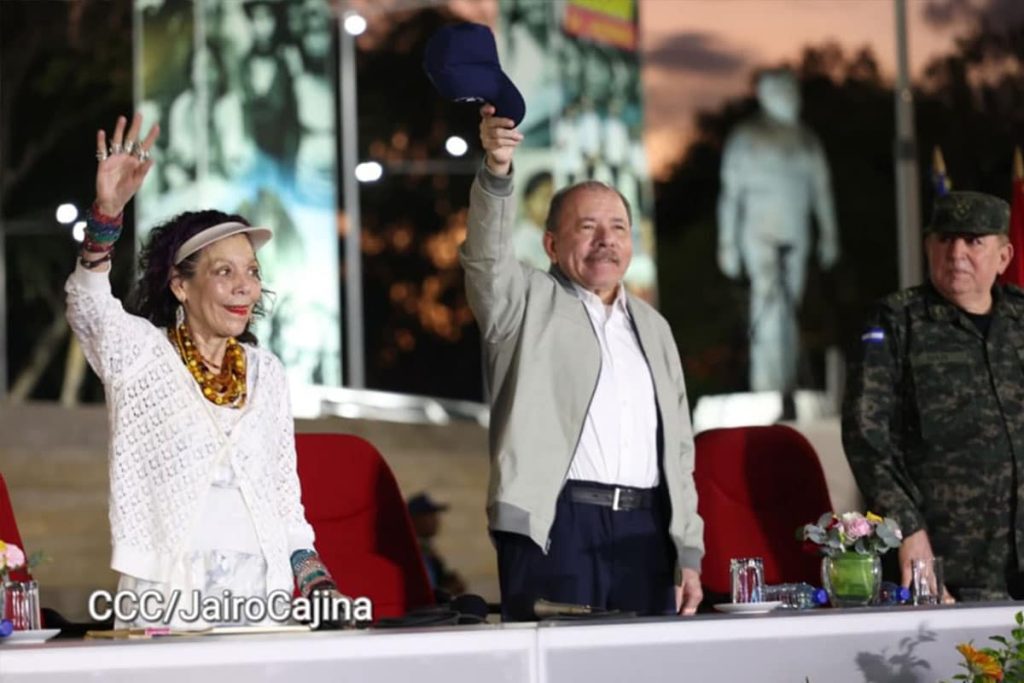
Behind Costa Rica’s caution toward the Ortega-Murillo regime lies a long-standing political calculation. Sources consulted by DIVERGENTES indicate that Costa Rica, particularly under the administration of Rodrigo Chaves, has avoided direct confrontation with Managua for fear that the regime might close the border and disrupt the Central American trade route—a key corridor for the flow of goods among the countries of the isthmus.
For his part, former opposition congressman Eliseo Núñez argues that Costa Rica’s position comes as no surprise. The key, he says, lies in geography and money. For Central America, the passage through Nicaragua is “the equivalent of the Strait of Hormuz for the Middle East”: whoever controls it holds real power over the region’s trade flow. This explains, according to Núñez, what he calls the “conservative” stances of Costa Rica and Honduras—countries where business groups have significant interests in Nicaragua and are unwilling to risk them in the face of a regime that, he warns, “is a real threat in that regard.”
“This makes it clear to us that Central America will not be the main ally in the effort to restore democracy in Nicaragua, because there are too many conflicting interests for us to have confidence that things will go smoothly,” Núñez stated.
The former lawmaker clarifies that he does not view this as a political decision by the governments, but rather as an imposition by business groups with interests in Nicaragua. A pattern that, he says, is repeated beyond Costa Rica: also in Guatemala, El Salvador, and Honduras, where economic ties to the regime carry more weight than any democratic considerations.
Fernández’s statements do not come out of nowhere. Relations between San José and Managua have been deteriorating since the first weeks of her administration. Foreign Minister Manuel Tovar has criticized Russia’s military presence in Nicaragua in international forums and demanded that Europe enforce the democratic clause of the association agreement; the regime rejected Costa Rica’s shortlist of candidates for the SICA General Secretariat, although the Costa Rican candidate was ultimately approved; and the conflict over illegal gold mining along the border persists.