
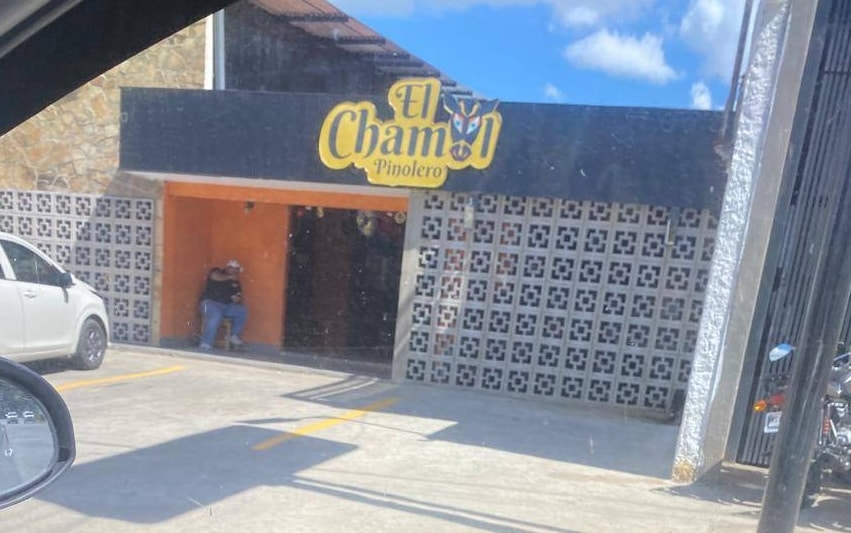
In the backyard of political scientist Óscar René Vargas’s house, where fruit trees once cast a dense shade that provided relief from Managua’s stifling heat, a marimba band now plays in the evenings. Nothing remains of that lush greenery. In its place is a terrace with tables belonging to a restaurant called El Chamol Pinolero, located one block north of the Monte Los Olivos funeral home, in a house confiscated by the dictatorship of Daniel Ortega and Rosario Murillo from this opposition figure, now in exile in Costa Rica.
Vargas’s house was partially demolished and remodeled; the most visible feature is the façade of El Chamol Pinolero: a natural stone wall on the left side and black-and-white decorative panels with a repetitive geometric design on the rest of the façade, resembling ornamental blocks. The restaurant serves traditional Nicaraguan cuisine in a bustling evening atmosphere that stands in stark contrast to the quiet of Vargas’s home before it was confiscated: a peaceful house, with books and armchairs in the living room.
“I don’t know if they sold or rented out the house. All I know is that the house was occupied between May and June 2023,” says Vargas, a political prisoner released from the Ortega-Murillo dictatorship and later exiled. “I know that some unpublished books on the history of Nicaragua in the 19th and 20th centuries that were taken from my library ended up being sold at a used bookstore,” laments the exile.
About four kilometers from the confiscated house now occupied by El Chamol Pinolero in Villa Fontana, the home of former judge Rafael Solís was handed over by the Ortega-Murillo regime to boxer and world champion Román “Chocolatito” González, as confirmed by various Sandinista sources to DIVERGENTES. Next to this residence, the home of Rafaela Cerda—mother of a former official close to the Sandinista leader—was also handed over to Walter Castillo Sandino, who claims to be the grandson of Augusto C. Sandino. Both recipients of the confiscated homes are loyal to the co-presidents.
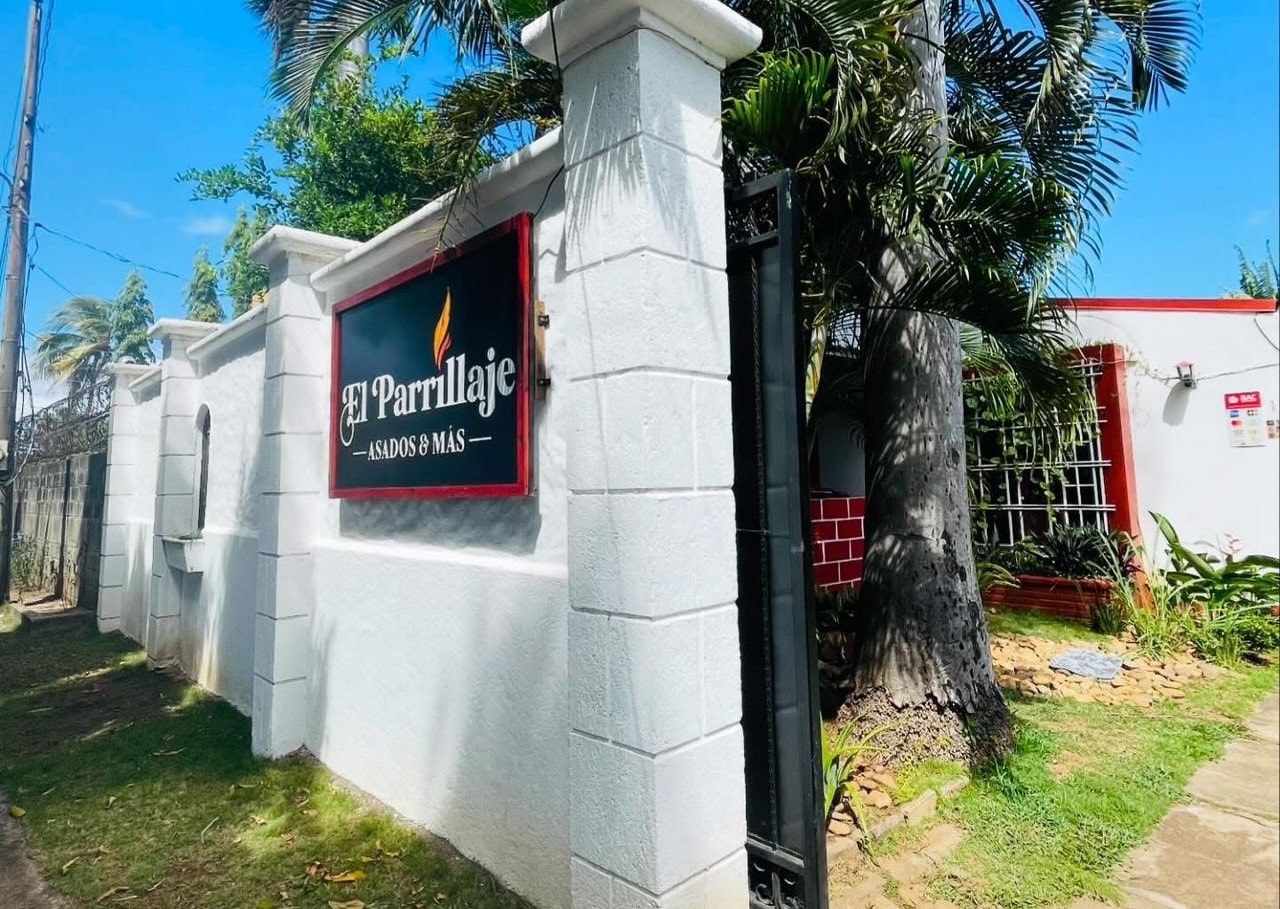
In the house stolen from Solís’s mother, Walter Castillo Sandino opened a restaurant called “El parrillaje, asados & más.” The business is run by the daughter of Sandino’s grandson.
An Asian couple now lives in the house handed over to “Chocolatito,” although it is unclear whether they are renting it or occupying it under a direct arrangement with the boxer. The same sources indicate that Román González “sought a bank loan to make improvements to the property, but the banks denied his request upon discovering that the home had been confiscated from Rafael Solís.” DIVERGENTES attempted to verify the details regarding González’s loan on its own with banking sources, but we received no responses.
The boxer’s attorney, Carlos Blandón, “said he had no information” about how the house was acquired when contacted by DIVERGENTES via telephone.
Confiscations—one of the Ortega-Murillo regime’s main repressive tools against exiled opponents—are entering a new phase: the co-presidents have begun to sell, rent, and distribute the stolen homes. Although the previous Constitution prohibited this type of dispossession, the new legal framework imposed by the Sandinista administration has legalized it. The political crime of “treason” and the resulting revocation of citizenship have enabled the confiscation of property, reviving the dreaded specter of the 1980s: the massive seizure of properties that came to be known as the Piñata.
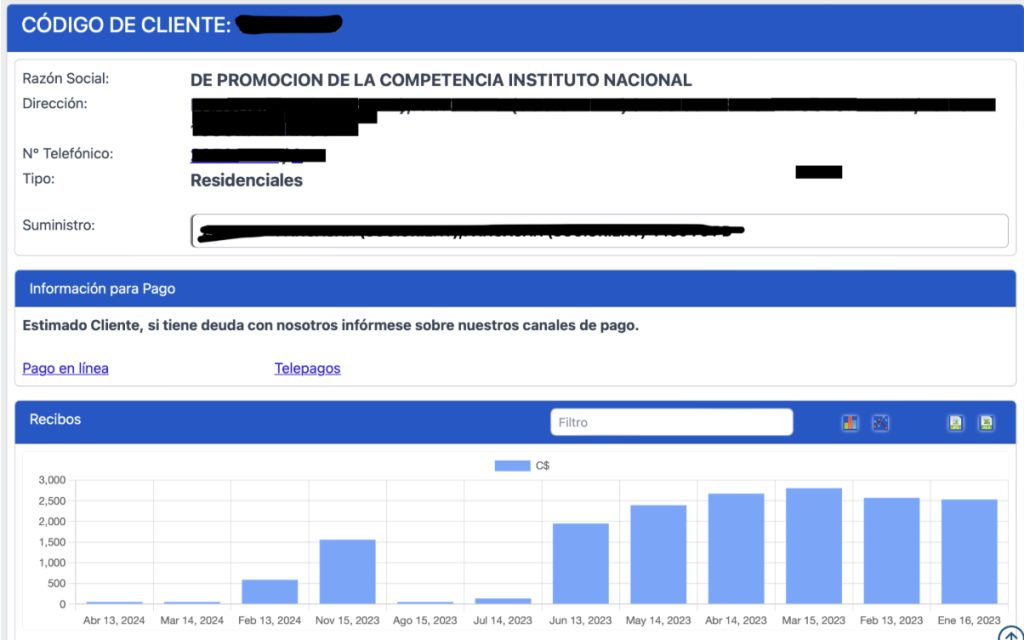
Starting in 2023, the Ortega-Murillo regime began distributing some of the confiscated properties among public institutions. According to the investigation “The Tip of the Iceberg of the New Ortega-Murillo Piñata” by the Observatory for Transparency and Anti-Corruption (or OPTA, its acronym in Spanish), several properties were transferred to the Nicaraguan Social Security Institute (or INSS, its acronym in Spanish), the National Technological Institute (or INATEC, its acronym in Spanish), and the National Institute for the Promotion of Competition (Procompetencia).
The first case in this new repressive phase was the Amazonia Condominium in the San Juan neighborhood of Managua, where journalist Sofía Montenegro and feminist Azahalea Solís lived. Although only the two of them had been stripped of their citizenship, the regime de facto confiscated all 16 apartments in the complex. A month later, the Attorney General’s Office (or PGR, its initials in Spanish) demanded that the tenants already living there pay a monthly rent of $500 if they wanted to stay. They all ended up leaving. Months later, the apartments appeared listed on the Airbnb platform, though they were removed shortly thereafter.
The same pattern was repeated with the media outlets confiscated by the Ortega-Murillo regime. The buildings housing Confidencial and 100% Noticias, seized in December 2018, were transferred to the Ministry of Health (or MINSA, its acronym in Spanish). The building that once housed the 100% Noticias television station now operates as a treatment center for people with alcohol and drug addictions, and the space that used to be the Confidencial newsroom was converted in 2021 into a maternity center that no one uses. The La Prensa newspaper, which was confiscated in August 2021, was handed over to the National Technological Institute (INATEC), which established the José Coronel Urtecho Cultural and Polytechnic Center there.
Homes Confiscated and Sold to the Highest Bidder (or “Sycophant”)
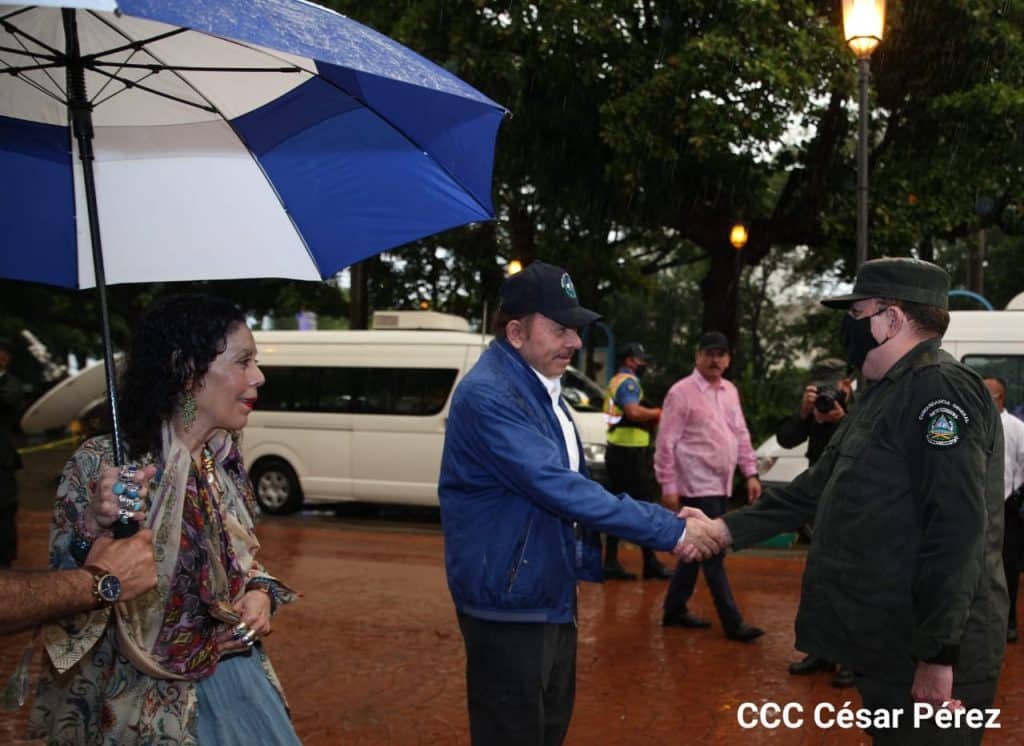
However, in recent months the pattern has changed. The co-presidential regime has put the confiscated homes up for sale or handed them over to the highest bidder or to its “sycophants,” says one of the exiles whose property was confiscated and who requests anonymity.
One of the most emblematic cases of this new phase of confiscations is that of Oswaldo Rivas, a photojournalist with a career spanning nearly 40 years who covered the 2018 protests for Agence France-Presse. The persecution against him began in June 2024, when the police barred him from working at the Granada Cathedral. Later, his home, located at kilometer 11 on the old highway to León, was raided. Police officers seized computers, televisions, bicycles, and vehicles, and his family was ultimately forced into exile. No legal charges have been filed against Rivas.
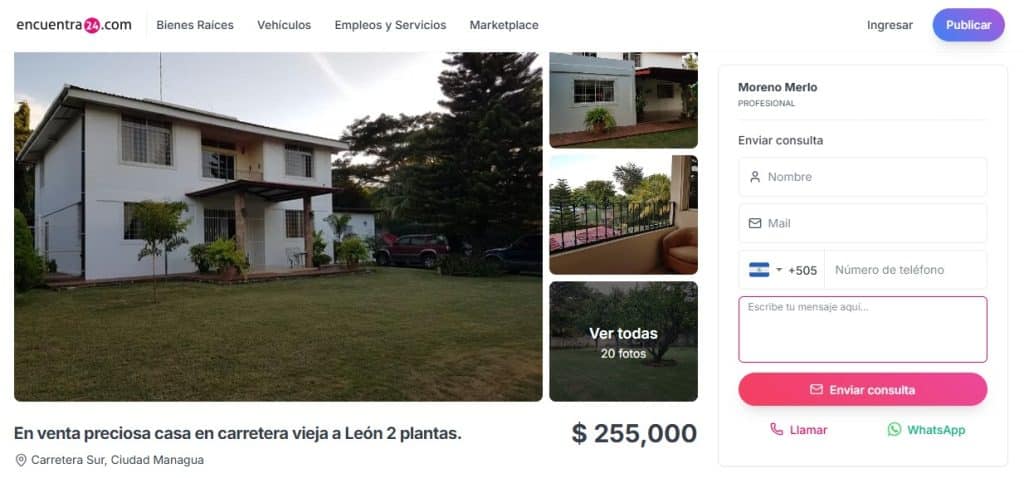
Almost two years later, in May 2026, Rivas found out online that his house was for sale. The listing appeared on the Encuentra24 platform, posted by a real estate agent identified as Moreno Merlo, with a price of $255,000 and the same photos that he himself had uploaded before fleeing the country. His lawyers told him they could not intervene for fear of losing their licenses. The home ended up in the hands of a third party identified as Armando Llanes, whom the photojournalist does not know.
Dr. Anely Pérez Molina, a dermatologist exiled along with her family on March 25, 2023, after being illegally detained and accused of “treason” and cybercrimes, experienced something similar. Her home in the Monte Fresco neighborhood, valued at $750,000, was guarded by the police for two years and appeared abandoned. In May 2026, individuals linked to the regime took possession of it. Pérez reported that everything was left inside: furniture, appliances, a pickup truck, and the only mementos she had left of her father, the Sandinista guerrilla Cristian Pérez, who was killed in the Xiloá massacre in 1979.
DIVERGENTES consulted with other opposition members whose property had been confiscated and confirmed that the properties have been transferred, though it remains unclear whether through sale or politically motivated distribution. We attempted to trace the transfer of these properties through the public registry and other data sources, but there is currently no traceability that reveals the new owners. However, the change in ownership of other confiscated properties was confirmed by checking the NIS numbers with Unión Fenosa. One of those properties belongs to former Sandinista guerrilla Dora María Téllez.
Journalist Patricia Orozco, who is in exile in Spain, said that her home in the El Carmen neighborhood, within the security perimeter of the co-presidential bunker, was demolished almost immediately after being confiscated.
Ligia Gómez, a former official at the Central Bank of Nicaragua (BCN), also confirmed to this publication that her home was handed over to “people close to the dictatorship,” though she did not specify their identities. Human rights defender Gonzalo Carrión stated that “a couple with a child” now lives in his home located at 148 Altos de Nejapa.
“The man in our house walks around armed. That’s all I know. What I’m trying to say is that this is our family home, paid off over a 15-year loan, but now occupied by strangers—people who are, in any case, taking what isn’t theirs. They should have a modicum of decency and not act tough with what they’ve stolen,” Carrión protested.
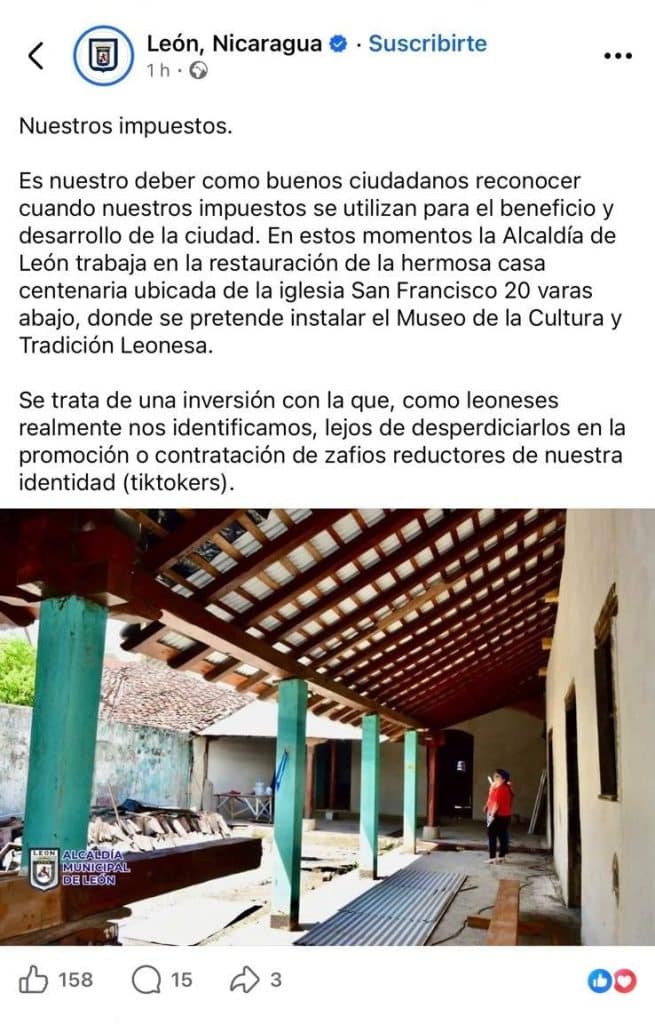
In this new phase, properties handed over to city governments are also being recorded. The City of León announced on its social media accounts the restoration of a “centuries-old house,” located 20 varas from the San Francisco Church, to house the Museum of León Culture and Tradition. The statement does not mention that the property belongs to Nicaraguan scholar Ernesto Medina, who was exiled due to political persecution by the dictatorship, which also stripped him of his nationality.
Journalist and small business owner Henry Briceño was also exiled, secretly, on November 24, 2024, when about twenty police officers arrived at his home in San Rafael del Sur and expelled him from the country along with his family, without a court order and without allowing him to take anything with him. The regime effectively confiscated four properties from him—his home, the Hostal El Central, the Autohotel La Loma, and a house rented in the name of one of his sons—valued at over one million dollars. Forty days later, on January 10, 2025, the government opened a branch of the Cruz Blanca at what had been his primary residence. For Briceño, the speed with which the new institution was established proves that everything was planned: “They were already waiting for the house,” he said.
Stolen Properties Promoted by Influencers
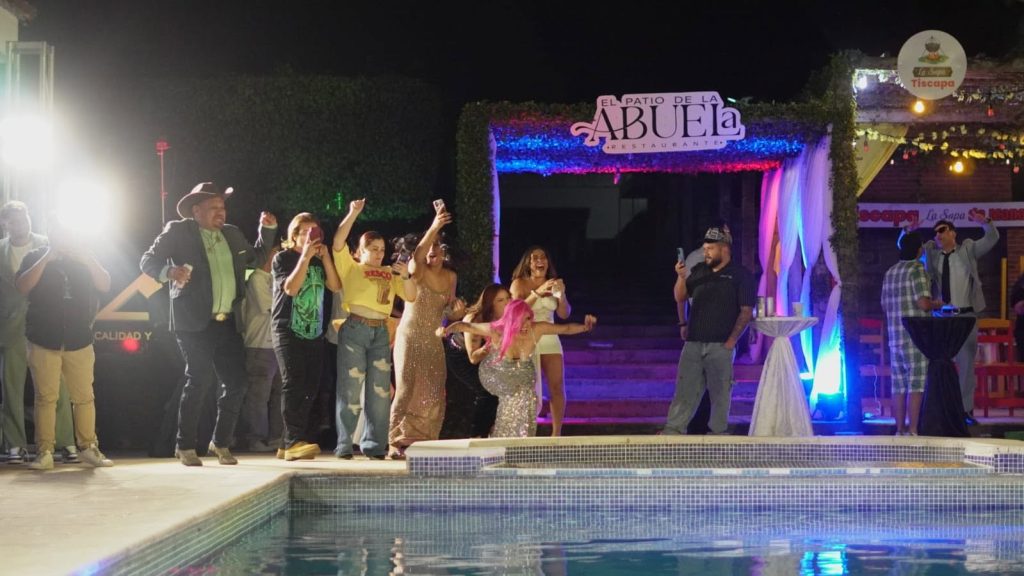
The new wave of confiscations has also reached the regime’s influencers. Japanese TikToker Toshiharu Yamaki, known as Toshi, who has hundreds of thousands of followers, promoted the Hotel Escuela Nicarao in San Juan del Sur in one of his videos.
The hotel operates out of two confiscated properties: the Hotel Casablanca, owned by Rafaela Cerda, mother of former judge Rafael Solís, and the Farallón de Sotavento condominium, built by the Chamorro Barrios family on land inherited from former President Violeta Barrios de Chamorro. Toshi has not been the only one; other content creators have also promoted the place.
Something similar happened with the house confiscated from the Puerta de la Montaña Ministry, an evangelical congregation whose assets were expropriated in December 2023, along with the imprisonment of 11 of its pastors. The house, located in Altos de Santo Domingo and previously used as a “guest house” for preachers and missionaries, served as the setting in May 2026 for the reality show “Proyecto B, La Casa de los Bellacos,” produced by Bellacos Entertainment and broadcast live on social media for two weeks. The congregation’s leader estimated the total value of their confiscated assets at $5 million.
“Do Not Buy Stolen Properties”
Faced with a new wave of sales and auctions of confiscated property, a group of Nicaraguans dispossessed by the dictatorship decided to organize themselves. This is the “April 19” Association of Nicaraguan Confiscation Victims, made up of five affected individuals who have spent nearly five months building a framework to document and, eventually, recover what was stolen.
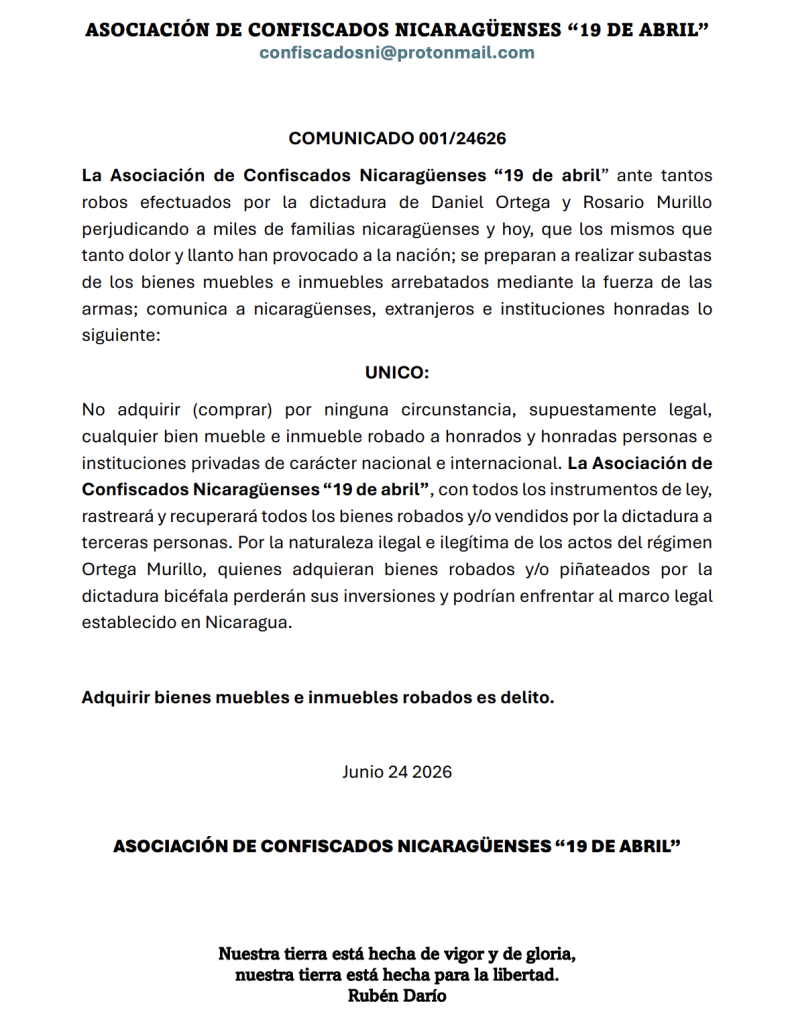
On June 24, the association issued a statement addressed to “Nicaraguans, foreigners, and honorable institutions”: under no “supposedly legal” circumstances should they acquire movable or immovable property that was forcibly seized from private individuals and institutions. They assert that they will track down and recover what was stolen and sold by the dictatorship to third parties, and that those who purchase such properties “will lose their investments.” “Purchasing stolen movable and immovable property is a crime,” the statement concludes.
According to one of the people whose property was confiscated—who is part of the organization and asked not to be identified—the group is already compiling an inventory of what was seized: homes, land, farms, businesses, and media outlets. They are also reviewing cases involving frozen pensions and NGOs with foreign investment. Beyond documenting the dispossession, the association is working on concrete solutions to address the issue in the event of a change in government: the return of assets where possible, exchanges, compensation, and bonds backed by external financing—to avoid repeating the mistakes of the first “piñata” of the 1990s.
The 2024 report by the Observatory for Transparency and Anti-Corruption (OPTA) documented, at that time, the completed confiscation of 135 properties, with a total value of $250 million. The report warned at the time that this figure was merely the tip of the iceberg: the lack of available information and the victims’ fear of coming forward prevented anyone from knowing the true extent of the dispossession. Two years later, with new confiscations, sales, auctions, and transfers to individuals and institutions, the debt that the regime continues to impose on Nicaragua can only have grown.
The United Nations Group of Human Rights Experts on Nicaragua (GHREN) has documented the confiscation of property as part of a systematic pattern of transnational repression against Nicaraguans in exile, along with the arbitrary deprivation of nationality, the refusal to renew passports, and reprisals against family members who remain in the country.
If you have been a victim of a property seizure and would like to share your story, email us at [email protected]