
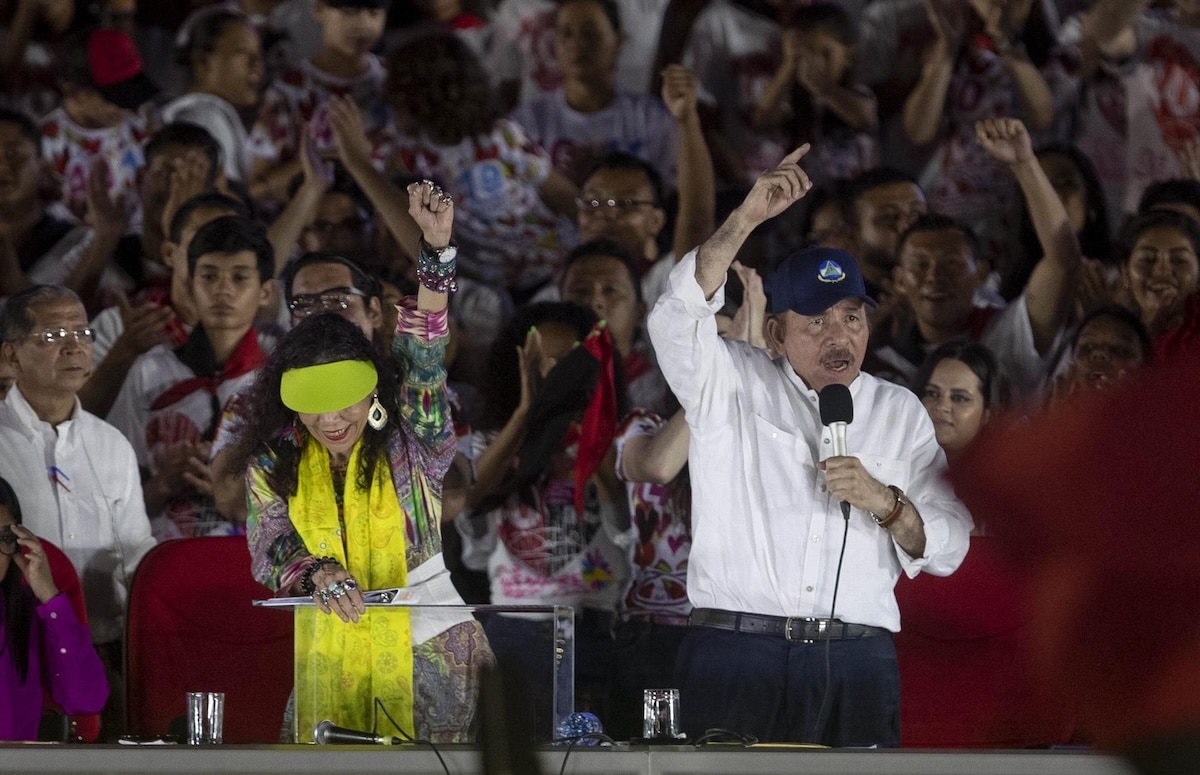
Daniel Ortega and Rosario Murillo’s regime unveiled on Tuesday the constitutional reform plan with which it intends to prolong its hold on power and eliminate elections in Nicaragua: “renewable” seven-year presidential terms, accompanied by legal safeguards to prevent the opposition from challenging their hold on power.
The proposed constitutional amendment was announced by Sandinista deputy and National Assembly President Gustavo Porras, one day after the regime summoned the diplomatic corps accredited in Managua to clarify Ortega’s July 19 order regarding the plan to abolish elections. Speaking before the international representatives, the deputy assured them that elections would indeed take place, but made it clear that the constitutional reform would exclude those whom the Sandinistas consider “coup plotters,” “traitors,” or those directly or indirectly linked to attempts to overthrow the government. This provision already exists in two ordinary laws.
One day after that meeting, Porras read the explanatory memorandum for the reform on the floor of the chamber and revealed a proposal he had not detailed to the diplomats: “Our system of ‘State and People’s President’ proposes terms of office lasting seven years, renewable once, which ensures stability in vision, operations, and continuity.”
The proposal opens the possibility for Ortega and Murillo to remain in power through the renewal or extension of their terms, without necessarily having to go through an election in which other candidates could challenge them for power. However, neither the text of the bill nor the specific procedure by which these “renewable” terms would be implemented has been made public yet.
Juan Diego Barberena, a lawyer and opposition figure in exile, interpreted that the term could encompass the legal mechanism through which the regime intends to abolish elections entirely. “When you extend a term, it means you’re not going to elect the person who will hold that office,” he explained. “You’re simply deciding to extend the term of the person currently holding the office without any competition from others, without any other candidate.”
Guerrilla commander Dora María Téllez interpreted this initiative as “an announcement intended to perpetuate tyranny.” “The terms will be ‘renewable.’ Of course, there’s no reelection because there won’t be an election,” Téllez added.
Reform After Reform
The proposal will once again extend the presidential term, just one year after the 2025 constitutional reform increased it from five to six years. That major reform of the Constitution fundamentally altered the nature of the Nicaraguan state by establishing the co-presidency of Ortega and Murillo and subordinating all state institutions as “bodies” coordinated by the marital executive.
During the meeting with the diplomats, he admitted that the regime was discussing whether to include the presidential term in the reforms. “We have to see whether it can be modified, cannot be modified, or should be modified,” Porras cautioned, adding that he intends to establish a term “that allows us stability, security, and peace.”
“Some countries have a 10-year term; others have a 7-year term. Quite a few countries have a 7-year term. Others have a 6-year term. Still others have a 5-year term. Recently, some countries have extended their terms from 5 to 6 years. We had extended ours from 5 to 6 years in a constitutional amendment last year. And there are countries with 4-year terms, which often become 8 years. It’s like saying 8 but not actually 8—rather, in 4-year increments. In other words, all of these options exist,” Porras explained.
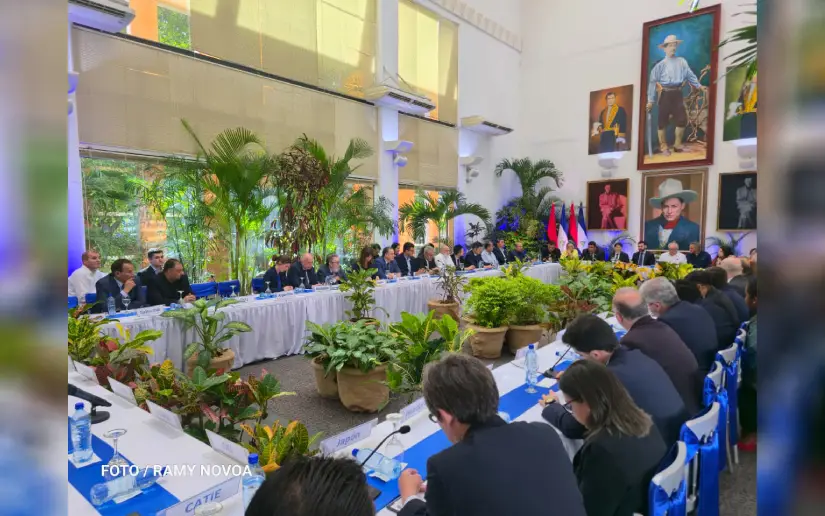
However, the president of Parliament did not specify any timeframe, because they were going to discuss “what is best for Nicaragua.” Less than 24 hours later, he presented this bill, which still leaves several questions unanswered. For now, Parliament has not yet published the constitutional amendment in its entirety, including all its articles.
In practice, the reform will finalize the electoral model that Ortega and Murillo have imposed, especially since 2021, when they arrested all opposition presidential candidates: elections without real competition, with the opposition persecuted, exiled, or disqualified, and with token parties authorized to participate as long as they do not challenge for power or pose a threat to the regime.
The result is the consolidation of a hegemonic party system, in which the Sandinista Front maintains the appearance of electoral pluralism while controlling who can compete, under what conditions, and how far they can go.
Barberena believes that the regime intends to repeat the format of the 2021 elections, albeit in an even more radical manner. “They are going to repeat the scenario—only more radicalized—of the absence of political competition. The dictatorship will play alone,” he remarked.