
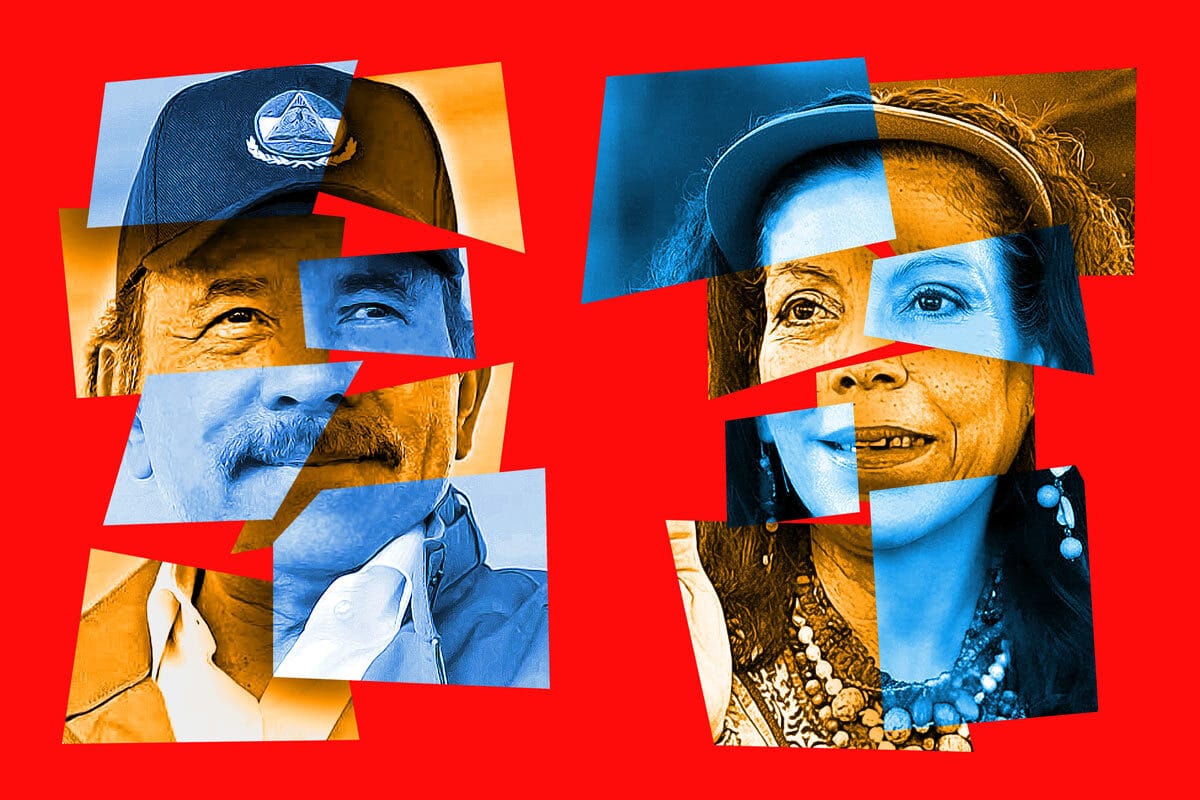
The last time I was close to Daniel Ortega was on January 9, 2012, as he was receiving his credentials as Nicaragua’s reelected president. It was his second consecutive term, and standing beside him was Rosario Murillo, then first lady and coordinator of Nicaragua’s Council for Communication and Citizenship. She was not yet co-president. I was down below, crouched on one of the steps of the main staircase of the Supreme Electoral Council; I was holding my Sony Handycam to fulfill my assignment for that day.
That year, Ortega was 66 and Murillo was 60. “He was still kicking”—as people would say—and so was Rosario; although she always had her eccentric hippie style, both of them looked strong. They weren’t yet those two elderly people who today walk with difficulty every time they appear at a public event. Obviously, the years—and the evil they carry—have taken a toll.
Since then, I haven’t been as close to them as I was that afternoon. I covered the Revolution’s anniversaries from the platform set up about 80 to 100 meters from the main stage, and since 2022, when I had to leave Nicaragua, I’ve only seen them in YouTube broadcasts and the official photographs from every party event.
It is well known that they are both politicians who rarely make public appearances. In one of his most recent prolonged absences, Ortega went 61 days without appearing in public—a record he has set twice—and he has now gone 58 days (as of October 30, when this article was published) without showing his face. These limited appearances mean that the photographic archive of Ortega and Murillo is sparse, limiting us to using screenshots from broadcasts or photos by César Pérez and Jairo Cajina, the official photographers of the co-dictatorial couple.
It’s not that we need to see the co-presidents every day, but the scarcity of recent photographs of Ortega and Murillo poses a challenge when it comes to illustrating articles and reports in the Nicaraguan media in exile and international news agencies. However, in recent months, that challenge has turned into a cause for concern.
A couple of months ago, while browsing social media, I got the impression that the images of Ortega and Murillo made them look younger to me, so I started saving some images posted on Facebook and news websites. Specifically, depictions of the co-presidents, although they aren’t the only figures featured in these images. What’s striking about these illustrations—and I’m sure Hellmut Escobar, our human illustrator, will take offense at my calling them that—is that each image depicts a different Ortega or Murillo. No matter how subtle these facial changes may be, the perception of people exposed to these images can begin to shift.
I’m not talking about the images used by propaganda sites like El19Digital, Multinoticias, Viva Nicaragua, or JP, whose goal is to enhance the public image of the co-dictators. I’m talking about—and analyzing—those published by independent media outlets and journalists in exile to illustrate news stories about Ortega and Murillo.
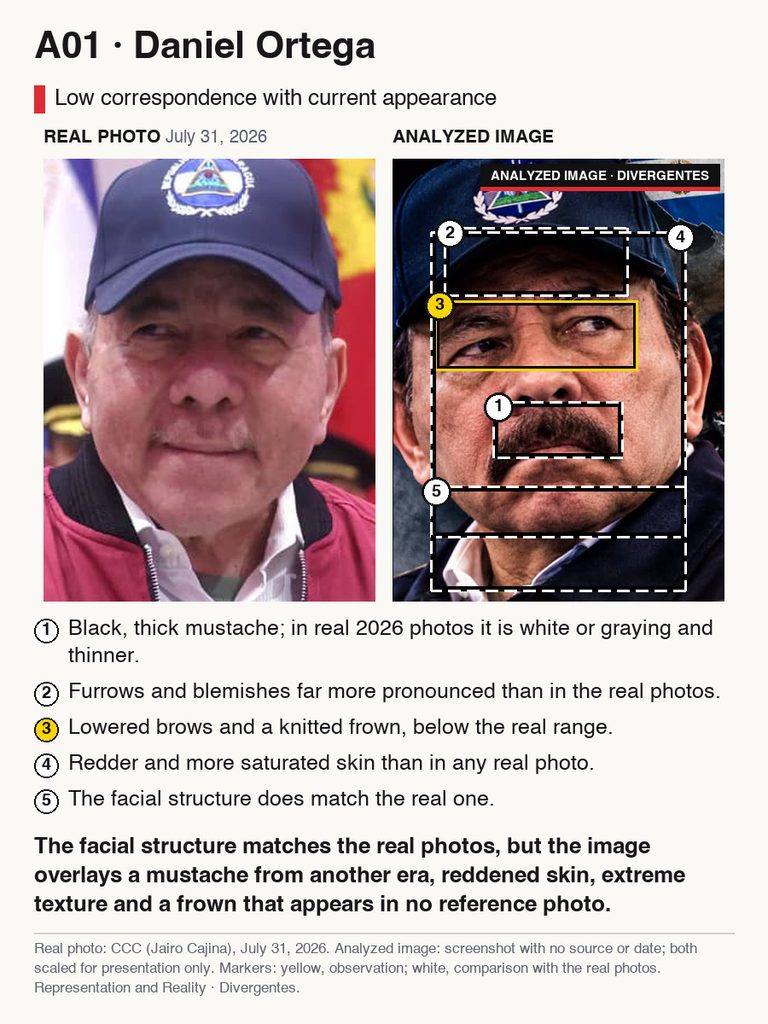
In a recurring image of Ortega, he appears with a dark mustache or dark hair—features from previous years—even though by 2026 they are white. These are photos from a different time period that are used to generate these undated thumbnails presented alongside current events. The facial changes almost always follow the same pattern: faces that are redder, more pronounced, and harsher.
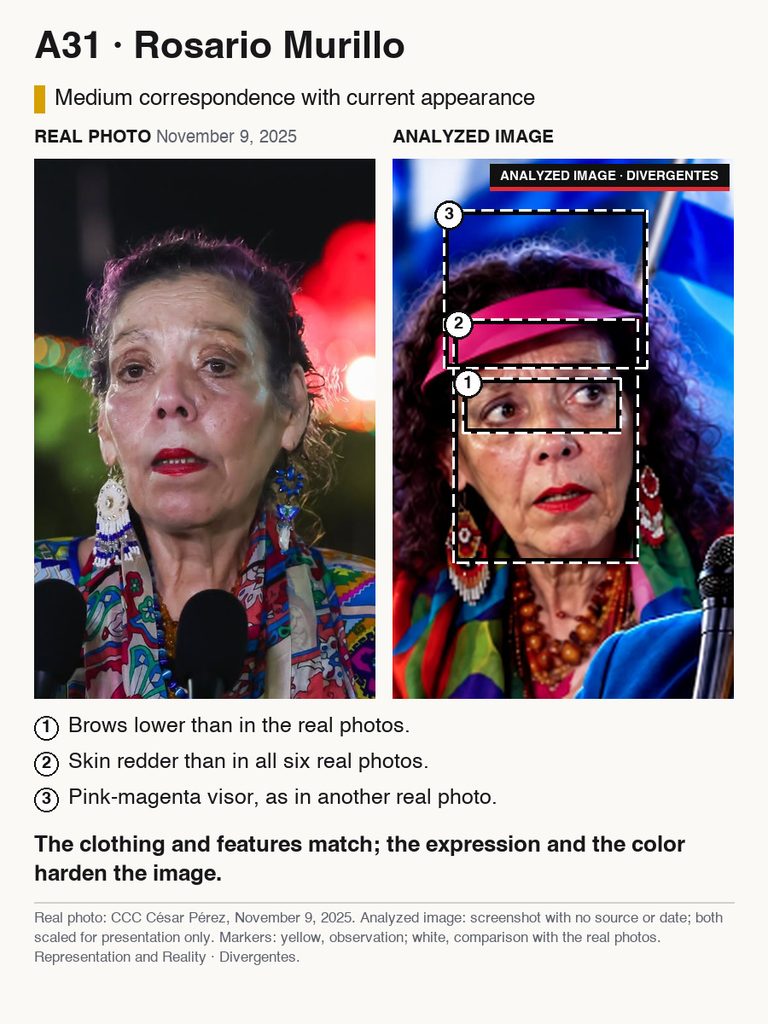
Of the 31 images I saved, 26 feature recolored skin; 29 facial depictions have redder and more saturated tones than in the reference photographs—even though the official reference photos already have certain technical adjustments to color and lighting—and 16 images show more pronounced wrinkles and furrows. Six images show hardened expressions—gestures of anger, alarm, or disdain—that are not present in the reference photographs. An analysis of the 31 images used for video thumbnails and social media posts, compared with 15 photographs from public events, suggests that skin tone is the most altered feature; Ortega and Murillo appear with a greater degree of redness compared to their actual photos. Another feature that changes significantly is Ortega’s mustache, which appears darker in relation to his skin. The analysis disproved my initial hypothesis: they do not look younger, but I did perceive them as more vigorous and stern due to the editing and composition of the images.
Generative artificial intelligence—as I’ve mentioned in other articles—is a powerful tool for journalism or any other profession where it can be applied. Even so, it becomes a double-edged sword in the real-world portrayal of power by altering the appearance of the protagonists.
A study (Grinfeld et al., 2026) argues that in a digital environment saturated with photographs and images, the ease with which AI can produce fake visual content makes it difficult for people to distinguish between what is authentic and what is fabricated. The results suggest that repeated exposure to images on social media creates a risk of familiarity or perceived credibility, even when the content is artificial. However, another more recent study (Kramer, 2026) found that repetition did not increase the perceived realism of faces, and the author concludes that seeing an image repeated just once is not enough to make an AI-generated face appear more real. This does not mean that repetition can never produce that effect.
The images of Ortega and Murillo circulating on social media may create this cognitive bias, particularly among older adults. They may be less accurate than other groups at recognizing synthetic or manipulated images, although they have a certain advantage when it comes to identifying real faces (Cai et al., 2026). However, we cannot assume that all users have the same tools and knowledge to recognize manipulated faces or images.
Ortega’s health is frequently called into question, and to a lesser extent, Murillo’s. His prolonged absences often give rise to various rumors about the dictator’s condition: that he is sick, in a coma, or even dead. However, he always ends up reappearing at public events. He no longer dances as he used to, but he is still seen driving his Mercedes-Benz or walking with difficulty toward the podiums. In contrast, the edited or retouched images present Ortega as energetic, aggressive, and dominant.
The analyzed images manipulate precisely these cues in ways that run counter to how Ortega and Murillo actually appear. In 29 of the 36 close-up shots, the skin appears redder or more saturated. Although their facial structure remains intact, repeated exposure to these images could lead to acceptance of an altered representation. A study by Ian D. Stephen and colleagues found that an increase in reddish tones in male faces was associated with a greater perception of aggressiveness and dominance. However, these conclusions do not directly apply to the analyzed images or the audience viewing them. Furthermore, from the perspective of color psychology, red can take on meanings related to danger, anger, and aggressiveness.
What is cause for concern is that these images are not distributed by the regime’s propaganda channels, but by media outlets that have a responsibility to document and hold the government accountable. Although these choices may stem from editorial or design considerations rather than an intent to deceive, they are also constructing a distorted visual representation of that power. Because there are so few public appearances, people lack a sufficient basis for comparing their faces. To what extent is journalism responsible when it alters the visual representation of those in power—even when doing so to illustrate news stories rather than to deliberately deceive?
A photograph or illustration is not meant to simply fill the space left by the text. The former documents reality and provides information that words cannot always convey; the latter allows us to explain or interpret what cannot be photographed. If we previously normalized the bad practice of grabbing any image “from Google” simply because the article needed an image, we shouldn’t be surprised that those same editorial shortcomings are now amplified by artificial intelligence.
Although the media has always relied on illustrations, cartoons, and photomontages, the fine line between the illustrative and the real used to be clearly defined and easily identifiable. And while visual manipulation is not a recent invention, AI has expanded its ease and capacity to produce realistic results. I understand the use of AI in our context: we are in exile, journalism is a precarious profession, and some media outlets do not have the budgets to hire illustrators, designers, or photographers, or to pay for photo licenses.
I’m not going to demonize AI (I used it to analyze the photographs we’ve been discussing), nor is this an attack on my colleagues. We sorely need respectful criticism—and self-criticism—these days. This is especially true given that there are no Nicaraguan journalism schools or observatories to provide us with the necessary guidance. However, we can look to global leaders like The Associated Press (AP), which, since 2023, has maintained a ban on using generative AI to create, alter, or enhance news photographs. AP’s guidelines allow for the creation of graphics and photo collages as long as they do not alter the facts or produce an image that looks like a photograph. It must be clear that these are graphic compositions.
Perhaps we need to do more work on the boundaries we must establish—as journalists and as an audience (and, by the way, we are already finalizing our manual and policies on AI use)—regarding content generated by artificial intelligence. Although a synthetic image is not automatically disinformation, its presentation, context, labeling, and potential to mislead people do matter.
The responsibility of documenting power involves preserving what actually happened and distinguishing it from what was digitally imagined. The issue is not whether Ortega and Murillo appear strong, with more chiseled or graying faces, but rather the accuracy of the portrayal of two dictators. We risk ending up remembering them as almost as whole and strong as they were 14 years ago, when I last saw them up close.
Note on image analysis methodology: We compared 31 images of Daniel Ortega and Rosario Murillo—flagged as possible alterations made using artificial intelligence—with 15 real photographs dated between November 2025 and September 2026, most of which came from official channels. Using a 478-point facial mesh, we measured facial proportions, skin color, and texture, and compared each value to the range shown in real photos of the same person. We then reviewed, image by image, nine features, ranging from facial structure to clothing. The analysis does not determine whether AI was used or who published each image; it describes how they differ from real photographs and does not infer anyone’s health status. We used AI tools under human supervision and editorial oversight; we did not use them to generate or retouch images.