
What should be a simple administrative procedure for Nicaraguans abroad now functions as an extension of repression that transcends borders. The Sandinista regime’s refusal to apostille documents for citizens in exile or those who simply seek better opportunities outside Nicaragua stunts immigration, employment, and academic processes in various countries. It also reinforces a practice that not only expels people but also limits their ability to rebuild their lives outside the country.
Although applicants for international protection are not required to submit apostilled documents—as lawyer and human rights advocate Juan Carlos Arce explains—in practice, thousands of Nicaraguans do need them. Those seeking to regularize their immigration status outside of asylum proceedings, resume university studies, or access formal employment depend on documents such as police records, birth certificates, or academic diplomas that are properly apostilled.
That is where the Ortega-Murillo regime’s blockade becomes decisive. Without the official stamp, Nicaraguan migrants are trapped in a legal limbo that limits their assimilation and hinders any attempt at rebuilding their lives. Without valid documents, they are excluded from formal systems of employment, education, and immigration regularization, which prolongs their stay in conditions of informality or uncertainty.
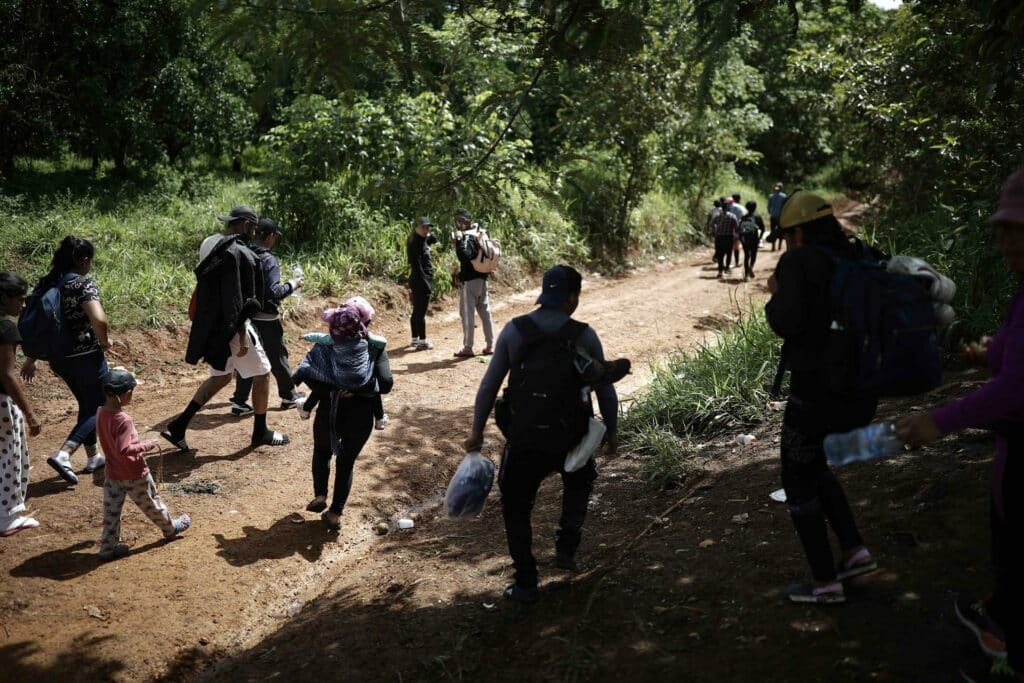
The impact of such restrictions is amplified by the scale of the Nicaraguan exodus. Since 2018, more than 800,000 people have left the country, according to estimates by international organizations such as the United Nations High Commissioner for Refugees (UNHCR) and the International Organization for Migration (IOM).
Unlike standard consular practices in the region, where countries maintain mechanisms for issuing and validating documents for their citizens abroad, in Nicaragua the refusal to apostille documents introduces an additional factor of exclusion that does not depend on the host country, but rather on the state of origin itself.
The impact of the apostille blockade
Through its social media and online platforms, DIVERGENTES has received complaints, testimonies, and stories from Nicaraguans facing this situation. For this report, we share three independently verified cases.
Stories like that of Daniel, a 20-year-old Nicaraguan man who asked that his identity be protected for safety reasons, clearly illustrate how this pattern operates. In late March 2026, his mother went to the Ministry of Foreign Affairs in Managua to request an apostille for his police record and birth certificate—documents essential for advancing his immigration process abroad. The response was immediate and definitive: his documents could not be apostilled.
There was no formal explanation, no legal basis, and no alternative. The refusal was based solely on a verbal response. “They told her it wasn’t possible. That was it. She asked several times and they didn’t give her any reason,” Daniel recounts.
The lack of information was not the only obstacle. She was not told whether there was a system error, an administrative note, or a pending requirement. The response was absolute and left no room for negotiation. “At no point was she given clear information, nor was she told if there was any formal impediment justifying this decision,” he explains.
From criminalization to forced exile
Behind the apostille blockade lies a context that defines his current situation. Daniel left Nicaragua in June 2024, after military counterintelligence officers came looking for him. At that time, he recounts, an agent read him the so-called Law 1050 and warned him that he would be placed under surveillance for alleged acts that “undermine peace and national sovereignty.”
Law 1050 was passed in December 2020 and has been used by the regime to criminalize real or perceived members of the opposition. The law allows a wide range of behaviors, including criticism of the government, to be classified as “treason,” and has served as the basis for arrests, legal proceedings, and restrictions on the rights of citizens considered dissidents.
From that point on, Daniel’s life changed. He was forced to report his movements, document his comings and goings from his town, and report to a police station every week. “On several occasions, police squads came to my house to force me to comply with these reporting requirements,” he recalls.
“I was a young man who had just turned 18, facing constant fear, stress, and deep anxiety over the possibility of being arrested at any moment; in addition to repeated harassment by the authorities,” Daniel points out.
Faced with this situation, he decided to leave the country. He left behind his job, his studies, and his family. “Today, as I try to move forward with my immigration process from abroad, I am encountering this unjustified refusal to apostille my documents, which severely limits my chances of regularizing my status,” he adds.
A requirement that determines access to employment and studies
In Costa Rica, 26-year-old María faces a similar situation. She left Nicaragua after facing police harassment in late 2025. Today, she is trying to enter the job market. Her family tried to obtain an apostille for her university diploma, but “they were told they could not process the request,” she recalls.
Faced with the impossibility of obtaining her academic documents certified by the Nicaraguan Ministry of Foreign Affairs, María says that she is “taking whatever work comes her way,” because she cannot apply for formal jobs in her professional field as a business administrator.
Beyond employment, the impact also extends to the academic sphere. The validation of university degrees in many countries requires apostilled documents. Without them, exiles cannot continue their studies or practice their professions.
That is the case of Luis, 28, who also lives in Costa Rica. He left Nicaragua in 2022 and is seeking to have his high school diploma recognized so he can continue his university studies. “I was in my second year of engineering when I had to leave the country. I came straight here to work as an Uber driver, and now that I can continue my studies, they’re asking me to submit my high school diploma with an apostille. Without it, I cannot move forward to continue with the same career or start a new one,” he explains.
A chain of control that ends at the Foreign Ministry
Lawyer and human rights advocate Juan Carlos Arce argues that the refusal to apostille documents is part of a chain of restrictions that begins with the very issuance of the documents.
“At the Collective, we have no record of apostille denials. This is perhaps because, within the chain, we have focused on the first link—the issuance of the document; that is, to apostille a document, the document must first exist. If it is not issued, as happens in many cases, there is nothing to apostille.”
The expert points out that institutions controlled by the Sandinista regime operate as the final authority within that chain. “The Foreign Ministry thus functions as the last checkpoint in a long chain of abuses; it is the final turn of the screw in an institutionalized system designed to nullify people’s legal existence,” he said.
In that sense, he explains that the problem does not begin at the Foreign Ministry, but rather in an institutional chain that limits access to basic documentation from the outset. When the documents do exist, the refusal to apostille them acts as an additional filter that ultimately closes off any possibility of legal validation outside the country.
From this perspective, the refusal is not due to administrative failures but rather to a deliberate pattern. “In this instance, the regime can ‘correct’ the flaws in its repressive system to prevent a citizen listed in its database as a dissident from achieving a completely legal and legitimate goal related to their legal recognition,” he explained.
“An arbitrary act tinged with revenge”
The refusal to apostille documents is part of a broader pattern of repression that is not limited to Nicaraguan territory. Reports by the Group of Human Rights Experts on Nicaragua (GHREN) have documented that the regime has extended its control mechanisms beyond Nicaragua’s border, affecting people in exile through various methods of rights restrictions.
These practices include denationalization, confiscation of property, and the denial of official documents—measures aimed at severing the bond between the citizen and the state, as documented in DIVERGENTES’ investigations into the systematic dispossession of property from political opponents.
The lawyer from the Nicaragua Nunca Más Collective agrees with this approach. “The purpose of these actions is to destroy one’s legal identity by denying their link to their country. When the state refuses to issue, authenticate, and apostille documents, the severing of that link becomes evident.”
The consequences are clear. “In doing so, the regime is determined to prevent, by any means possible, a person from assimilating and continuing with their life. It is an arbitrary act tinged with revenge,” says the expert, who is also in exile.
For Daniel, Luis, and María, the denial of an apostille is not just a failed administrative step, but a barrier that limits what they can and cannot do outside Nicaragua. One is unable to move forward with his immigration process, another has put his studies on hold, and the third is excluded from the formal labor market. Their stories share the same sticking point: they depend on documents that exist but that the government refuses to validate.