
Security agencies under Daniel Ortega and Rosario Murillo’s Sandinista regime have shifted their strategy in the fight against drug trafficking in an attempt to refute the U.S. position that the country is a regional drug hub and, consequently, a threat to Central American stability.
This stance by the United States, reaffirmed in the context of the implementation of its regional security program, the Shield of the Americas, adds to the conflicts and tensions that the Sandinista dictatorship is experiencing with Central American countries such as El Salvador and Costa Rica over drug seizures.
The shift in strategy now focuses on announcing strikes and seizures against drug trafficking, highlighting that these shipments managed to evade controls in other countries, primarily Costa Rica, according to security analysts consulted by DIVERGENTES.
Since the U.S. Department of State stated through a spokesperson in late March 2026 that “Nicaragua continues to fail to meet its international obligations regarding drug control and, throughout history, has ignored requests from the U.S. government for cooperation in combating drug trafficking in its country and throughout our region,” the regime has announced three new blows to drug traffickers in less than a month.
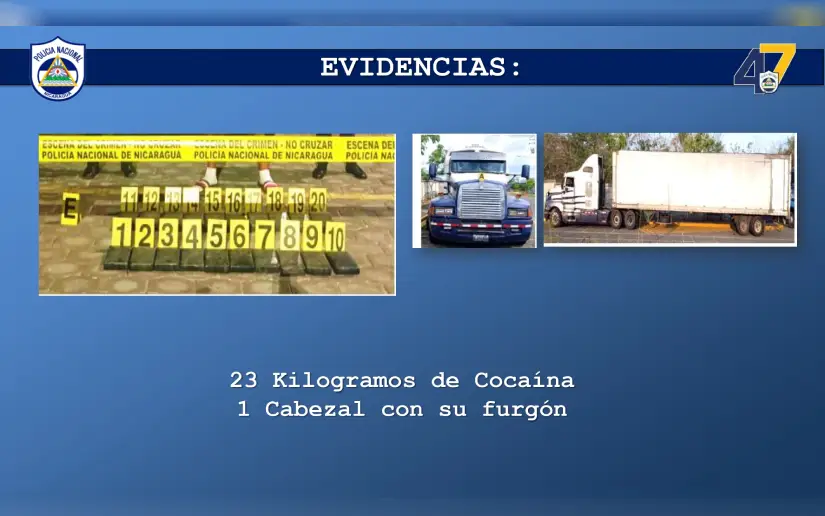
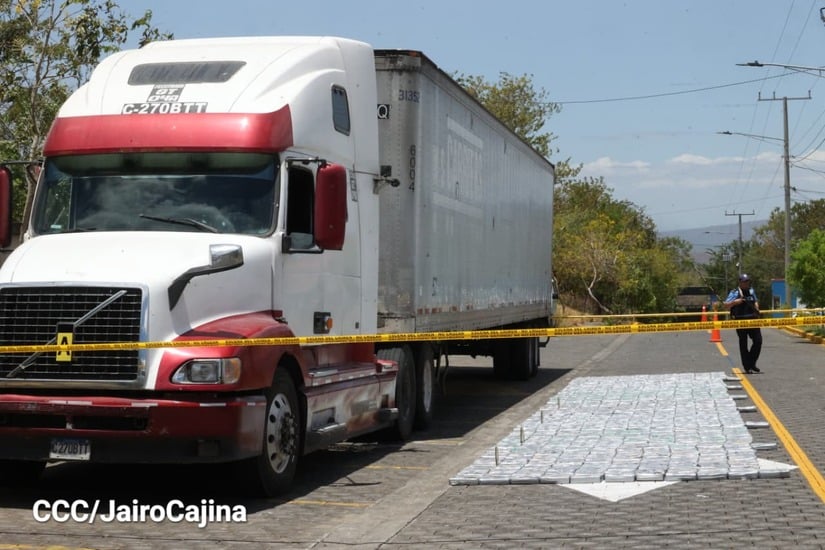
Two of these seizures involved alleged shipments that managed to pass through Costa Rican border controls. The most recent occurred on April 27, when National Police authorities announced the seizure of a van transporting 53 bales of fabric scraps originating from Costa Rica and bound for Guatemala, which concealed 20 rectangular packages of cocaine weighing 23 kilograms.
Displaying Effectiveness in the Face of Criticism From the United States
However, analysts consulted point to a shift in strategy by the Sandinista regime—known for its opacity and lack of transparency—behind these crackdowns.
“Of course, the recent seizures announced by the regime are a desperate measure in response to U.S. policy. The regime wants to demonstrate ‘effectiveness’ in the face of U.S. demands regarding the region’s anti-drug efforts. But mainly because Nicaragua knows that the Trump Administration is gathering information on Nicaragua’s collaboration with international drug trafficking networks. The Americans have been unhappy since the DEA’s departure in 2025 and, even before that, due to the lack of bilateral cooperation in the fight against drugs,” warns a Nicaraguan security analyst speaking on condition of anonymity, due to the Sandinista dictatorship’s policy of reprisals and violence.
Anti-drug cooperation between the United States and Nicaragua is currently nonexistent, a spokesperson for the U.S. Embassy in Managua confirmed to DIVERGENTES, noting that the U.S. Drug Enforcement Administration (DEA) no longer maintains full operations in the Central American country.
To Increase or Decrease Seizures: A Dilemma
Luis Enrique Amaya, a Salvadoran researcher on public safety, explained that the limited international credibility of Nicaragua’s law enforcement agencies makes it difficult to verify the accuracy of this alleged improvement in the effectiveness of seizures.
“If seizures increase, from a positive perspective one could say: they’ve increased because the effectiveness of security forces has improved, leading to more seizures. But one could also say that if they’ve increased, it’s because drug trafficking in the region has grown, and therefore there are more drugs circulating in our countries,” he noted.
“The same applies if seizures decrease. One could say it’s positive because there are fewer drugs circulating in the region, but it’s also negative. At the same time, one could argue that an alternative interpretation is that the effectiveness of security institutions has declined, and drugs are therefore circulating more freely without being targeted for seizure,” Amaya added.
“They’ve Always Claimed to Have Absolute Control Over the Country”
Mario Zamora, Costa Rica’s Minister of Public Security, in response to reports from the Nicaraguan police and army, told the media in this country that an investigation into its border controls was underway to determine how the drug shipment had passed through the newly installed scanners, noting that there were “a number of questions about what happened” and that they would analyze it as “a situation outside the usual parameters.”
Tania Molina Rojas, a Costa Rican security consultant and researcher, commented that the problem with Nicaragua’s seizure reports is that they are clouded by ego, politics, and ideology, as is generally the case with authoritarian governments such as the Sandinista regime.
“They’ve always wanted to be seen as a very safe country, where there’s no organized crime, no mafias, and no drug trafficking, because they’ve always claimed to have absolute control over the country. It seems to me that this is basically impossible. It’s impossible for any country in Latin America. So they also react very quickly for political reasons, but also out of pride, to show that they control the territory and have the military capabilities to fight,” Rojas noted.
According to Rojas, this situation is exacerbated by the evident policy of confrontation between the Ortega-Murillo dictatorship and the administration of President Donald Trump.
“Retaining Wall” Is a Public Relations Strategy
“They also seek to emphasize that those shipments never leave Nicaragua. They want to demonstrate that military power and control are robust enough to prevent drugs from being smuggled into the United States. Furthermore, they claim that this country is not a re-export hub—certainly not one for sending drugs to the United States—because they have a major ideological, political, and diplomatic problem with the United States,” he added.
According to the Nicaraguan security analyst, the Ortega-Murillo regime has sidelined the country as a key player in the regional strategy to combat drug trafficking.
“Nicaragua has been labeled a drug transshipment hub, which raises the national security risk assessment for the United States. The ‘retaining wall’ strategy is more of a public relations and image management policy by the Nicaraguan Army. By pursuing a policy of isolation from the United States and the Central American region and turning to Russia for security, it has actually created major obstacles to regional efforts,” he concluded.