
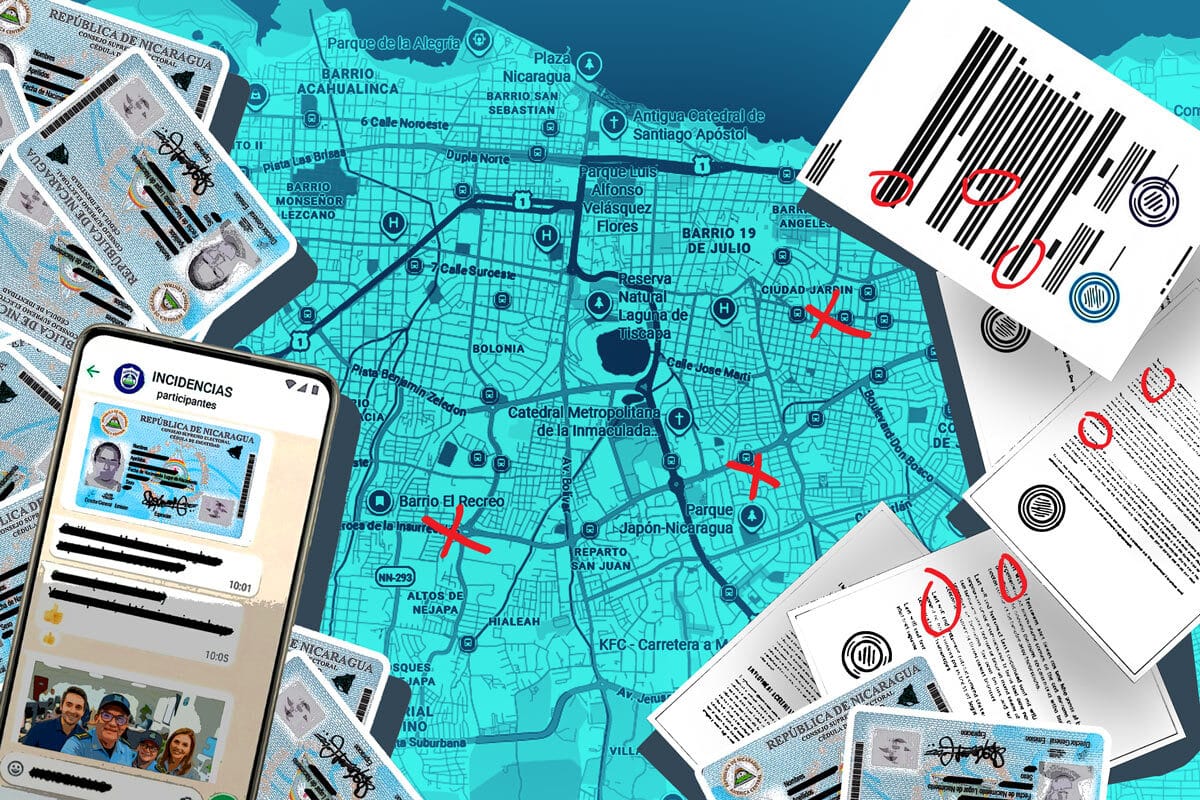
Several times a day, two uniformed police officers arrive at ID registration offices in Nicaragua to verify whether anyone “flagged” as an opposition member has completed a procedure. The identification appears in the Supreme Electoral Council’s (or CSE, its initials in Spanish) system under the term “incident,” and this requires officials from this government agency to report the case and provide the officers with the citizen’s updated information, such as their address and phone numbers.
The practice is known internally as a “police cross-check” and was confirmed to DIVERGENTES by three sources linked to the CSE who work in different parts of the country. All requested that their identities be kept confidential for security reasons and separately described the same procedure.
CSE officials consulted by this publication assert that this mechanism has allowed the police to update the locations of people who have moved to a different neighborhood or relocated to other areas within Nicaragua. In some cases, they have also been instructed to deny ID card applications after reporting an “incident.”
The officials’ account matches that of five people who recently completed ID card procedures at different registration centers. All confirmed seeing two uniformed police officers arrive carrying AK rifles and heard the officers ask the official in charge if there was “any incident.”
A Political Alert Within the System
According to sources linked to the CSE, when an official looks up the information of a politically flagged individual in the system, the word “incident” appears on the screen as an alert associated with that person’s record. The employees assert that this flag identifies citizens considered opponents or dissidents and does not correspond to a police report related to the commission of a crime.
The officials consulted explain that the identification originates from political structures operating in the neighborhoods. However, they do not know who subsequently enters that information into the CSE system or through what procedure the “incident” is generated.
Sources explain that when an “incident” arises, they cannot inform the citizen that they are flagged and must continue the process as usual. During the police officers’ next visit, they report the alert and submit the information provided by the person, including any changes to their address or phone number that they may have reported. From that point on, they wait to be told whether they can complete the process or must reject it.
A Photo to Verify the “Confronta”
They also explained that, at the end of each visit, one of the police officers takes a photo with his phone alongside the staff members present and sends it to a WhatsApp group for the institution. The CSE staff members do not have access to that group.
According to the sources, the photo serves as proof that the officers went to the station and conducted the “confronta” at a specific time. It also records which staff members were present when they were asked about the incidents.
The workers claim they are required to provide the requested information and that they know they could face problems if they omit an “incident” and it is later verified that a person on the list visited the station during their shift.
In this sense, this practice also serves as a control mechanism over those working in the ID issuance offices, who must cooperate with police inspections and document their participation.
An “Incident” That Can Halt the ID Card Process
The officials consulted say that the alert does not always end with the submission of information. In some cases, after reporting an “incident,” they have been instructed not to continue with the process and to reject the ID card application. One of the staff members also explained that if police arrive while a flagged individual is still at the office, that person may be taken to a police station for questioning.
Officials interviewed by DIVERGENTES caution that not all delays or rejections in ID card applications are due to political reasons. They explain that many applications are also rejected due to the CSE’s quality control measures, particularly because of discrepancies between the signatures on file and those provided during the application process.
However, in a climate of surveillance and repression, an administrative rejection can also instill fear among citizens that they have been politically “flagged.”
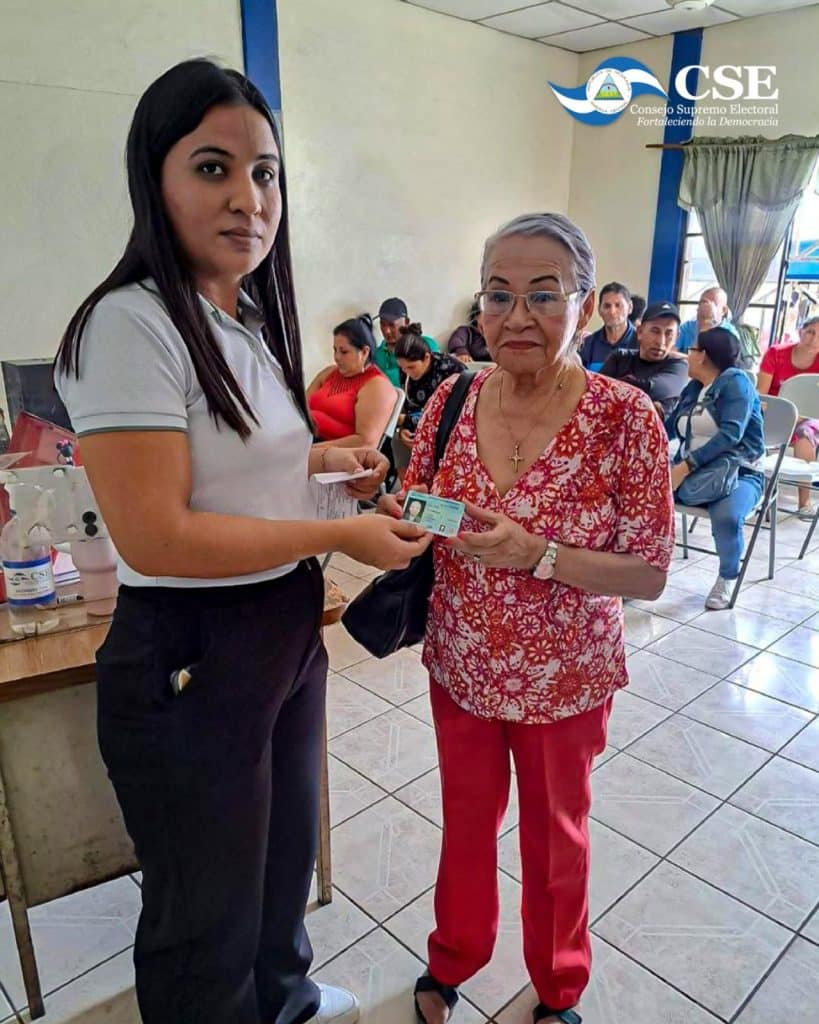
That was Claudia’s fear, a Managua resident who recently accompanied her 16-year-old daughter to apply for her first ID card. From the moment she arrived at the ID office, she was worried that presenting her own identification as part of the process might cause a problem.
“I was really afraid that when I handed over my ID card, there would be a problem with my identification, because I have many relatives in exile who left the country two years ago due to police harassment. I was afraid they would ask me about them or that there would be a problem with my own record,” she told DIVERGENTES on condition of anonymity.
Her fear grew when she returned to pick up the document and was told that her daughter’s application had been rejected. “At that moment, I thought the worst,” she recalls.
The problem was not politically motivated. The official explained that her signature did not exactly match the one on her ID card and that the document had not passed the CSE’s quality controls. The woman had to repeat the process and practice her signature to reproduce it as required. Three days after her second attempt, her daughter received the ID card.
Claudia notes that the official was courteous throughout the process and explained that other applications are also rejected when signatures do not match. However, before learning the reason, she feared that the rejection was related to her relatives in exile and to the fact that she was not a member of the Sandinista Party.
Stricter Controls on Signatures
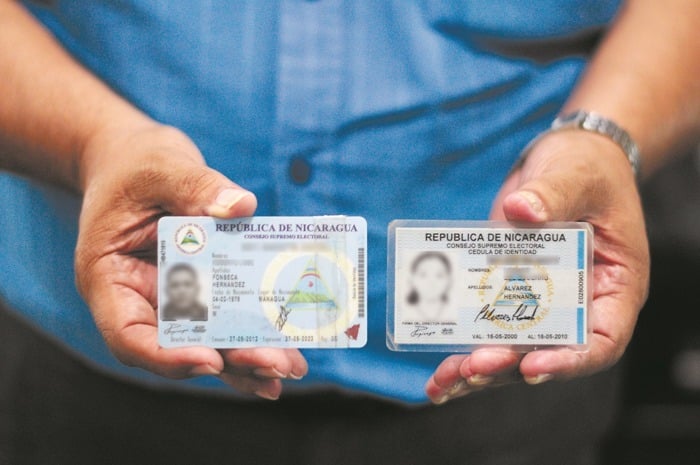
A source at the CSE states that rejections due to discrepancies in signatures have become frequent because the quality control department is demanding ever-greater precision. This criterion applies both to parents accompanying their minor children to apply for an ID card for the first time and to individuals renewing their ID cards.
According to the employee, minor variations in a signature did not necessarily prevent the process from continuing in the past, but now even the slightest differences can cause the application to be rejected and require it to be resubmitted.
“It almost seems as if they’re making the process as difficult as possible for people, because sometimes it’s just a small detail that doesn’t match, and that’s enough to cause the application to be rejected,” the official states.
The employee notes that these rejections stem from the CSE’s administrative checks and are distinct from the political “incidents” that appear in the system.
Surveillance spread from neighborhoods to institutions
The use of territorial structures and state institutions to identify and track down opponents had already been documented by the United Nations. The United Nations Group of Human Rights Experts on Nicaragua documented in a report published in 2025 an “extensive surveillance and intelligence network” operating under the direction of Daniel Ortega and Rosario Murillo. The network includes the National Police, the Army, the Ministry of the Interior, Telcor, the Ministry of Health, Sandinista Front structures, and pro-government armed groups.
The United Nations Group of Experts’ report established that the information gathered by this network is channeled to police, intelligence, and party structures to identify opponents, monitor their activities, harass them, or track their location.
The experts also documented that Sandinista territorial structures are involved in gathering information. The so-called Electoral Victory Units collect data that political secretaries pass on to the FSLN leadership, which in turn shares the information with the National Police and the Army’s Defense Intelligence Directorate.
The report notes that this system has permeated various levels of society and that its members gather information on coworkers, neighbors, and family members. In another section, the experts identified political secretaries as central figures in the surveillance and control of opponents and noted that they participate in identifying officials and citizens who should be investigated.
The report does not mention “police cross-checks” at ID registration offices. However, testimonies obtained by DIVERGENTES reveal that surveillance also operates in these offices, where authorities can determine when a politically targeted individual is conducting a transaction and obtain updated information to track them down.
“A Massive Apparatus for Repression”
Salvador Marenco, a lawyer and human rights defender with that organization, believes that the mechanism described by DIVERGENTES’ sources is consistent with a system in which public institutions have been used to monitor the population.
“All state institutions are interrelated and interconnected for the purpose of repression; the state has become a vast machinery designed to repress the population, to monitor the population, and above all, to intimidate the population,” he stated.
Marenco believes that these practices infringe upon rights such as privacy, legal certainty, and identity. He also warns that they can instill fear even when dealing with routine matters involving the government.
“All of these intimidating practices could discourage people from carrying out routine procedures that should be standard in any country, such as applying for an ID card or a driver’s license, among others,” he said.
For the human rights defender, this mechanism is part of a surveillance system that begins in people’s immediate surroundings and extends to institutions. “We are facing total surveillance—surveillance that originates in neighborhoods,” he stated.
Marenco warns that the consequences of being politically targeted can outweigh administrative obstacles. “Being targeted could have enormous, extremely serious consequences, such as arbitrary detention, torture, and forced disappearance, as has happened on numerous occasions,” he said.
A Mechanism that CSE Officials Claim Operates Nationwide
The Supreme Electoral Council reports on its website that there are 138 regional, departmental, municipal, and district ID issuance offices distributed across the country’s 15 departments and two autonomous regions.
Officials consulted by DIVERGENTES assert that the “police cross-check” takes place nationwide at all ID issuance offices. However, this media outlet was unable to independently confirm that the mechanism operates in all the offices reported by the CSE.
Based on the nationwide scope described by the officials—with 138 ID issuance offices and two officers assigned to each “check”—the process could require the deployment of up to 276 police officers during each round of visits, one around noon and another in the afternoon at the end of the workday.