
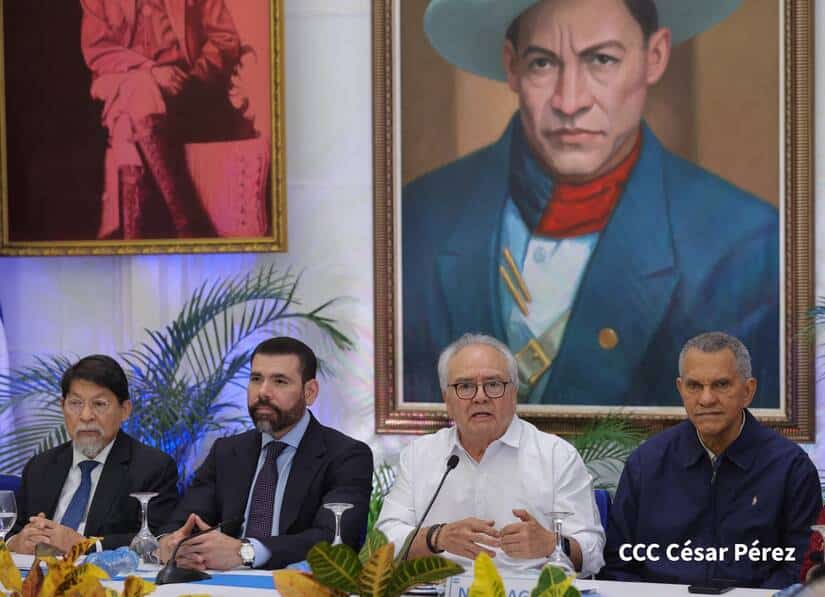
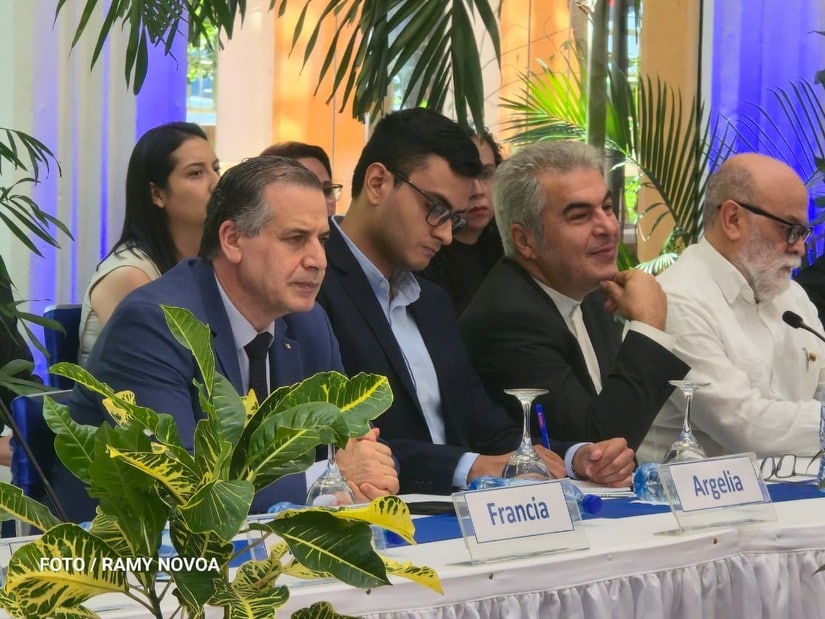
During a meeting with the diplomatic corps accredited to Nicaragua on Monday, July 27, Sandinista congressman and National Assembly President Gustavo Porras revealed the constitutional reforms that will serve as “barriers” to opposition candidates who wish to participate in elections in Nicaragua.
Eight days after dictator Daniel Ortega asserted that there “there will be no more elections” in Nicaragua, regime officials began “a broad consultation process”—with state oversight bodies, the Army, the National Police, executive branch agencies, and social, professional, and labor movements—starting this Monday with the diplomatic corps and international missions accredited in Nicaragua.
Following the global outcry and condemnation from several countries and multilateral organizations sparked by Ortega’s categorical statement, the regime has attempted to nuance its stance. For this reason, during this meeting with diplomats, Porras sought to make it clear that in Nicaragua, “there will indeed be elections.”
Enacting a Constitutional Ban on Electoral Competition
Initially, Porras confirmed that these are constitutional amendments they intend to pass in early September—although on July 22 he had said early August—and during the second legislative session in January 2027. The Sandinista official read part of the amendment they are working on: “Those who exercise or have exercised direction, leadership, financing, direct or indirect participation, or any type of involvement in the planning, preparation, or execution of an attempted coup d’état or a successful coup d’état may not be candidates for elected office, nor may they hold public office by electoral appointment or as President.”
In reality, this ban is not new, because it was already provided for in Law 1055 (Law on the Defense of the People’s Rights to Independence, Sovereignty, and Self-Determination for Peace), which defines “treason” as acts committed by those who “lead or finance coups d’état, disrupt the constitutional order, or request military sanctions or interventions against the State.” In fact, this was the law that justified the imprisonment of seven presidential candidates and 30 other opposition figures during the 2021 electoral process.
For this reason, Porras wanted to make it clear that the change “is not unfamiliar” or “strange,” but what the regime now seeks is to enshrine it in the OrMu Constitution. The Sandinista congressman asserted that the proposal aims to “elevate these prohibitions to constitutional status” in order to “establish that constitutional barrier so that no one can run for any office in Nicaragua while calling for military intervention against us. That cannot happen; it is unacceptable.”
Porras said that any candidate who violates the Constitution will be barred from participating to ensure “free elections, without foreign interference, and without external financing.”
As part of the reform package, the regime is also considering changes to the Supreme Electoral Council (or CSE, its initials in Spanish) to grant it the authority to revoke the legal status of political parties that field such candidates. In addition, the CSE may also directly cancel any candidacy.
“They’re Going to Repeat the Scenario” of the 2021 Elections
A political analyst consulted by DIVERGENTES said that this reform aims to enshrine in the Constitution—rather than relying on ordinary laws—the entire list of offenses outlined in Laws 1055 and 1145 (Special Law Regulating the Loss of Nicaraguan Nationality), which applies to Nicaraguans convicted under Law 1055 and serves as the legal basis for stripping hundreds of opposition figures, activists, and journalists of their nationality and confiscating their assets.
“Clearly extend the ban to appointed public officials, not just elected officials,” the analyst added. “This reform seeks to use retroactive and extremely broad language such as ‘those who hold or have held’ office and ‘direct or indirect’ participation, which allows it to cover past conduct and vaguely defined ties,” he asserted.
Juan Diego Barberena, a lawyer and opposition figure in exile, believes the regime will repeat the format of the 2021 elections. “They’re going to repeat the scenario—only more radicalized—of the absence of political competition. The dictatorship will play alone.”
Barberena also considers it crucial that obstacles are being put in place to prevent the formation of political parties—obstacles that were already present, albeit “superficially,” in the OrMu Constitution.