

Daniel Ortega and Rosario Murillo’s regime prioritizes strengthening a police force that has been singled out by international human rights organizations for its involvement in political surveillance and the repression of the population, while patients in Nicaragua’s public hospitals face long waits due to a shortage of doctors and teachers instruct classes with as many as 70 students.
According to the study Nicaragua in Figures 2026, prepared by economist and director of the Inter-American Dialogue Manuel Orozco, the country has 104,400 police officers—including 76,000 volunteers who operate as paramilitary units—compared to 6,200 doctors and 39,000 teachers in the public system. In other words, for every doctor, there are nearly 17 police officers, and for every teacher, approximately three police officers.
With an estimated population of 6.9 million, Nicaragua has about 42 regular police officers per 10,000 people. When volunteers are included, the figure rises to 151—nearly four times the initial ratio.
In contrast, the World Health Organization (WHO) reports nine doctors per 10,000 inhabitants in Nicaragua, including professionals in the public, private, and social security sectors.
This means that, even without counting volunteers, Nicaragua has 367% more police officers than doctors per 10,000 inhabitants.
Nicaragua Compared to Central America
At the regional level, the country has nearly twice as many police officers per capita as Honduras, Guatemala, and Costa Rica, according to Orozco’s study. While Nicaragua has 42 regular police officers per 10,000 inhabitants, Honduras has 24, and Guatemala and Costa Rica each have 23. This comparison does not include the 76,000 volunteer police officers.
But when it comes to doctors, the figures change. Nicaragua has just nine per 10,000 inhabitants, compared to 16 in Guatemala, 19 in Honduras, and 27 in Costa Rica. In other words, for every doctor available in Nicaragua, Costa Rica has three relative to its population.
The shortage of healthcare personnel is also reflected in the records of the Pan American Health Organization (PAHO). A country profile published by the organization indicates that Nicaragua had 21.9 doctors, nurses, and midwives per 10,000 inhabitants—a figure below the international median of 49 professionals used by the WHO to identify countries with a relative shortage of healthcare workers.
Although this is not a minimum recommended number for all countries, the indicator helps gauge the staffing constraints facing Nicaragua’s health care system.
A similar situation exists in education. Nicaragua has 1.7 teachers per 100 students, while Honduras has 2.5, Guatemala has four, and Costa Rica has 6.4. This means that, relative to its student population, Costa Rica has nearly four times as many teachers as Nicaragua.
The difference is even greater when the size of the two countries is taken into account. Costa Rica, with a population 25% smaller than Nicaragua’s, has 80,000 teachers—105% more than the 39,000 recorded in Nicaragua, according to Orozco’s study.
“Volunteer” Police Officers and the Regime’s Forced Recruitment
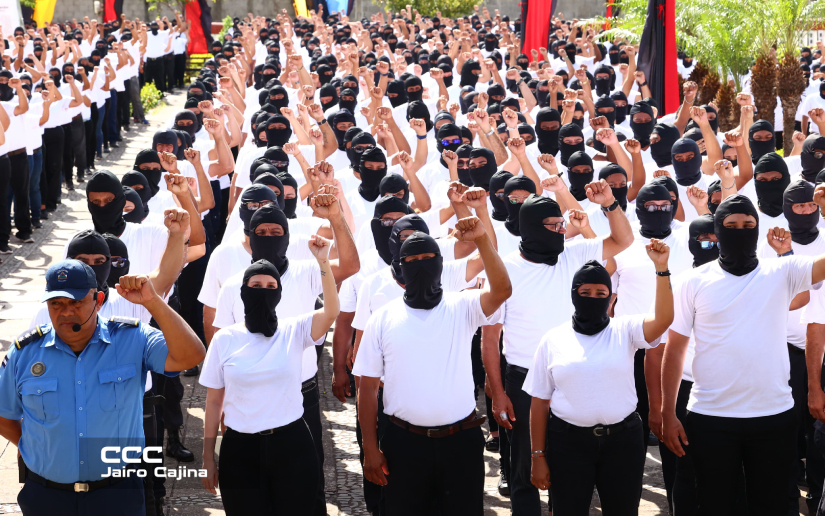
In contrast to the staffing shortages faced by the health and education systems, the police force expanded through the massive recruitment of volunteers in 2025.
Among those recruited were employees of public institutions. Even teachers reported being pressured to join the ranks, amid concerns raised by international human rights organizations.
Between January and February 2025, the regime organized mass swearing-in ceremonies for volunteer police officers in various cities across Nicaragua. People with their faces covered participated in these ceremonies, while the Sandinista dictatorship presented these mass recruitments as a measure to strengthen public safety.
The Volunteer Police force was formally recognized in Article 92 of the Constitution, as amended in 2025, which defines it as an auxiliary body supporting the National Police. The same amendment prohibits forced recruitment. However, government employees reported that they were summoned to the swearing-in ceremonies under threat of dismissal and other reprisals.
This expansion of the police force occurred seven years after the April 2018 protests, when police officers and pro-government armed groups participated in repressive operations against demonstrators.
Fewer Doctors and Long Wait Times for Care
The disparity between police and healthcare personnel concerns José Antonio Delgado, a Nicaraguan doctor in exile, who believes the regime has prioritized the expansion of hospital facilities without adequately addressing the needs of healthcare professionals.
“The shortage of doctors is enormous. Private practitioners only serve the population that pays them at their private clinics, which is a minority. And doctors in the public health insurance system only serve the insured population—nothing more,” he noted.
For this reason, he believes that the availability of healthcare professionals to treat those who depend exclusively on the public system is lower than what is reflected in the national indicator.
The staff shortage, he explains, results in delays in receiving specialized consultations, undergoing tests, and accessing scheduled surgeries. “The shortage of doctors leads to long waiting lists for outpatients,” he stated.
The specialist cited as an example patients who receive a diagnosis at a health center and must wait several months to be evaluated by a specialist at a hospital.
He also described the difficulties faced by those who need gallbladder surgery, due to the time that elapses between diagnosis, preoperative consultations, tests, and the scheduling of the operation.
Delgado argues that shortcomings in health centers ultimately increase demand at hospitals, because some patients go directly to the emergency room when they do not receive a timely response. “That shortage of doctors causes all this chaos, because it creates a chain reaction,” he explained.
The doctor also questions the health fairs organized by the Ministry of Health (Minsa), which offer specialized consultations and surgeries during special events. In his view, these activities do not replace the need for permanent specialists in the municipalities. “So, the health problem isn’t solved. All they’re doing is applying Band-Aid solutions,” he stated.
Education Is Not a Priority for the Regime

Gabriel Putoy, a mathematics teacher and member of the Teachers’ Union (or USME, its acronym in Spanish), currently in exile, criticized the Ortega-Murillo regime for expanding the police force while public education faces problems such as a shortage of teachers, overcrowded classrooms, low salaries, and political pressure against the teaching profession. In his view, the figures reflect the government’s priorities.
The teacher also questioned the pressure reported by Ministry of Education workers to join the Volunteer Police during the mass swearing-in ceremonies held in 2025.
“Education is not Doña Rosario’s (Murillo’s) priority; what is, however, is control and surveillance on every corner and in every square meter of Nicaragua,” he told DIVERGENTES.
“The gap between the number of police officers and teachers isn’t wider because many teachers refused to become volunteer police officers—because that’s what the regime wanted: to force teachers to become paramilitaries and police officers. Today, many teachers who refused are unemployed or being punished by the regime,” he noted.
In February 2025, the newspaper LA PRENSA published testimonies from teachers and administrative staff at public schools who claimed they had been summoned to police swearing-in ceremonies and feared losing their jobs if they refused to participate.
More Resources to Protect Co-Dictators Than for Road Safety
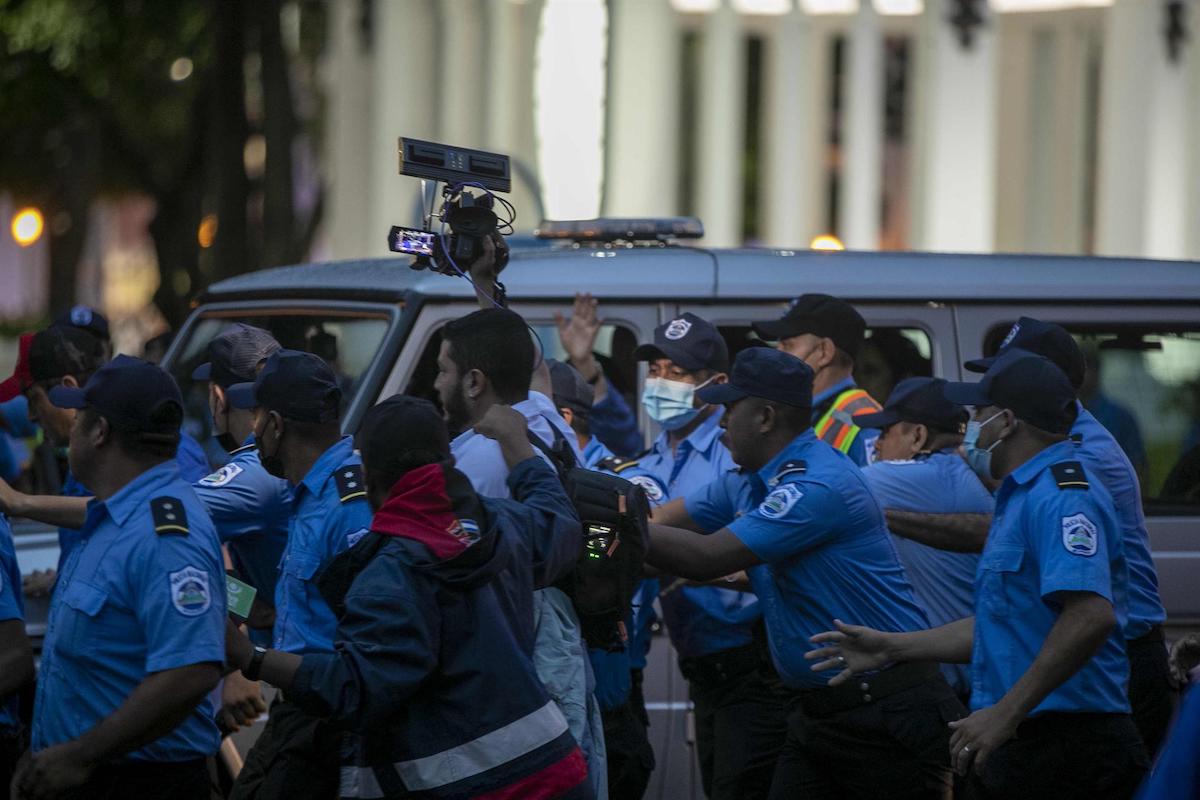
The National Police’s budget for 2026 totals 5,622.3 million córdobas, according to documents from the Ministry of Finance.
Although the Ministries of Health and Education receive larger total allocations, the internal distribution of the police budget reveals differences among the functions performed by the institution.
The VIP Protection Program has a budget of 248 million córdobas and 1,269 budgeted positions. In contrast, Road Safety has 71.7 million and 345 positions.
This means that VIP Protection receives 3.5 times more resources and has 3.7 times more positions than the program responsible for preventing traffic accidents.
This disparity exists in a country where 903 people died in traffic accidents in 2025, according to police statistics.
Among its functions, the VIP Protection Program is responsible for providing security to members of the branches of government, diplomatic representatives, and other prominent figures. For 2026, it plans to carry out 39,749 security plans and 265,072 technical anti-explosive inspections. The Road Safety Department, on the other hand, is responsible for accident prevention, traffic regulation, road safety education, and accident investigation throughout the country.
These allocations do not make it possible to determine how much it costs to support the volunteer police force, because the budget documents do not provide a specific breakdown of the resources allocated to that unit.
Police Expansion and Lack of Transparency
The recruitment of thousands of volunteers has expanded Nicaragua’s police force, although there is insufficient public information to determine how many remain active, what duties they perform, or how much it costs to operate the force.
The 2026 budget provides for 17,299 positions in the National Police, a figure that differs from the 28,400 regular officers counted by Orozco. However, the lack of transparency regarding the number of officers and the categories used in official records makes it impossible to clarify this discrepancy and determine precisely how many police officers are on duty.
This lack of information also makes it difficult to determine the resources allocated to support the Volunteer Police and to assess the extent of their involvement in security operations. More than a year after the mass swearing-in ceremonies, the authorities have not provided a public breakdown that would reveal the actual size of this force or its costs to the state.