
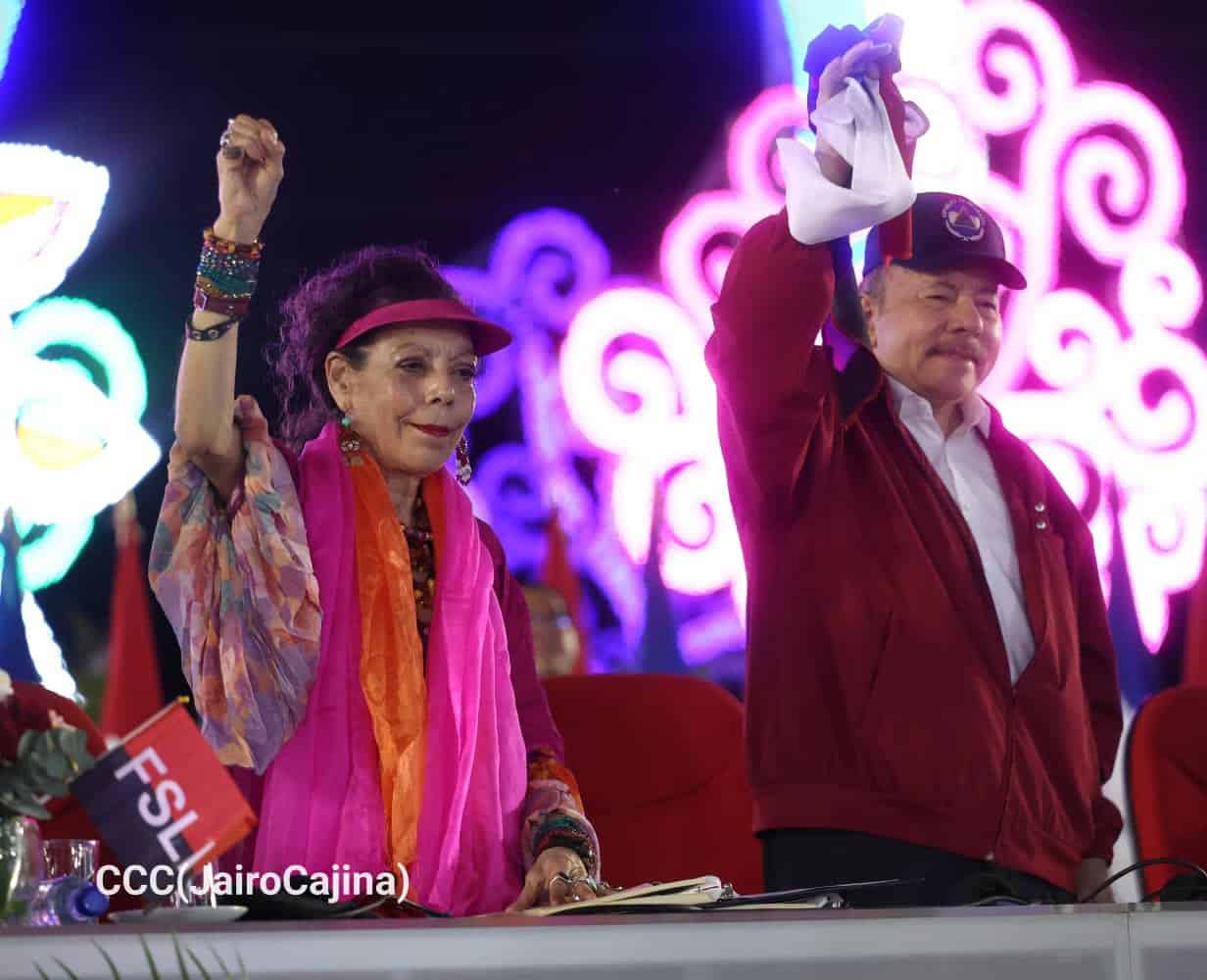
The formal elimination of elections in Nicaragua, as announced by Sandinista dictator Daniel Ortega this weekend, would require a profound reform of the country’s constitutional order, according to Nicaraguan lawyers and political analysts consulted by DIVERGENTES. The difference lies in the mechanism: a direct constitutional reform or a Constituent Assembly controlled by Ortega and Rosario Murillo.
In his July 19 statement, Ortega did not make clear how he would remove elections from Nicaragua’s political system. The president merely mentioned that he would coordinate with the National Assembly to “put up a wall” against political parties. On Tuesday, July 21, Congress announced that it would hold special sessions with the Supreme Electoral Council (or CSE, its initials in Spanish) “to ensure the constitutional, legal, and formal steps” required by Ortega’s mandate.
Juan Diego Barberena, a lawyer and opposition figure in exile, believes the dictatorship could implement two options. The first is the simplest: “Through a constitutional amendment establishing that there will be no elections in 2027, or by extending the term for several more years without any solid basis or justification.”
Constituent Assembly to Establish an Indefinite Presidential Term
The second option is to transform the National Assembly—which, according to the latest constitutional amendment, is now a state body—into a Constituent Assembly, without calling for elections. “This is absolutely unconstitutional, but we can no longer expect anything to happen through formal channels,” Barberena clarified.
The Constituent Assembly is a body composed of representatives elected by the citizens to draft a new Constitution. It is considered the highest expression of sovereign power for defining the political and legal rules and institutions of the State. They are generally formed during periods of profound institutional crisis, democratic transitions, or breakdowns of the constitutional order.
Along these lines, once the National Assembly becomes a Constituent Assembly—as a supreme, unlimited, and sovereign power—it can interpret the current Constitution as it sees fit to establish an indefinite presidential term. All of this would take place while a new Constitution is being drafted.
To implement this option, Barberena said that the regime would not hold elections to choose representatives, but could instead hold a kind of plebiscite to ask whether people agree or disagree with transforming the current National Assembly into a Constituent Assembly, or whether they agree or disagree with the current legislative body drafting a new Constitution.
Lawyer and human rights defender Juan Carlos Arce agreed that, from a legal standpoint, this could pave the way for a Constituent Assembly to suspend elections while a new Constitution is being adopted. “Once the new Constitution is adopted, they can establish a one-party system,” he added.
Arce clarified that conducting a legal analysis of this “is impossible,” because denying the right to vote cannot be legitimized by any reform. Even so, he believes that eliminating elections would require a complete constitutional reform. “Eliminating elections at the legal level is a complete overhaul of our system of government.”
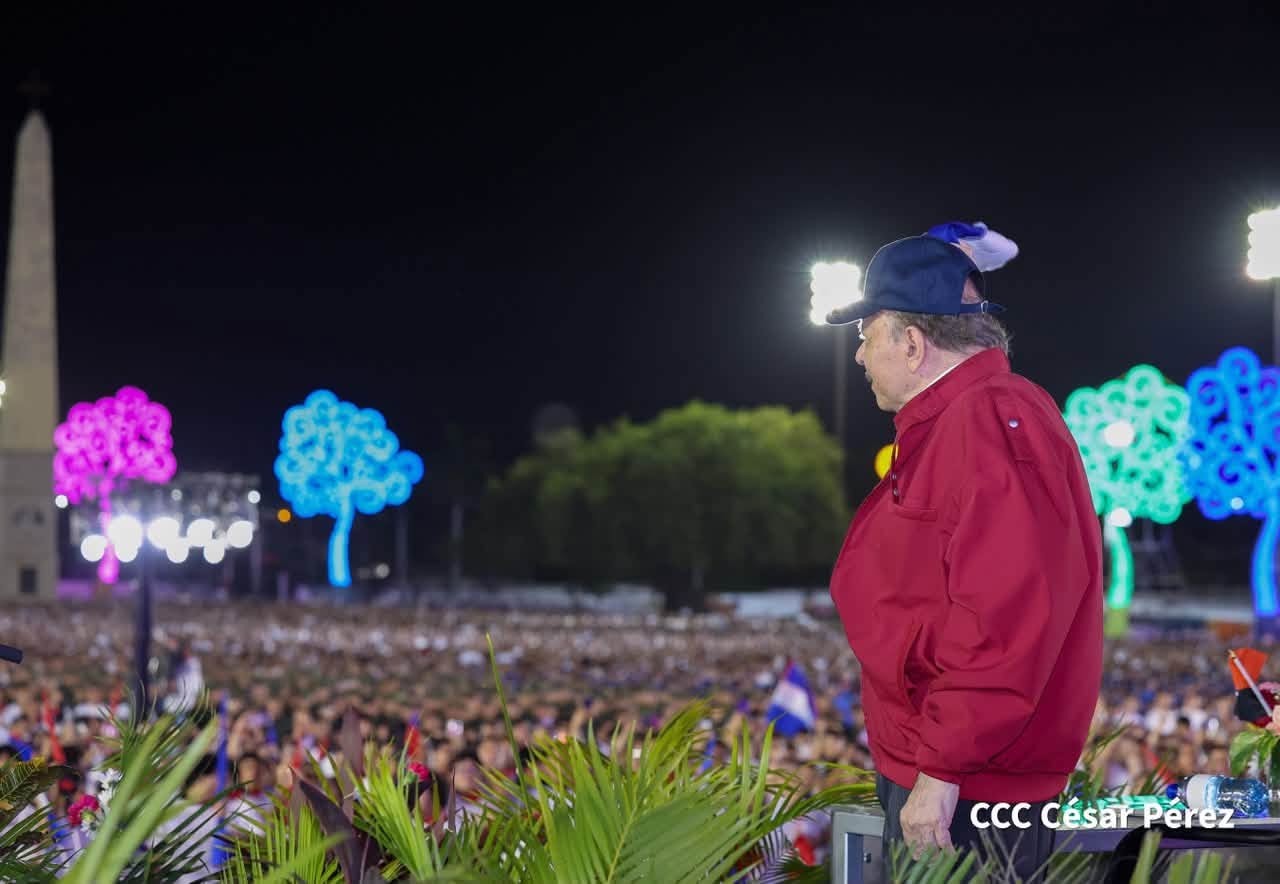
A One-Party Regime?
Since Ortega has not clarified the process for annulling the elections, there is no certainty about the model he will implement. Juan Sebastián Chamorro, one of the presidential candidates imprisoned before the 2021 elections, said that Ortega wants to impose a one-party regime in Nicaragua, like those in China, Cuba, and North Korea. “Ortega has always maintained that political parties are undesirable because, according to him, they divide societies,” Chamorro said.
In Cuba, North Korea, and China, the Constitution legally prohibits any political organization other than the official ruling party. In Cuba, the Communist Party of Cuba (PCC) governs; in China, the Communist Party of China (CPC); and in North Korea, the Workers’ Party of Korea (WPK).
In North Korea, for example, voters can only approve or reject candidates previously selected by the regime. Elections function more as a mechanism of control than as an electoral contest.
Chamorro believes that Ortega could move toward a similar system, with internal elections or processes controlled by a single political structure.
Attorney Juan Carlos Arce also noted that Ortega could move toward a model inspired by North Korea, based on the dynastic perpetuation of power. According to the attorney, the regime seeks to consolidate the Ortega-Murillo family as a permanent governing structure and replace electoral legitimacy with mechanisms of political and ideological control.
On Tuesday, July 20, the Nicaraguan Parliament—controlled by operatives of the Sandinista dictatorship and its “mosquito” political allies—issued a statement announcing that it will hold “special sessions with the Supreme Electoral Council to ensure the constitutional, legal, and formal steps that underpin the reforms, for a state and pathways that guarantee the legal foundations of this crucial aspect of our institutional framework, and underpin the political, democratic, sovereign, and free practices of our national and local elections for public officials.”
“The National Assembly is convening to fulfill the mandates received on July 19, the 47th anniversary of the triumph of democracy and freedom in Nicaragua,” adds the statement from the Sandinista-controlled legislature.
A Single Party With Nuances?
Attorney Juan Diego Barberena said that this option is unlikely to be considered by the Ortega-Murillo regime. “In our [Nicaragua’s] political party landscape, there is no single political party; rather, there are other parties that serve as satellites, which we already know do not play a role in the struggle for power,” he explained.
Currently, Article 9 of the Constitution states: “Cultural and social pluralism ensures the organization and participation in all electoral processes established in the Constitution of political parties that comply with the Constitution and the laws.”
Meanwhile, Article 49 states: “Nicaraguan citizens have the right to organize or join political parties in order to participate in politics and run for public office. Political parties must incorporate the Fundamental Principles of this Constitution into their bylaws.”
According to Barberena, Nicaragua has a sort of “sui generis single-party system,” because internationally it presents itself as a “pluralistic party system.” The lawyer believes that these “puppet” political parties will maintain their place in the electoral system because the regime “does not need to eliminate them, since they will support the entire system the regime needs to establish.”
Ortega Fears Elections
He noted that the elimination of elections amounts to the “perpetuation of power through a dynastic system” and reflects “the absolutist nature” that the regime has gradually taken on.
For Arce, Ortega’s statement stems from his “terror” of the democratic system and popular elections. “He knows that in free elections with international observation, he would inevitably lose,” he said.
Since the elections that brought him to power in 2006, Nicaragua has experienced electoral processes marked by allegations of fraud or restrictions on candidates and political parties. The most recent elections in 2021 were described as “a pantomime” by the United States.
“In Nicaragua, we haven’t had real electoral processes since 2008. [Ortega’s] statement raises the stakes for the international community and marks a new phase in the dictatorial project: it is the official death of the state and the formal establishment of absolutism as a form of government,” Arce said.
International Response
U.S. Secretary of State Marco Rubio responded to Daniel Ortega’s proposal to abolish elections with a “call to action” directed at the international community, urging it to “join forces to demonstrate to the Murillo-Ortega dictatorship that it cannot expect to maintain business as usual with other nations when it is thwarting the basic tenets of our democratic hemisphere.”
“Daniel Ortega’s declaration that under his family’s dictatorship Nicaragua will never again hold elections lays bare their true authoritarian nature. Daniel Ortega and Rosario Murillo have abandoned even the pretense of popular consent,” Marco Rubio said in a brief statement released by the State Department. “The Nicaraguan people have the right to choose their own leaders through democratic elections.”
OAS Secretary General Albert R. Ramdin, in a post on X, said that the Ortega-Murillo regime has made official what its actions have been demonstrating for some time: an abandonment of democracy. “Eliminating elections is the definitive denial of the people’s sovereign right to choose their government. Free, fair, and periodic elections are not optional; they are an essential element of representative democracy,” Ramdin stated.
The OAS leader said that the erosion of democracy in any country in the Americas “is never a purely internal matter,” since attacks on democratic institutions “have regional consequences, as they weaken democratic governance and affect the stability and shared values of the hemisphere.”
Meanwhile, Costa Rica reiterated its concern over the systematic closure of civic spaces and the persecution of dissenting voices. The Costa Rican Ministry of Foreign Affairs and Worship stated that it has always supported and will continue to advocate for free, democratic, transparent, and pluralistic elections in Nicaragua. “It is worth recalling that, due to the absence of the required conditions and guarantees, Costa Rica did not recognize Nicaragua’s most recent electoral process, held in 2021,” the statement noted.
Nicaragua’s response was swift. The Nicaraguan Foreign Ministry reminded Costa Rica of the principle of “non-intervention and non-interference in the affairs of other states” and described the statements by the Costa Rican Foreign Ministry as “presumptuous.”