

A group of long-time Sandinista activists reported that they are facing pressure to sell land that the regime itself granted them more than a decade prior, in recognition of their participation in the war during the ’80s. The complainants told DIVERGENTES that intermediaries tied to the Attorney General’s Office (or PGJ, by its initials in Spanish) have contacted them to propose selling their plots at prices below market value, warning them that they could lose the land if they refuse to negotiate.
One of those affected states that he was recently stripped of five acres of land that had been allocated to him years earlier as part of former-combatants recognition programs. According to his testimony, after refusing to sell his property, the plot was redistributed among five different people, who received an acre each. The complainant—who requested anonymity to avoid becoming a victim of the dictatorship’s reppression—maintains that this redistribution took place after he rejected offers to sell the land.
The properties—around five acres per beneficiary—were handed over between 2010 and 2015 to former combatants tied to military structures of the Sandinista Revolution, including members of the so-called Pablo Úbeda troops. The complainants claim that the pressure intensified starting in 2023, and that several beneficiaries are currently facing similar warnings.
Leaked audio messages reveal threats
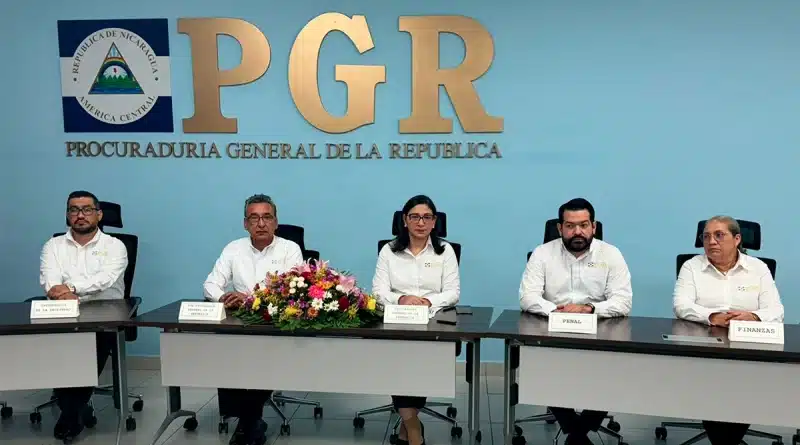
The complainants provided DIVERGENTES with several WhatsApp audio messages from a lawyer who works at the PGJ. In the recording, the woman states that she will report land that, in her opinion, is not being used.
The people who shared the audio message requested that their identities not be revealed for fear of retaliation or of losing the property they still own. In the audio message, the woman links her intervention to an alleged political directive about the use of these lands.
“I want to make it very clear that what belongs to the people is the people’s, and that’s the order of the day. Anything that is not being properly managed must be reported and placed in the hands of the revolution—our revolution,” the lawyer states in the recording.
“I work for the PGJ. Take note. And so I’m going to report this because I’m an activist and I serve the people. I’m sorry, but I will report you because that land will be mine whether you like it or not,” the woman says in the audio message sent to the complainants.
The activist who received this warning claims that, prior to this threat, the lawyer had suggested he sell the property to an acquaintance who is allegedly another Sandinista activist. However, the lawyer’s statement that the land would belong to her led him to believe that she might also have a personal interest in the property.
Reported pressure since 2023
According to three other testimonies gathered for this report, local officials and political operatives within the Sandinista regime have informed them that there is a government directive to recover land that has been allocated to beneficiaries who are not using it.
According to their account, the explanation they were given is based on the idea that, “what belongs to the people returns to the people if it’s not being used.” Following this argument, intermediaries linked to state institutions have proposed purchasing these plots.
The complainants state that the offers made are at prices below market value. They assert that, in some cases, the warnings include the possibility that their land will be taken away from them and handed over to others. “They tell us that if we don’t sell, the government will take it back or send other Sandinista comrades to occupy it,” said one of those affected.
These warnings, according to their testimonies, are relayed through visits to the properties, phone calls, or text messages sent via local political operatives who also work in government institutions.
Former-combatants recognition programs
The allocation of land to combatants has been a policy implemented at various times since the triumph of the Sandinista Revolution in 1979. During the ’80s, the Sandinista government carried out an agrarian reform that redistributed properties confiscated from the Somoza family and sectors linked to the former regime among farmers’ cooperatives, rural communities, and combatants of the Sandinista Front.
After returning to power in 2007, Daniel Ortega’s government launched recognition programs aimed at long-time Sandinista activists. These initiatives included special pensions, social programs, and access to land or agricultural plots for people who had participated in the country’s armed conflicts.
In 2013, the National Assembly passed the Special Law on Assistance to Former Combatants for Peace, Unity, and National Reconciliation, which establishes social benefits and support programs for former combatants from various armed conflicts. Between 2010 and 2015, groups of former combatants received rural plots of land as part of these programs.
Restrictions on the sale of property provided through government programs are typically limited to an initial period intended to prevent speculation. In this type of allocation, the conditions establish that the beneficiary may not sell the property during the first few years following delivery, with the aim of guaranteeing that the property is used by the recipient. Once that period has elapsed—which is, in many cases, of around five years—the owner may dispose of the land in accordance with the standard rules governing private property.
The complainants claim that the pressure they have faced includes demands that they sell the plots to buyers suggested by intermediaries linked to the government—a condition that, they say, was not provided for in the terms under which they received the land.
Combatants of the Pablo Úbeda troops
Some of the complainants were members of the so-called Pablo Úbeda troops—a military unit created in 1979 to carry out special operations during the armed conflict of the ’80s. These units participated in military operations during the Contra War against the counterrevolution.
Many of its members remained affiliated with the Sandinista movement for decades and are active in organizations of former combatants. For many of them, the land granted by the regime served as recognition of their participation in the war.
“We fought for the revolution. We never imagined that one day they would try to take away from us what we earned through that struggle. Just because we aren’t currently using them shouldn’t be a reason for them to threaten to take them away from us, because they already belong to us. The government gave us our papers, and we’re in good standing,” said one of the complainants.
Asset seizures since 2018
Allegations of pressure on property owners come amid reports by human rights organizations of confiscations and seizures of property linked to the political crisis that has gripped Nicaragua since 2018.
The Attorney General’s Office (or PGJ, by its initials in Spanish)—formerly known as Procuraduría General de la República (PGR)—has been identified in journalistic investigations and independent reports as one of the institutions responsible for carrying out asset seizures in Nicaragua, particularly since the political crisis that began in 2018. These actions have been part of a state-led strategy targeting opponents, civil society organizations, media outlets, and individuals considered critical of the government.
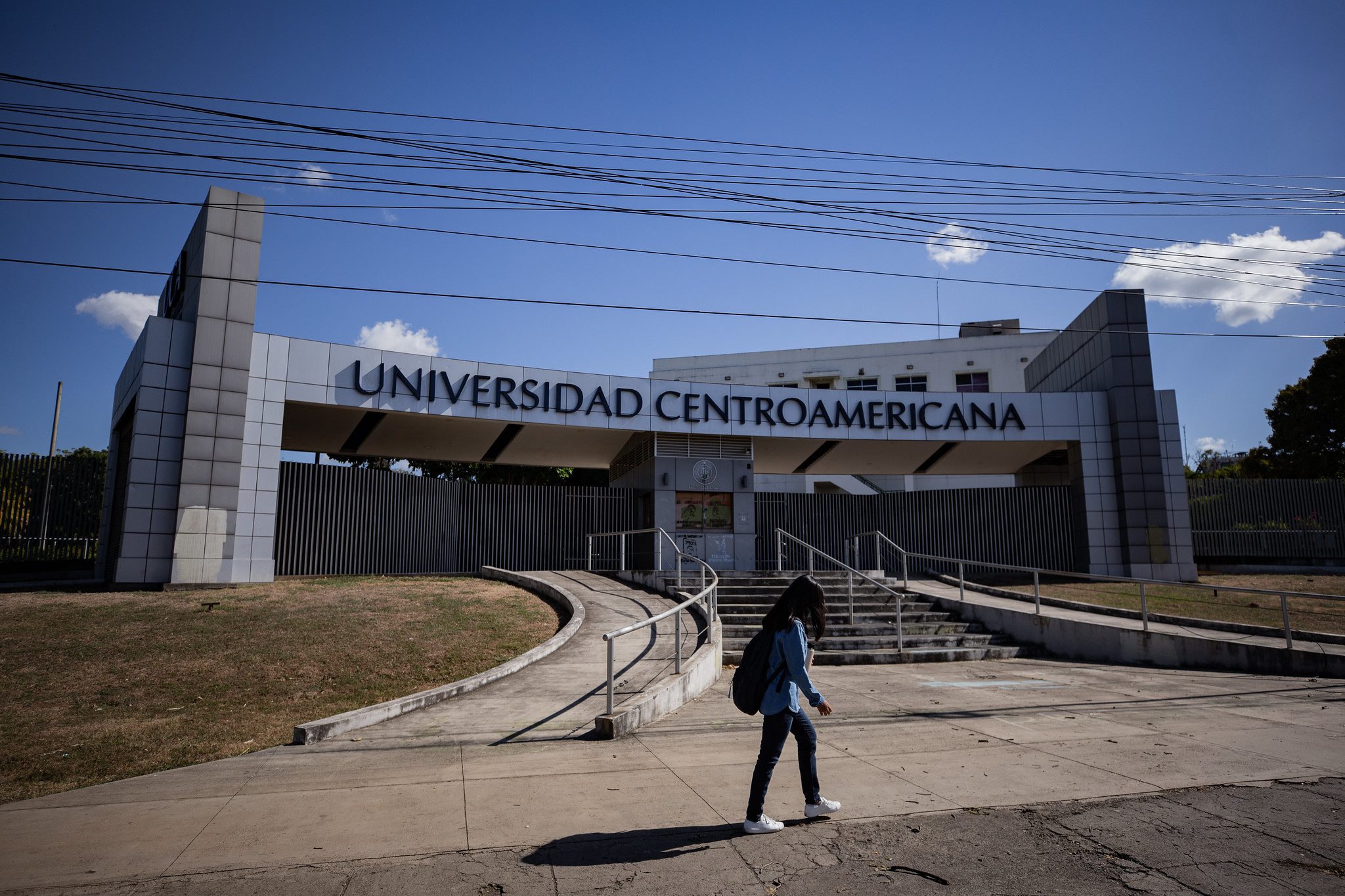
In various documented cases, the PGJ has justified these actions as “recoveries” or “restitutions” of property to the state. However, human rights organizations and independent media outlets characterize them as arbitrary confiscations linked to political repression, in a context in which the Sandinista regime has stripped opponents, universities, civil society organizations, and independent media outlets of their property through judicial proceedings and administrative decisions that have been questioned by international bodies.
Lawyer and human rights defender Juan Carlos Arce, a member of the Nicaragua Nunca Más Collective, believes that these complaints reflect the climate of legal uncertainty surrounding private property in the country.
“The dictatorship’s dismantling of the rule of law manifests itself in everyday life through legal uncertainty regarding the use, enjoyment, and possession of property. No one in Nicaragua at this time can be certain of their ownership of property and possessions,” he stated.
According to Arce, this situation affects not only the right to property, but also other rights related to legal certainty and access to institutional protection mechanisms.
“We Nicaraguans are living in the 21st century under conditions similar to those of the feudal era, when the feudal lord owned everything. The right to own property was largely contingent on loyalty to the feudal lord—exactly what is happening in Nicaragua,” he said.
Arce also stated that, in practice, citizens lack institutional mechanisms to defend their rights against the state. “When a conflict arises—especially with the state—there are no effective mechanisms or bodies to protect rights,” he pointed out.
Under-pressure sales and potential legal implications
Arce explained that a transaction carried out under threats or pressure cannot be considered a free negotiation from a legal standpoint. “It is an abuse of power; in any state governed by the rule of law, this has civil implications, but also criminal ones, since we are dealing with coercion or extortion,” he stated.
Arce pointed out that free will is an essential element in any contract. He also stated that when public officials exert this kind of pressure, there may be institutional liability.
“In this specific case, the officials are acting within the framework of a criminal structure that is encouraged by the state,” he said.
Violations documented by human rights organizations
The Nicaragua Nunca Más Collective has documented various human rights violations in Nicaragua since the political crisis began in 2018.
“In the Collective, we have documented a systematic pattern of human rights violations intended as punishment,” Arce said. He noted that international organizations such as the Group of Human Rights Experts on Nicaragua (GHREN) have begun investigating possible corruption patterns tied to human rights violations.
“This kind of action is evidence of an abusive regime that violates human rights and is deeply corrupt, one that has established vast criminal networks for theft and influence peddling whose scale we Nicaraguans cannot even begin to imagine. It is the ‘Loot State’ concept 2.0, Reloaded, which Pedro Joaquín Chamorro denounced more than 40 years ago,” Arce concluded.
He also pointed out that, in the current context, Nicaraguans have lost basic safeguards related to property rights, due process, and legal certainty, which—he said—limits their ability to defend their property against decisions or pressure from the state.
Until now, the complainants claim that they have not received any formal notification regarding administrative or legal proceedings related to the land. However, they maintain that warnings received in private conversations and leaked audio messages reveal pressure and possible personal interest surrounding the plots of land that the regime itself handed over to them. According to them, these practices point to a process of arbitrary land dispossession that, in their opinion, reflects the corruption surrounding the administration of these assets by the current dictatorship subjugating Nicaragua.