
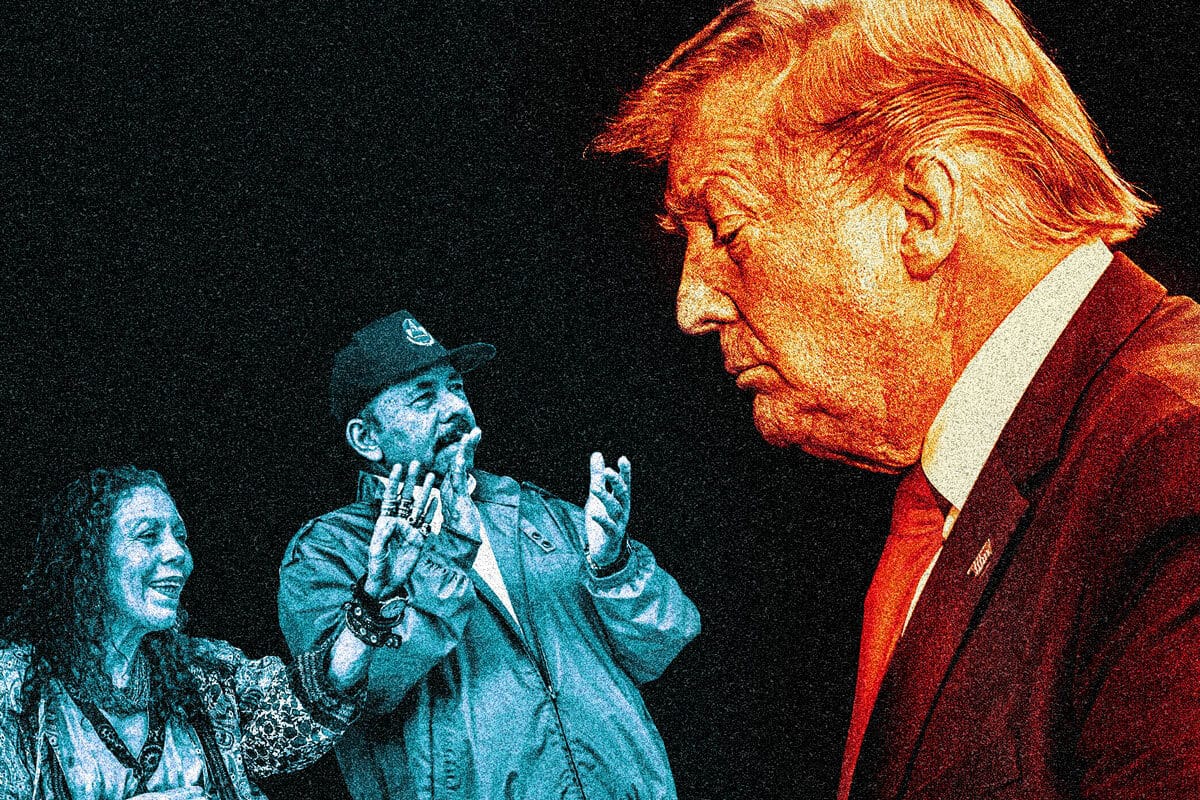
The return of the BHMB mining company to its owner, Baruch Rapoport, was the result of a U.S. diplomatic pressure strategy aimed at protecting its citizens’ investments in Nicaragua, and the willingness of the Sandinista dictatorship led by Daniel Ortega and Rosario Murillo to seek common ground to curb the impetuous and unpredictable foreign policy of President Donald Trump’s administration.
Two sources linked to the legal and financial structures of the Sandinista dictatorship told DIVERGENTES that the decision to return the mining company was made due to a lack of other bargaining chips in negotiations with the United States, primarily regarding regional security and migration issues.
“The idea is to pursue a scenario similar to that of Venezuela, which seeks to keep the United States placated on the economic front while paving the way for new political developments. There aren’t many options left for negotiation, so the government is betting on this, because it’s an issue of great interest to the United States,” said one of the sources consulted.
The direction of this shift in the regime’s political strategy regarding its turbulent relationship with the United States was reportedly set by Chargé d’Affaires Elias Baumann himself, who made it clear from the start of his tenure that one of his priorities was to safeguard the interests of U.S. investors in Nicaragua.
“As I’ve learned more about Nicaragua, Nicaraguan and U.S. business owners have shared with me the challenges they face every day. Many of these same concerns were highlighted in the U.S. government’s investigative report on Nicaragua’s commercial practices and policies. As announced in December, the Nicaraguan government must demonstrate progress in resolving these issues,” Baumann wrote on social media platform X on January 22, 2026, less than a month after being officially assigned to the post. Baumann had previously served as Minister-Counselor at the U.S. Embassy in Managua before being appointed Chargé d’Affaires.
Washington Reaffirms Support for U.S. Investors
The U.S. Department of State, in response to an inquiry from DIVERGENTES, made it clear that a “high priority” of Baumann’s diplomatic efforts was to safeguard the interests of U.S. investors in Nicaragua.
“The Department of State promotes U.S. commercial interests around the world, and Nicaragua is no exception. The Chief of Mission and the Embassy team maintain an ongoing dialogue with U.S. businesspeople in Nicaragua to learn firsthand about their achievements and the challenges they face. Protecting our citizens and their interests remains one of the Department of State’s highest priorities,” said a spokesperson for the U.S. Department of State.
The spokesperson added that Nicaragua under the Sandinista regime is a country where “investors must exercise extreme caution and due diligence when investing in Nicaragua. Investors should not expect a fair application of the rule of law or a predictable business environment,” in line with what was reported in the Department of State’s own 2025 Investment Climate Statements.
In response to this media outlet, the Department of State reiterated that U.S. citizens have been warned that Nicaraguan authorities “may confiscate property—including land, homes, cash, and financial assets—without prior notice or justification.”
“The Trump Administration will continue to use all available tools to defend U.S. interests and amplify the Nicaraguan people’s demands for freedom, inalienable rights, and economic security,” the Department of State said.
The Regime’s New Strategies
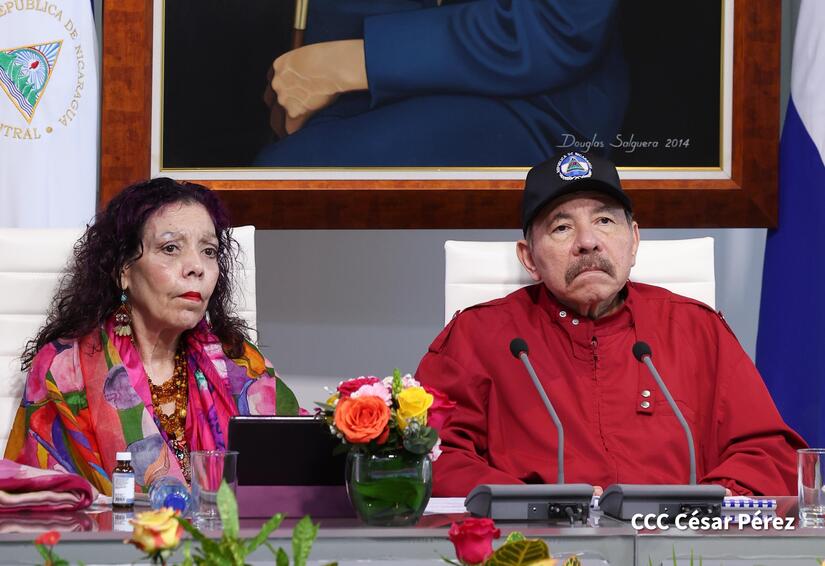
On Friday, June 26, DIVERGENTES revealed that the Sandinista regime began selling, renting, and distributing homes stolen through confiscations from those who had been banished or exiled. The previous Constitution prohibited this type of dispossession, but the new legal framework imposed by the Sandinista administration in January 2025 legalized it.
Likewise, previous analyses published by DIVERGENTES revealed that the Sandinista regime, through a failed negotiation led by Co-Foreign Minister Denis Moncada, proposed greater cooperation with Washington on immigration matters—something the co-presidential regime had already been doing for months by quietly receiving flights carrying deportees in Managua. However, the United States told the co-foreign minister that the issue had already been resolved based on the harsh anti-immigration policy promoted by the Trump Administration.
Another offer Moncada made was to reestablish and strengthen cooperation in the fight against drug trafficking, months after the Drug Enforcement Administration (DEA) stated that Managua was not cooperating on that front and announced its withdrawal from Nicaragua. They told him that such cooperation had to happen no matter what, because otherwise it would be yet another issue they could resolve with bombs, as in the Venezuelan Caribbean.
Between Pressure and Diplomatic Prudence
Manuel Orozco, a specialist in migration issues at the renowned think tank Inter-American Dialogue, questions whether “foreign policy mechanisms and diplomacy are truly developing a strategy to address legal uncertainty and its impact on the property of U.S. citizens or businesses.”
Two public developments that appear to have influenced the BHMB case were revelations in the Nicaraguan exile press reporting that the mining company had been awarded to an obscure Chinese businessman named Minhui Sun, and the statement made via his X account by Richard Grenell, Donald Trump’s Special Presidential Envoy for Special Missions, who described the theft as “outrageous.”
Orozco opined that behind the United States’ actions in response to the abuses of the Sandinista dictatorship, there are two possible scenarios. “The question is how the United States assesses Nicaragua’s actions in light of its relationship with Russia and China; in light of its corruption, which includes confiscations; and in light of its violations of civil and political rights,” he said.
“Observations so far point to one of two things: a tendency to keep a low profile toward Nicaragua, knowing that U.S. power could shift the power balance in a matter of minutes; or a measured approach aimed at gradually undermining the dictatorship, while other steps are taken, such as internal weakening, strengthening the opposition, or economic deterioration,” he concluded.