

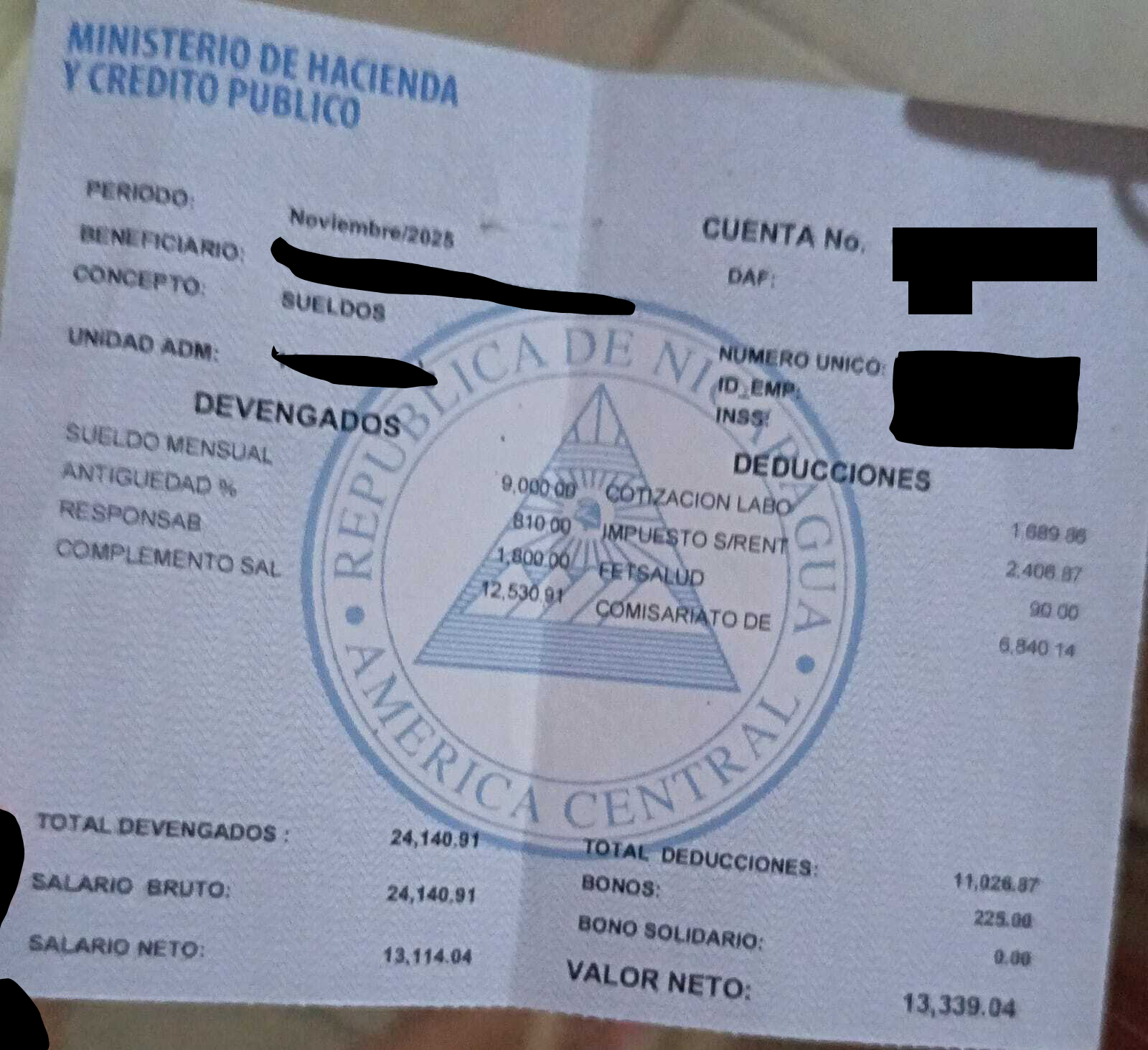
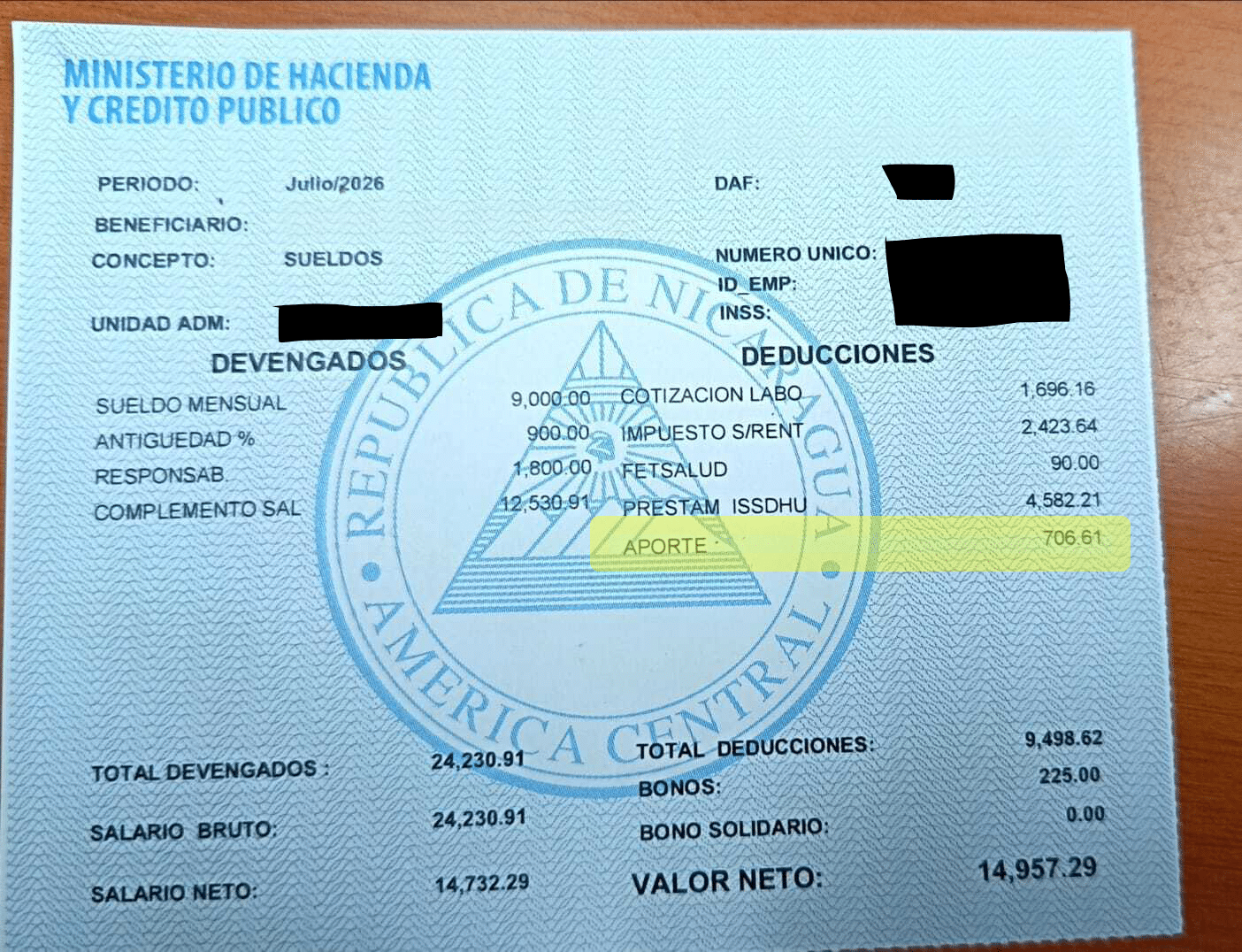
Gloria’s pay stub—she is a teacher at a public school in Managua—shows that 270 córdobas (C$) are deducted from her salary—equivalent to seven dollars per month according to the official exchange rate in effect since August 2023—under the heading “contribution,” a charge applied to public employees’ pay stubs by Daniel Ortega and Rosario Murillo’s regime as a forced and illegal contribution to their political party, the Sandinista National Liberation Front (or FSLN, its initials in Spanish).
The deduction began appearing on state employees’ pay stubs in May 2026 and has continued ever since. The teacher—who asked to remain anonymous to protect her personal safety given the police state currently in place in Nicaragua—receives a gross monthly salary of C$12,000 (US$328) and says that losing C$270 each month represents a significant cut to her daily expenses. For her, that amount is equivalent to two weeks’ worth of public transportation fare to get to her workplace.
Her pay stub is part of a collection of pay stubs obtained by DIVERGENTES thanks to contributions from workers at various public institutions, who confirm and document these deductions.
The cut this teacher faces is just a fraction of a system of deductions imposed on public employees that, according to a DIVERGENTES investigation, could total 454.9 million córdobas (US$12.4 million) per year across 24 public institutions.
In 2025, before this deduction began to be applied to state payrolls, the FSLN reported a total revenue of 662.44 million córdobas, of which 108.67 million córdobas came from “party-member contributions.” If DIVERGENTES’ projection holds for 12 months, deductions under the heading of “party contributions” would total 454.9 million córdobas in one year: more than four times what the party reported under that same heading in 2025 and equivalent to 68.5% of all the revenue it reported that year.
The calculation is based on the salary structure for 147,906 positions included in the 2026 General Budget of the Republic and shows that the bulk of the deductions would come from the lowest-paying salary brackets.
From Party Dues to Payroll Deductions
Party dues have historically been a source of funding for the FSLN. The party’s own bylaws stipulate that its members must pay dues regularly to finance the organization’s work. For years, these collections also extended to public employees affiliated with the party. Sandinista delegates would arrive at state institutions with lists to collect contributions in cash, with amounts that could vary depending on the position held.
In 2026, the mechanism and scale of the collection changed. Beginning with the May payroll, deductions identified as “party contributions” started appearing directly on public employees’ pay stubs. Workers interviewed by DIVERGENTES assert that they did not give prior authorization for these deductions.
Salvador Marenco, a lawyer with the Colectivo Nicaragua Nunca Más, believes that this change further blurs the line between the functions of the state and the interests of the ruling party, because public institutions act as employers while simultaneously implementing a party-related deduction on their payrolls.
This mechanism also occurs against a backdrop of growing state power concentration within Daniel Ortega and Rosario Murillo’s inner circle, where there is insufficient public information to track the flow of these deductions.
DIVERGENTES was able to document that the deductions appear on payroll records and confirm that each institution makes the deduction, but it did not obtain evidence of the subsequent transfers. The lack of transparency in the FSLN’s financial statements makes it impossible to track these funds, as they report aggregate amounts and a majority of their revenue is listed under the category “other income,” without specifying its source.
The Formula Behind the Million-Dollar “Chunk”
The estimate is based on a leaked internal table from the Ministry of Finance and Public Credit (or MHCP, its initials in Spanish), obtained by DIVERGENTES, which establishes seven tiers for calculating the “party contribution” based on net income. According to the source who provided the document, this is the reference used by public institutions to calculate the deductions they apply directly to payroll.
To gauge how much money these deductions might generate, the formula in the table was cross-referenced with the budgeted salary structure. In 23 of the 24 institutions, it was possible to analyze 132,201 positions distributed across 125 budget categories, which group roles such as teachers, health services, general services, scientific technicians, management staff, and various areas of the police force.
The calculation was performed separately for each of the 125 categories based on average net income. The annual amount allocated to salaries was divided by the number of positions and the 12 months of pay to obtain an average monthly gross salary. Next, the Social Security contribution percentage was subtracted, and income tax was estimated where applicable, to arrive at an average net income. Using this result, the pay scale level and the corresponding contribution were determined. This average contribution was multiplied by the number of positions in each category to obtain the monthly and annual amounts.
In 21 of the 23 institutions analyzed by category, a 7% employee contribution to the Nicaraguan Social Security Institute (or INSS, its acronym in Spanish) was applied. The National Police and the Ministry of the Interior are the two exceptions, as their personnel are covered by the special regime administered by the Institute of Social Security and Human Development (or ISSDHU, its initials in Spanish), which establishes a 5% deduction.
The Nicaraguan Army required a different procedure. In addition to being subject to a different social security system, administered by the Institute of Military Social Security (or IPSM, its initials in Spanish), its salary data is not broken down to the same level of detail. For this reason, its calculation was performed separately and is explained below.
The Lowest Wages Fund the Sandinista Front
The filtered table establishes seven levels based on net income. The first covers wages up to C$10,000 (US$273) and sets a contribution of 2%. The second includes incomes from C$10,001 to C$20,000 (US$546). In this case, the worker pays a base amount of C$200 (US$5) plus 5% of whatever they earn above C$10,001.
This same mechanism is repeated as income increases. Each bracket advances in C$10,000 increments and combines a base amount with a percentage applied only to the excess. The rates rise progressively from 6% to 10%, up to the final level, for those earning more than C$60,000 (US$1,638) per month. This means that these percentages are not applied to the entire salary, but only to the portion that exceeds the threshold for each bracket.
Of the 132,201 positions across 23 institutions that could be analyzed by category, 91,573 would fall into the first bracket, representing 69.3% of the total. More than half of that group consists of 48,642 teaching positions. It also includes 14,241 general services positions, 11,938 police positions in crime prevention and public safety, 7,498 administrative services positions, 2,730 positions in the correctional system, and 2,089 firefighter positions, among other roles.
Although this group has the lowest rate in the table—just 2%—its size means it accounts for 49.2% of the estimated funding, or about 204.9 million córdobas (US$5.6 million) per year.
Another 36,984 positions—28% of the total budgeted across 23 public entities—would fall into the second tier, with average net incomes ranging from C$10,001 to C$20,000. This group includes 19,090 Health Care positions at the Ministry of Health (or Minsa, its acronym in Spanish), as well as thousands of scientific technicians, management staff, and administrative personnel.
Within the Police Force, 2,053 positions in the National Headquarters, 1,095 in investigation and intelligence, 474 in hospital health services, and 125 in police training would also fall into this range. Collectively, this second group would generate approximately 143.1 million córdobas (US$3.9 million) per year.
Combined, the first two levels account for 128,557 positions—97.2% of those included in the calculation—and would contribute 348.6 million córdobas (US$9.5 million). In other words, 83.3% of the 418.1 million córdobas (US$11.4 million) estimated for the 23 institutions would come from positions with average net incomes of up to C$20,000 per month.
The five highest-income brackets account for just 3,644 positions—2.8% of the total modeled—and would generate approximately 69.4 million córdobas (US$1.9 million) per year, equivalent to 16.6% of the estimated amount. These brackets primarily include executive positions, scientific and technical staff, and certain administrative services. These include, for example, 813 management positions at the Supreme Court of Justice, 219 scientific and technical staff at the National Assembly, and executive positions at the Office of the President, the Comptroller General’s Office, and other institutions.
At the very top, only 188 positions—about 0.1% of those included in the calculation—would reach the seventh and final level, corresponding to average net monthly incomes exceeding C$60,000 (US$1,638). The 188 belong to the National Assembly’s Executive category, whose average budgeted net income is estimated at C$64,206 per month. For that category, the formula yields an average contribution of approximately C$4,121 per month per position.
The 2% Contribution Would Take $3.1 Million Away From Teachers
The Ministry of Education (or Mined, its acronym in Spanish) has 62,557 budgeted positions for 2026, of which 48,511 are for teachers. Together, they represent about 42% of the 147,906 positions examined in this study. The institution has 8,123.2 million córdobas (US$221.8 million) annually for the permanent salaries of these positions.
The largest portion goes to teachers, amounting to approximately 6,307.4 million córdobas (US$172.2 million) per year. This allocation equates to an average gross monthly salary of C$10,835 (US$296) per position. After accounting for the corresponding payroll deductions, the average net income would be around C$9,815 (US$268), which would place teachers at the top of the pay scale.
For that income, the contribution would be about C$196 (US$5) per month per teaching position. Applied to the 48,511 budgeted positions, this would generate approximately 9.5 million córdobas (US$259,000) per month and 114.3 million córdobas (US$3.1 million) per year.
When the remaining positions at the Ministry of Education (Mined) are included, the estimated contribution for Education would rise to 149.7 million córdobas (US$4.1 million) annually. The institution also has 6,171 positions in Administrative Services, 5,095 in General Services, and 2,144 in Scientific and Technical Services, among other categories. The estimate assumes that the budgeted positions are filled and that the deductions are applied according to the formula in the leaked table.
Education and Health Would Account for More Than Half of the Funding
The Ministry of Health (Minsa) has 30,633 budgeted positions and 4,061.7 million córdobas (US$110.9 million) allocated for permanent salaries. It has the second-largest payroll among the institutions analyzed by this publication, after the Ministry of Education (Mined).
Of that total, 19,090 positions are in Health Services. The budgeted funds for this category amount to an average gross salary of approximately C$11,422 (US$312) per month per position. After accounting for applicable payroll deductions, the contribution would be around C$214 (US$6) per month.
Another 5,570 positions belong to General Services, with an average budgeted gross monthly salary of C$8,348 (US$228) and an estimated contribution of about C$155 (US$4) per position. As in Education, the individual amounts are relatively low, but applying them to tens of thousands of positions significantly increases the cumulative total.
The Ministry of Health’s total payroll would amount to approximately 79.1 million córdobas (US$2.2 million) per year. When added to the estimated 149.7 million córdobas for Education, the two ministries would total 228.9 million córdobas (US$6.3 million), close to 55% of the 416.7 million calculated directly from the salary categories of 23 institutions.
Education and Health together account for 93,190 budgeted positions, nearly two out of every three of the 147,906 positions across the 24 state institutions. The concentration of workers on these two large payrolls explains why, even though a significant portion falls into the lowest salary levels on the scale, their salaries would account for more than half of the estimated total by category.
However, the pay stubs obtained during the investigation show that the deduction applied does not always match the formula used to make these estimates. On a pay stub from the Health sector, one worker received C$36,467.01 (US$996) in gross pay and, after the corresponding deductions, was left with a net income of C$28,977.41 (US$791). According to the table, he was supposed to contribute approximately C$1,238.64 (US$34), but C$1,584.45 (US$43) were deducted—that is, C$345.81 (US$9) more than the formula indicates.
The Supreme Court of Justice Ranks Third in Contributions to the FSLN
With 7,323 budgeted positions, the Supreme Court of Justice would have the third-highest contribution among the institutions analyzed, trailing only Education and Health. Its payroll would amount to approximately 57.3 million córdobas (US$1.6 million) per year, despite having nearly nine times fewer positions than the Ministry of Education (Mined) and four times fewer than the Ministry of Health (Minsa).
The explanation lies in the compensation structure. The Court has 1,955.4 million córdobas (US$53.4 million) allocated for permanent salaries, distributed among a considerably smaller payroll. This raises average compensation and places a higher proportion of positions at the upper levels of the pay scale, where both the base amount and the percentage applied to the excess also increase.
Unlike in Education and Health Care, where the total amount is determined primarily by the size of their payrolls, higher salaries carry greater weight at the Court.
In the Police Force, the Same Salary Requires Different Contributions
Two pay stubs obtained by DIVERGENTES show that employees of the Sandinista Police Force with the same salary and the same take-home pay after Social Security contributions had different deductions for “party contributions.” The differences do not match the amount calculated using the official table leaked to DIVERGENTES either, which was used as a reference for these deductions.
The police force has 17,299 budgeted positions and 2.12 billion córdobas (US$57.9 million) allocated for permanent salaries. If the deductions were applied according to the formula, its payroll would generate approximately 40.3 million córdobas (US$1.1 million) per year.
The two pay stubs correspond to a driver and a police officer who each receive a gross monthly salary of C$6,000 (US$164). After making contributions to the ISSDHU, both are left with C$5,700 (US$156), so the table indicates a contribution of C$114 (US$3) for each.
However, C$300 (US$8) were deducted from the driver’s pay and C$550 (US$15) from the police officer’s. The first deduction exceeds the calculated amount by C$186, and the second by C$436. There is also a difference of C$250 (US$7) between the two, even though they have exactly the same salary and the same ISSDHU contribution.
The discrepancy also appears in other pay stubs reviewed during this investigation. Two employees with a gross salary of C$22,000 (US$601) end up with a net income of approximately C$18,803.33 (US$513). According to the table, both should have a contribution of close to C$640.12 (US$17).
On the pay stubs, one had C$1,200 (US$33) deducted and the other C$800 (US$22). The first deduction exceeds the amount calculated by the formula by C$559.88, and the second by C$159.88.
The Foreign Ministry Has $2.8 Million Lacking a Salary Breakdown
The budgets of the 24 institutions examined collectively allocate 21,785.9 million córdobas (US$ 594.9 million) to permanent salaries. A review of each budget line item made it possible to link these funds to the budgeted categories and positions in 23 institutions, although in some cases it was necessary to combine different funding sources. The most significant exception is found in the Ministry of Foreign Affairs, where the amount allocated for permanent salaries is considerably higher than what can be identified in the breakdown of positions.
The Ministry of Foreign Affairs has 437.8 million córdobas (US$12 million) budgeted for permanent salaries, but the available breakdown allows only 103.3 million córdobas (US$2.8 million) to be linked to specific categories and positions. The difference amounts to 334.4 million córdobas (US$ 9.1 million), and the documents examined do not show how that amount is distributed among the institution’s 362 budgeted positions.
This lack of breakdown prevents the application of the party contribution table to the 437.8 million córdobas, as was done with institutions that do have salary information by category. For this reason, the estimate for the Ministry of Foreign Affairs includes only the 103.3 million córdobas whose salary allocation can be identified in the breakdown of positions. The remaining 334.4 million are excluded from the calculation by category.
The Army Contributes $1 Million Based on a Differentiated Calculation
The Army reports 15,705 positions and 2,031.9 million córdobas (US$55.5 million) allocated for permanent salaries. The budget identifies 10,020 soldiers, 2,049 enlisted personnel (military personnel of ranks below noncommissioned officers), 1,906 officers, 604 noncommissioned officers, 598 civilians, and 528 civil servants, but does not specify how much of the salary allocation corresponds to each group. For this reason, it was not possible to apply the category-based calculation used for the other 23 institutions.
To incorporate this into the overall estimate, DIVERGENTES calculated the average gross monthly salary for all positions, which came to C$10,782 (US$294). After estimating payroll deductions and applying the formula from the table, contributions would amount to approximately 36.8 million córdobas (US$1 million) per year.
This amount, unlike the 416.7 million córdobas (US$11.4 million) calculated by category for the other 23 institutions, is an approximation based on the average salary for the entire institution. When both results are added together, the estimate for the 24 institutions totals 454.9 million córdobas (US$12.4 million) per year.
The Law Does Not Include Deductions for Political Contributions
Before receiving their net pay, Nicaraguan workers are already subject to deductions established by law. One of these is the contribution to the Nicaraguan Social Security Institute (INSS). Under the Comprehensive Plan, 7% of a worker’s salary is deducted. The employer contributes separately 21.5% when there are fewer than 50 employees and 22.5% when there are more than 50. This employer contribution is not deducted from the employee’s pay.
In addition to this deduction, Income Tax (or IR, its initials in Spanish) is applied, when applicable based on income level. Unlike the INSS contribution, this is not a fixed percentage for all workers. The General Revenue Directorate (or DGI, its initials in Spanish) stipulates that the withholding is calculated based on monthly income, from which legally permitted deductions—including the INSS—are subtracted. This result is projected over twelve months, and a progressive tax rate is applied to the annual net income.
The first C$100,000 of annual net income is exempt from IR. Between C$100,000.01 and C$200,000, a 15% rate applies to the amount exceeding C$100,000; between C$200,000.01 and C$350,000, a flat fee of C$15,000 plus 20% applies to the amount exceeding C$200,000; between C$350,000.01 and C$500,000, C$45,000 plus 25% on the amount exceeding C$350,000; and above C$500,000, C$82,500 plus 30% on the amount exceeding that threshold. The DGI’s official table shows that the rates apply to the amount exceeding the threshold for each bracket and not to the total income.
Article 88 of the Labor Code establishes that “corresponding legal deductions” must be made from wages. The same legislation includes measures to protect such compensation. Article 89 grants wages priority over other claims, except for court-ordered family support payments, while Article 92 establishes that the minimum wage is exempt from garnishment, except to protect the worker’s family.
Party Contributions Are Illegal and Violate National Case Law
The Nicaraguan labor courts have also established limits on the deductions an employer may apply to wages when they are not withholdings directly established by law. The document Labor Criteria 2017–2018, published by the Supreme Court of Justice and compiling rulings from the National Labor Court of Appeals (or TNLA, its initials in Spanish), states that certain deductions “require the employee’s authorization.”
One of the cases included is Ruling 1187/2017, dated October 19, 2017. Human Resources had unilaterally informed an employee about the approval of a loan to purchase a vehicle and how the installments would be deducted from his paycheck.
The TNLA took issue with the fact that the employer did not provide a formal document proving that the employee had authorized those deductions. The document itself also includes a section on “unilateral” deductions, which lists cases in which employers fail to justify the source of the deducted amounts.
The regulations and resolutions reviewed by DIVERGENTES do not establish a contribution to a political party as a mandatory wage deduction, while labor case law requires authorization for certain deductions that are not withholdings directly imposed by law. The workers interviewed for this investigation assert that they did not authorize the “party contribution” nor were they consulted before it began to be deducted from their wages.
For Marenco, a lawyer and human rights defender with the Colectivo Nicaragua Nunca Más, the lack of a provision supporting the deduction and the absence of consent are the main legal challenges to this practice.
“The Labor Code does not authorize these deductions,” he told DIVERGENTES. Marenco maintains that contributing part of one’s wages to a political organization should be a voluntary decision by the worker and not a deduction automatically applied to the payroll.
Can an Employee Refuse to Pay the Contribution?
For the human rights activist, the problem is not limited to the regulations governing payroll deductions. The relationship between the state as an employer and public employees—who would have to oppose a deduction taken directly from their paychecks—must also be analyzed.
In his view, the possibility of facing workplace consequences or political reprisals limits an employee’s ability to refuse the deduction. “In Nicaragua, there is no real freedom of choice. People are forced to do what the regime wants them to do, with no opportunity to protest,” he stated.
That fear is evident in the testimony of Laura—a pseudonym used to protect the identity of a Ministry of Health employee who spoke with DIVERGENTES. On her pay stub, she found a deduction of approximately US$20 for a “party contribution” that, she claims, she never authorized.
“I was furious when I saw the 700 córdobas deduction from my salary, and all my coworkers felt the same. None of us were consulted, but we can’t complain either. Here, all grievances are stated through clenched teeth, and that’s as far as it goes,” she recounted.
Marenco warns that a worker who objects to the deduction could face consequences ranging from being labeled an opponent of the government to losing their job. “You don’t have the right to object to these withholdings or deductions,” she said.
The attorney places these deductions within the context of a broader erosion of labor rights in Nicaragua. This situation coincides with renewed international scrutiny of the government’s compliance with its labor obligations.
Nicaragua Under ILO Scrutiny
On September 14, 2026, a Commission of Inquiry of the International Labor Organization (ILO) began its work to examine a complaint filed against the Ortega-Murillo regime for alleged noncompliance with four conventions related to freedom of association, collective bargaining, employment discrimination, and tripartite consultation.
The complaint was filed in 2023, and the proceedings are still pending. The Commission must establish the facts and formulate its conclusions and recommendations. The ILO’s investigation is not specifically related to “party contribution” deductions.
For Marenco, the central issue is that the state acts as an employer and, at the same time, its institutions enforce a party-related deduction that the workers interviewed by DIVERGENTES claim they did not authorize.
In his view, this employment relationship limits the ability to refuse the deduction without fear of consequences. “All you want is to provide for your child or your family, but you clearly don’t have the power to oppose these withholdings or deductions,” he emphasized.
DIVERGENTES, through the Institute for Press and Society (or IPYS, its initials in Spanish), inquired with the Nicaraguan Presidency about this mechanism. It asked who authorized the deductions, what their legal basis is, whether workers can refuse to pay them, to whom the withheld money is given, and how those funds are transferred. Information was also requested on how much has been deducted in 2026 and whether there is a record of those funds broken down by institution. The Presidency, controlled by co-dictators Daniel Ortega and Rosario Murillo, did not respond to the inquiries by the time this investigation was completed.
The FSLN Reported 108 Million Córdobas in Contributions in 2025
According to an investigation by Confidencial, contributions from party members were already included in the income reported by the Sandinista National Liberation Front (FSLN) before 2026, when deductions labeled as “party contributions” began to be documented on public employees’ pay stubs.
The news outlet reviewed the party’s financial statements published in La Gaceta and determined that, in 2025, the FSLN reported 662.44 million córdobas in revenue. Of that amount, 543.88 million corresponded to “other revenue,” 108.67 million to “member contributions,” and 9.89 million to real estate rentals. Thus, “other revenue” accounted for about 82% of the total, while member contributions amounted to 16.4% and rental income to about 1.5%.
A historical review of these accounts shows that member contributions are not a new source of revenue for the FSLN. In 24 financial statements published between 1999 and 2025, the party reported more than 6,000 million córdobas in revenue, of which 1,079 million córdobas (US$29.5 million) came from member contributions, representing about 17.8% of the total.
The estimated amount of contributions included in public financial statements in 2026 is considerably higher. The 454.9 million córdobas (US$12.4 million) that could be raised in a single year, according to DIVERGENTES’ analysis, is more than four times what the FSLN reported as “contributions from party members” in 2025 and accounts for nearly 42% of all amounts reported under that category in the 24 financial statements analyzed by Confidencial.
DIVERGENTES was unable to determine how the money deducted by public institutions subsequently reaches the FSLN. The receipts obtained during this investigation show that the “party contribution” is deducted directly from salaries, and the information gathered indicates that each institution processes the deduction through its own payroll system.
However, as of the time this report was finalized, it was not possible to obtain proof of transfers, identify the recipient accounts, or access other records that would allow us to trace the money’s path from state payrolls to the Sandinista party’s accounts.
For Gloria, this information is not visible either. What does appear on her pay stub every month is a deduction that she asserts she did not authorize. It is the equivalent of two weeks’ worth of bus fare to get to the public school where she works. As long as there is no record that allows her to track those funds after they are deducted from her salary, she can know how much is deducted, but not where that money ends up.